“When one recollects a certain street or house as a pleasant place to have visited, one is acknowledging that it has made itself memorable not as the great public spectacle is memorable but by handing out some small enrichment of life”
“What makes a building enter the consciousness and lodge its image in the memory in a particular way?”
Sinclair Gauldie, Architecture: The Appreciation of the Arts / 1
Firmitas, utilitas, venustas. Three attributes that Vitruvius said all buildings should express. Firmness, commodity, and delight. Firmness: is the quality of materials appropriate for this building? Commodity: does the building fulfill the function that it was designed to address? Delight: is it a beautiful building? These are a few concepts that I think about when I am standing in front of a memorable building. But it isn’t just the architecture that sticks in my memory, it is also the relationship to the environment where it stands. Its purpose in the environment. Its place in the world. There are numerous relationships to think about. Where is it located in relation to the street? What direction does it face? What kind of landscaping surrounds it? Do you like it? Why? No? Why not? What was the weather like that day? Was it sunny? How tall was that tree when you visited? Did it cast a shadow in an interesting way? Was the building under winter light or full summer sun? Do you think you would have liked it more if it had been raining instead? The more you think about these relationships, and the more you open your mind to their complexities and contradictions, the more impactful your engagement is with the place. The experience resonates more deeply for you, and your simple walk turns into a profound experience. Marcus Aurelius advised us in Meditations to “dwell on the beauty of life. Watch the stars and see yourself running with them.” If you seek these experiences out and open your mind to receive them when you have the opportunity, life will never be boring.
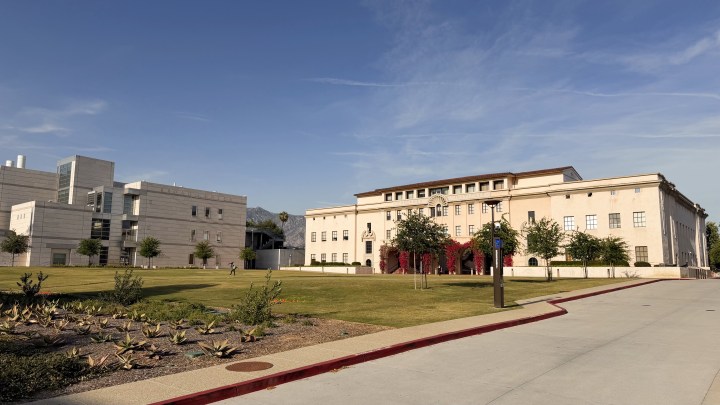
Let’s go back a few months. It is springtime and I am in Pasadena, California. I have a few hours of time for myself today and I decide to do something that I love: go for a walk and look at something interesting. My destination is California Institute of Technology, a private university in the heart of Pasadena. The campus was designed in 1917 under a master plan by architect Bertram Goodhue. It went through a major expansion in the 1960s under the influence of Professor Arnold Beckman. Caltech, as it is called for short, offers a variety of architecture styles from different periods in the twentieth century. I will visit campus twice today: once around sunrise, and once again around sunset.
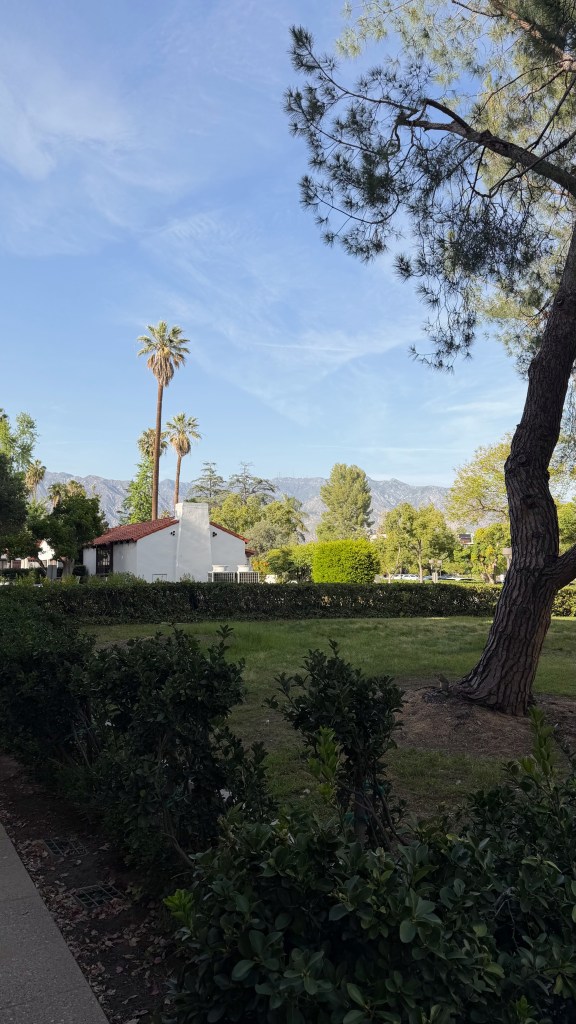
As I approach campus, I notice how seamlessly integrated it is into the surrounding neighborhood. On the horizon over the trees are the San Gabriel Mountains. This view, coupled with the towering palm trees, is classic Southern California. A place full of contradictions. Here you will find tropical trees, a mediterranean climate, a desert, an oasis, a white sand beach baking under the sun, and frigid ocean water. I approach Wilson Avenue, which is a north-south street that makes up the western border of campus. Looking south down the street I see a lot of the buildings come right up to the sidewalk. There are a few concrete paths around these buildings but there isn’t much line of sight from the road. I cross Wilson Avenue and walk onto Beckman Lawn. I take its openness to mean this is where I should enter campus. Beckman Lawn starts a series of Beckman-named features on campus. Their namesake, a former professor and alumnus of the school, spent most of the 1960s wielding his influence over a campus redesign.
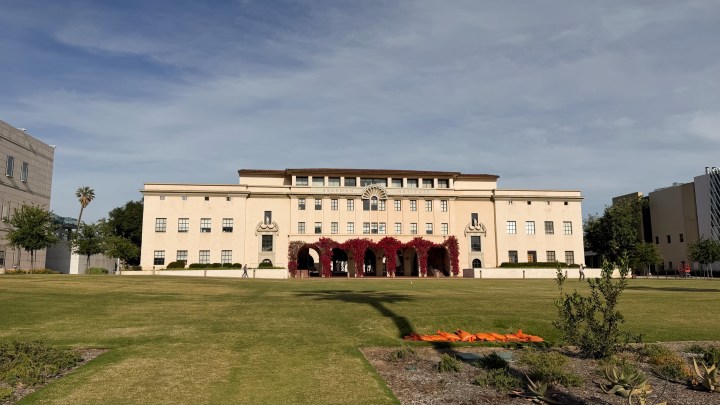
At the eastern boundary of Beckman Lawn is Beckman Institute. I am immediately drawn to its large and imposing presence. It carries some of the Beaux-Arts-style bravura and monumentality (think the Metropolitan Museum of Art in New York City). The building is oriented north-south and lies along the entire eastern border of Beckman Lawn. It is in three sections. The center section features a modern approach to a Renaissance style of architecture. There are elements of Italianate and Beaux-Arts that can be seen in the design of the courtyard, the placement of the windows, and the roof that is both flat and gabled. The ground floor features an arched peristyle that leads to an interior courtyard. A peristyle is a colonnade that leads to an open courtyard. The arches on the western side are lined with pink bougainvilleas that have been beautifully arranged to follow the gentle curves of the arches. The pink flowers stand out against the sandy façade. The arches on the eastern side are lined with wisteria trees, whose green leaves also contrast nicely with the façade. They also divert our attention to the trees in the lawns behind the building. Wisteria is one of many species of trees I saw on campus.
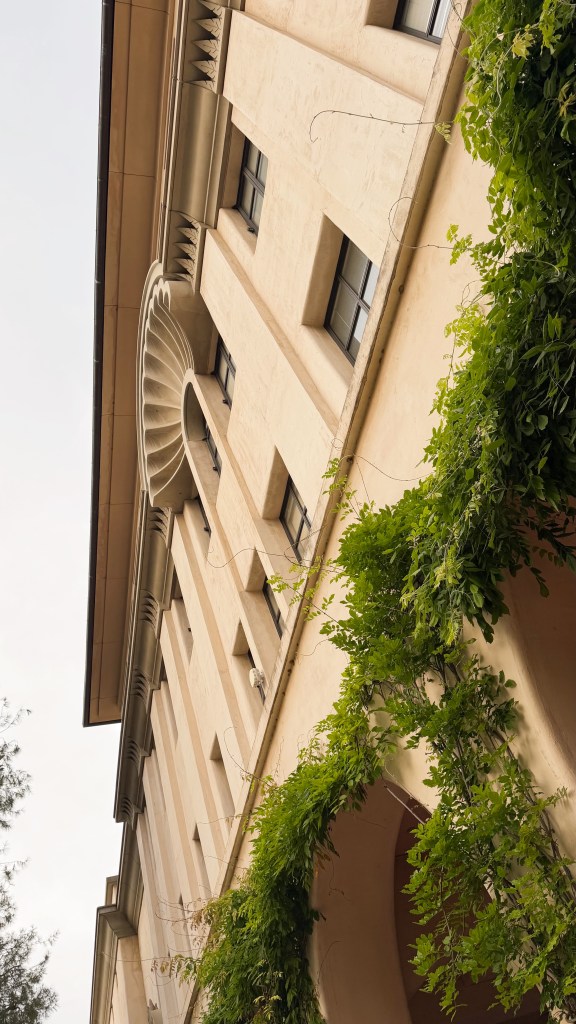
The center section is flanked by two equally massive symmetrical wings. The windows on these wings are smaller and allow themselves to get swallowed up into the wall. As a result, our eyes are continually drawn to the more interesting center section. The wings act like giant anchors that keep the center section grounded. The façade on each wing is flat with a textured finish. Sinclair Gauldie commented on the concrete finish of Le Corbusier’s Ronchamp design, crediting him with “relieving the deadness of flat, concrete surfaces by deliberately leaving them rough” (Gauldie 116). I see the same intentions at play with the textured wings in the Beckman design. Between the windows on levels two and three in the center section are what look like pilasters. These are a classical touch but with a modern flair as there is no fluting like you would see in a classical column used as a pilaster or an engaged column. Nor is there a formal capital in one of the three Greek orders. Instead, the capital is implied by a few vertical indentations in the architrave above each pilaster. There was a big push in postmodernist architecture to combine classical elements with modern touches. I think these pilasters in the façade are a good example of this being done well. They enhance the monumentality and bravura.
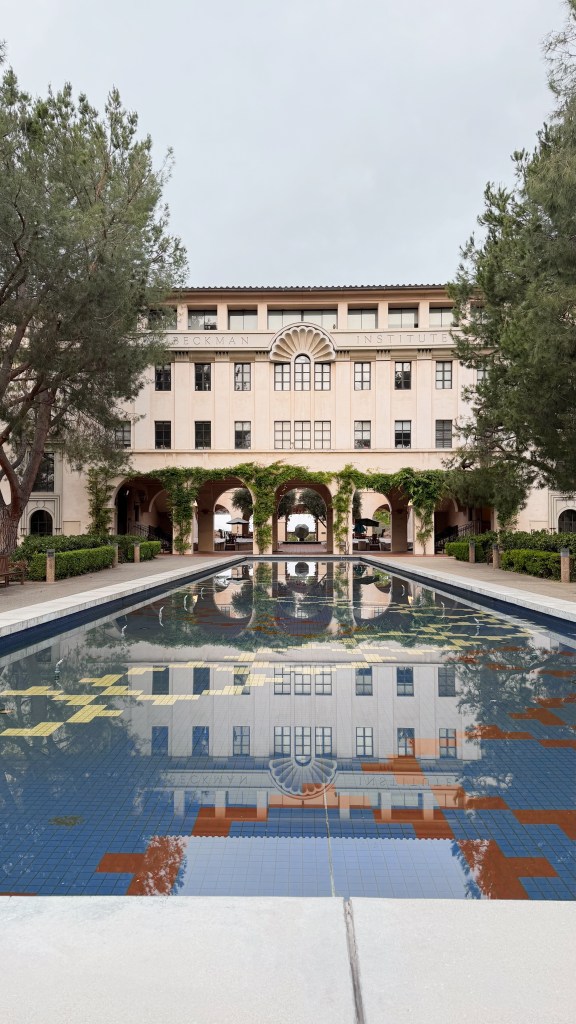
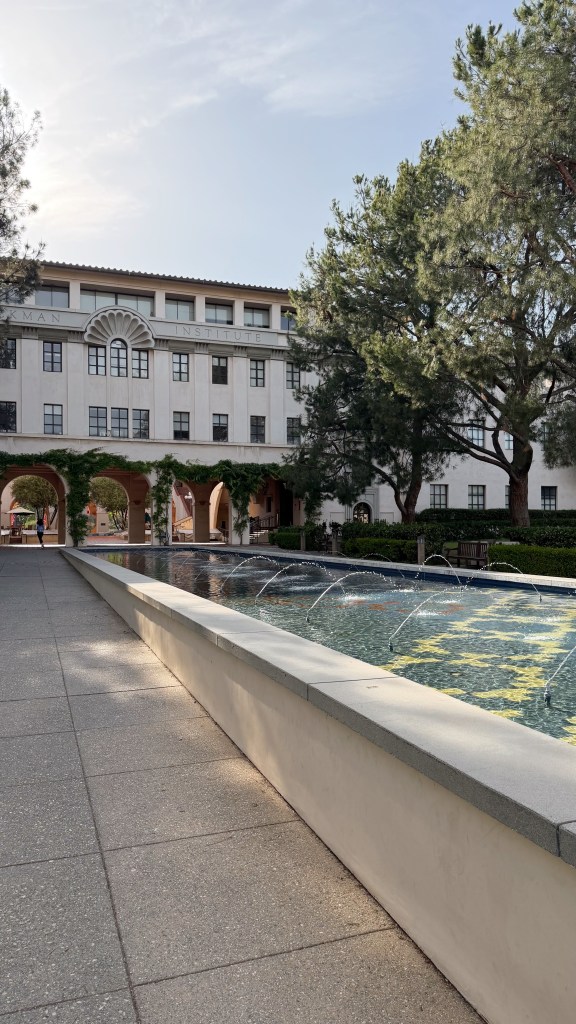
Walking through the courtyard to the other side of the building takes you to a reflecting pool called Gene Pool. The reflecting pool is aligned east-west and sits at a perpendicular angle to Beckman Institute. The base of the pool is lined with blue, orange, and yellow porcelain tiles arranged in patterns like a mosaic. At the edges are little jets that spray water into arches into the pool. The reflecting pool is an elegant contrast to the massiveness of Beckman Institute.
Looking at the rear façade, the bases of the arches in the peristyle are supported by squat square columns. In a traditional colonnade you would see round, fluted columns but this would clash with the rectangular patterns that are carried up into the second, third, and fourth levels. They would look small and they would be quickly overwhelmed by the massiveness of the building. These square columns have an element of the Doric order, which always sits at the base of a design with superposed orders. They embody the “heavy” trait characteristic of the Doric order without the actual Doric details. Another example of classical elements with modern touches.
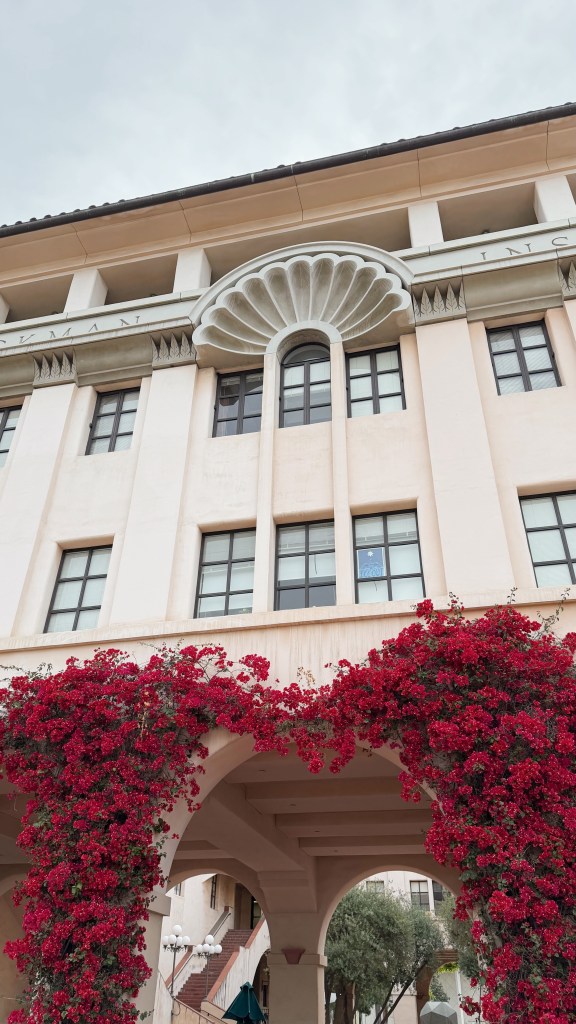
At the center where the third level meets the fourth level is a scalloped arch that aligns perfectly with the center arch at the ground level. It is beautifully done and brings the whole design together. The flat roof has rounded terracotta tiles that pair nicely with the scalloped sections of the arch. It also gives the roof a sense of vibrancy and playfulness instead of a dull flatness. These round elements complement the design. We get a sense of finality and completeness. It is a masterful blend of circular and square elements.
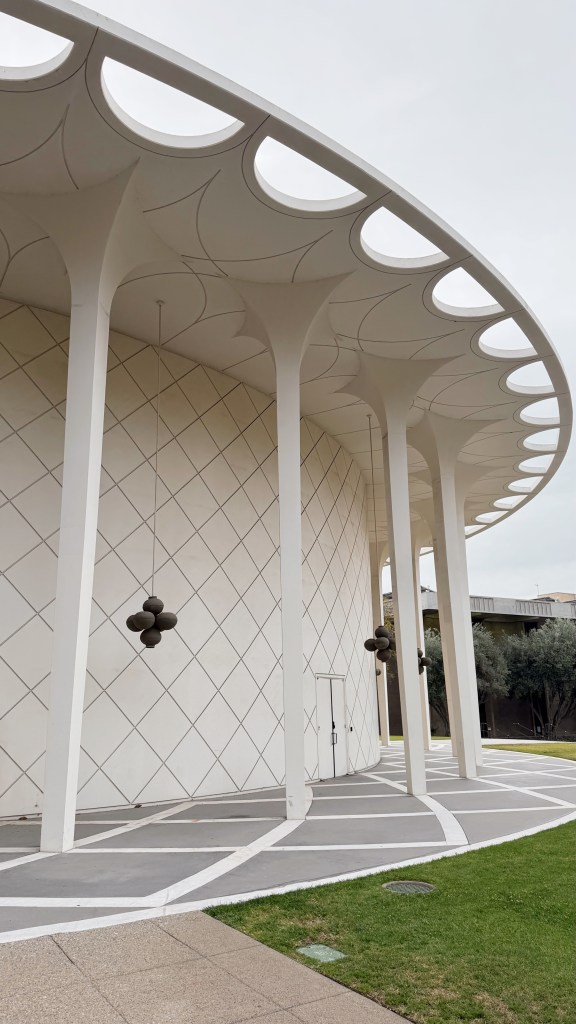
Continuing past the eastern end of the Gene Pool we arrive at Beckman Auditorium. This building was designed by architect Edward Durell Stone, who is famous for also designing Radio City Music Hall and the Museum of Modern Art (MoMA) in New York City. The building reminds me of the Roman Colosseum, which features superposed orders on at least four levels. The Beckman Auditorium attempts a similar effect but instead of superposed orders, it features a diamond cross-hatching that extends up the length of the wall and out on the surrounding sidewalk at the base of the building. The roof is oversized and extends out significantly over the base of the building. The roof is attached by an unbroken length of column extending from ceiling to ground. The columns are basic in design with the exception of the capital, which appears to emulate the Corinthian style of Greek columns albeit with a modern flourish. It keeps the shape but none of the intricate details like the acanthus leaves and abacus seen in the Corinthian capitals. Diamond cross-hatching is also seen in the underside of the roof eaves. Long pendant lights hang from the ceiling. The pendants themselves are groups of spheres arranged to look like a bird’s nest. The auditorium serves as the centerpiece of Beckman Mall, which is aligned perpendicular to the auditorium. Its circular design complements the rectangular elements we have seen thus far. The mall design is reminiscent of the National Mall in Washington, D.C., where the centerpiece is the Lincoln Memorial, and the Champs-Élysées, where the centerpiece is the Arc de Triomphe. This design reminds me more of the National Mall because of the reflecting pool. It seems like the intention was to walk through the Beckman Institute to the reflecting pool and then to Beckman Auditorium before turning south and walking down the Beckman Mall. I am happy that this is the path I took for my walk.
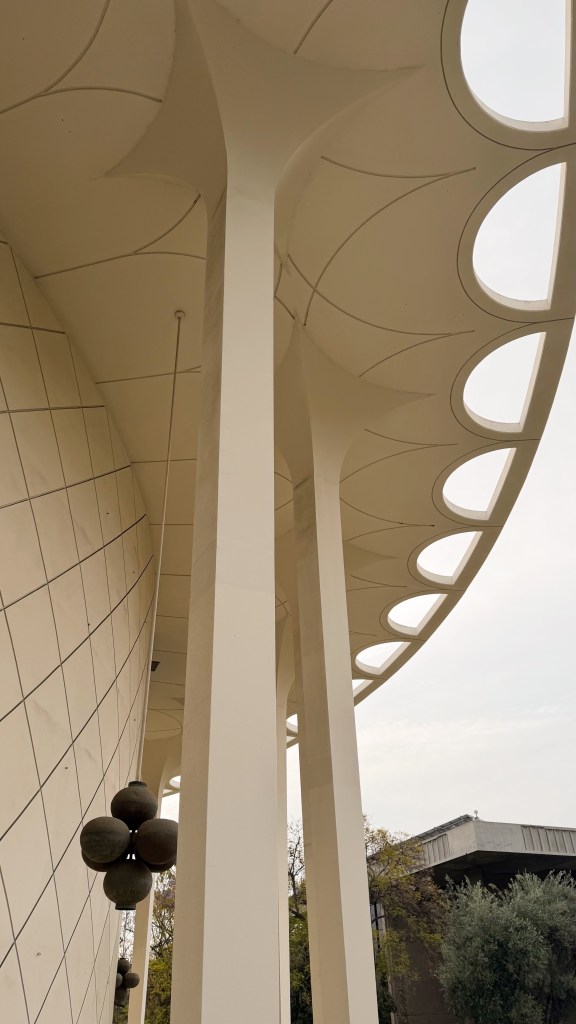
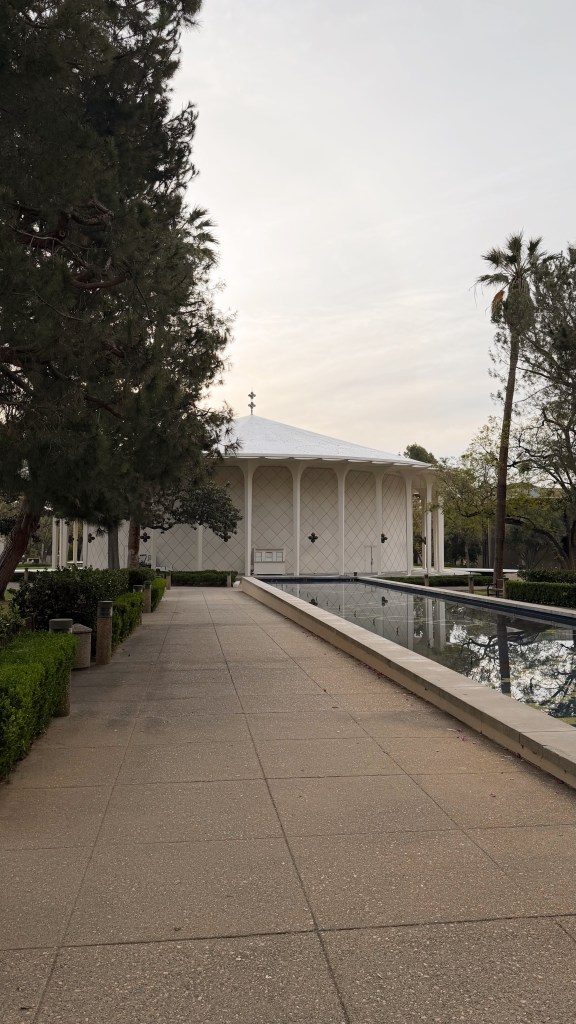
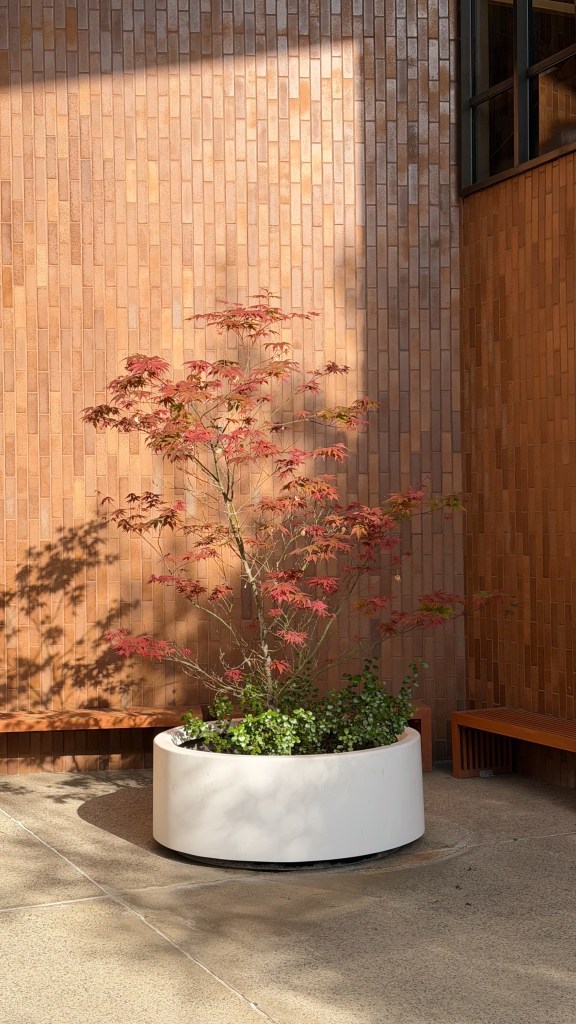
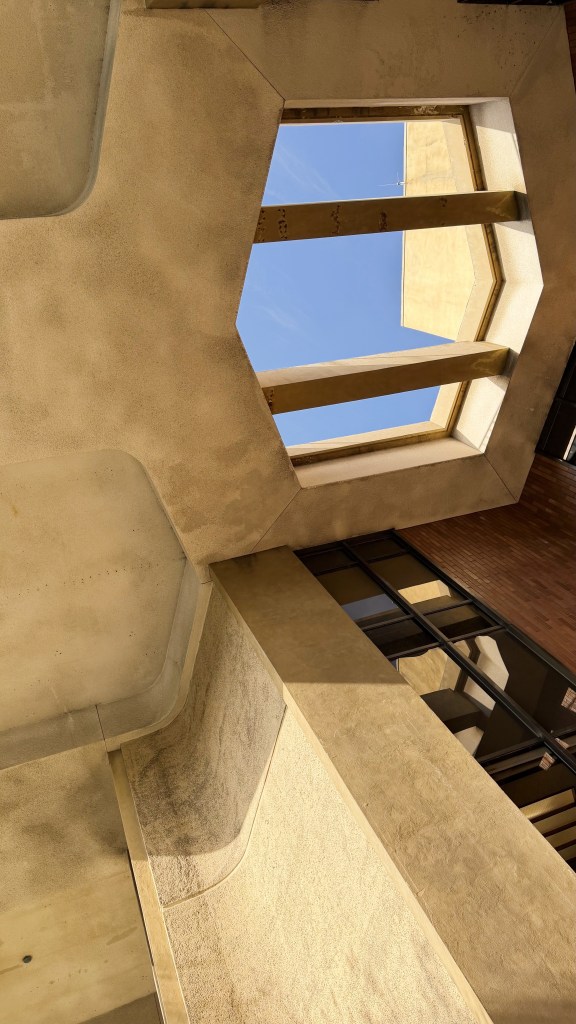
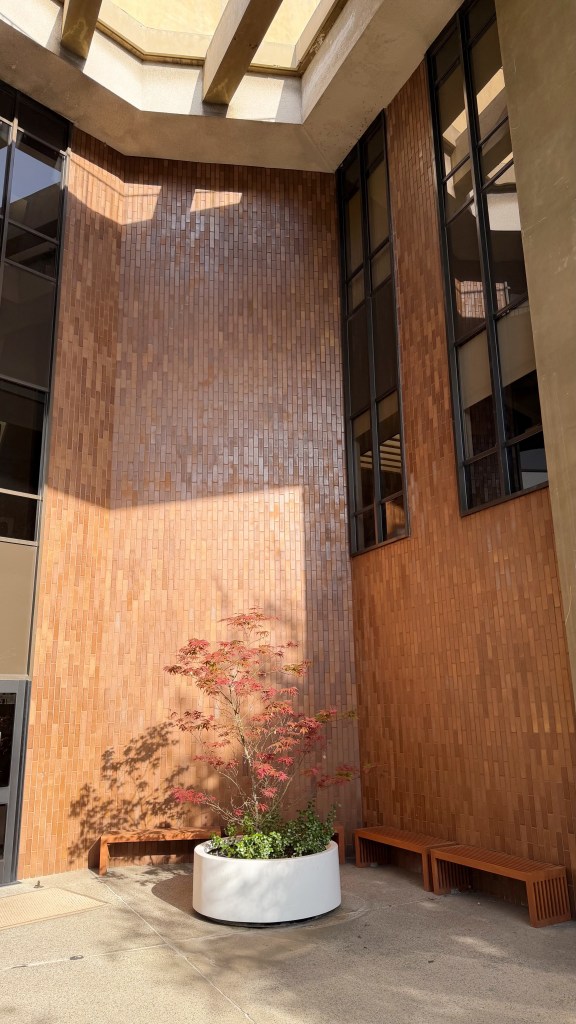
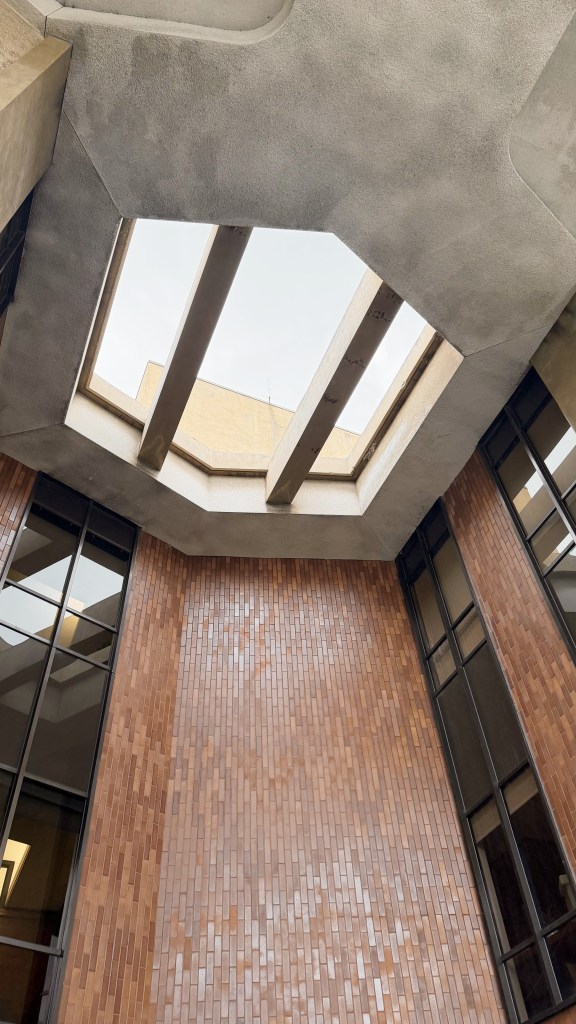
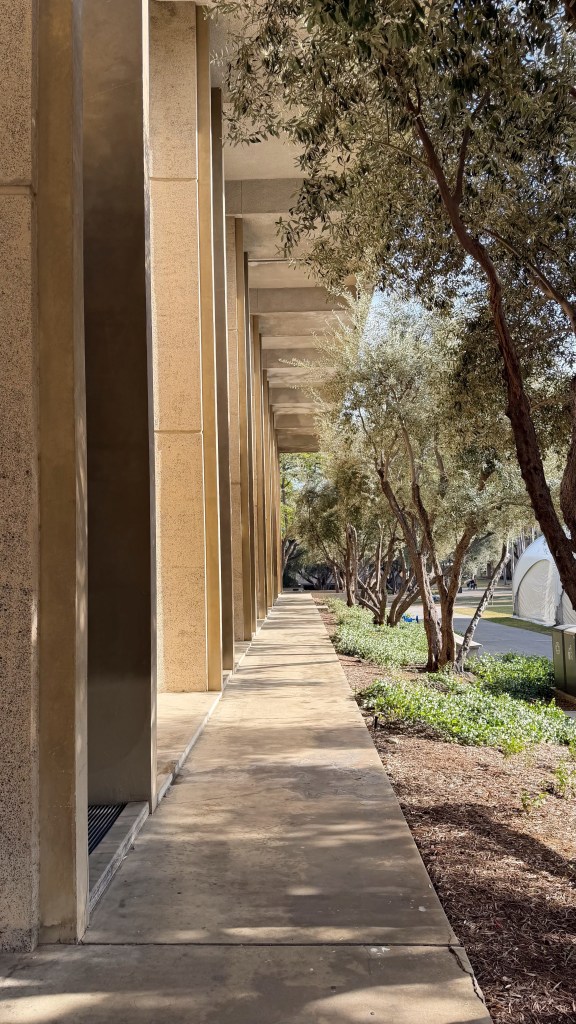
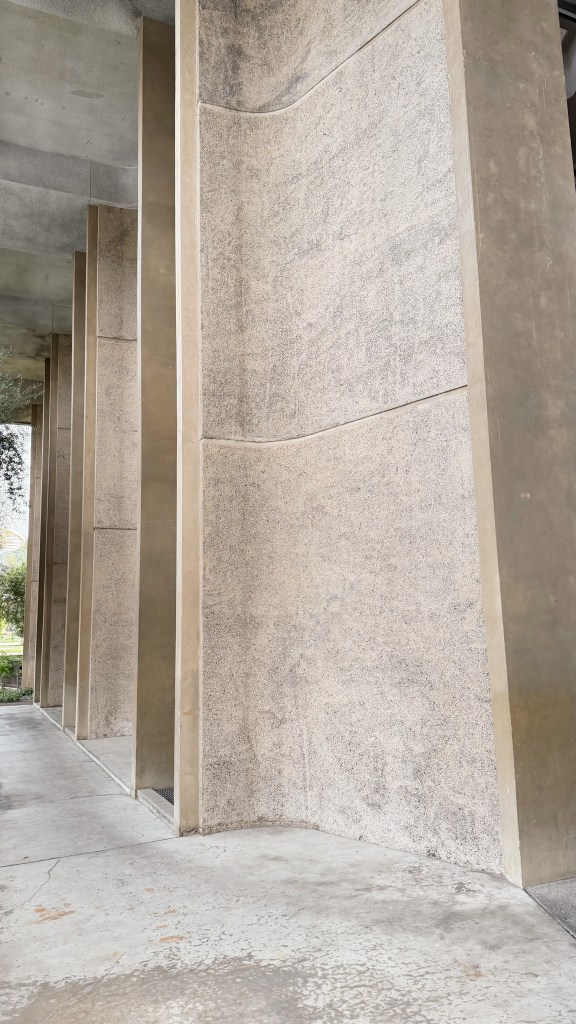
Leaving Beckman Auditorium I turned south and walked down Beckman Mall. The mall is fronted by two buildings on the eastern and western side. Baxter Hall is on the eastern side and faces the Beckman Behavioral Biology Lab on the western side. Both are designed in a Brutalist style that is commonly seen on a lot of college campuses. Each building is imposing and a mass of concrete and glass. Gauldie comments that modern architecture “lets the basic forms…speak entirely for themselves” (Gauldie 119). You can see that on display here with the soaring verticals that are crossed by the unbroken horizontal masses that are the roof slabs. The massive roof slabs are made to look lighter with vertical scoring. The exterior walls are curved inward and are reminiscent of the scallop shape we saw in the arch on the Beckman Institute. I like this design because it gives the building a little personality. Between curved walls are ceiling-to-ground vertical ribbon windows. My favorite feature on campus is one of the entrances to Baxter Hall. The entrance is an alcove that extends up to the roof. The walls are lined with long bricks that are aligned vertically and are deliberately faced with a rough texture. This makes them look shiny and polished. They shimmer and reflect sunlight. The bricks sit flush in their mortar beds which allows the whole wall to reflect sunlight without shadow. At the base of the wall are two wood benches and a red Japanese maple in a large circular planter box. The red leaves pair so nicely with the red bricks. I loved the contrast. At the top of the wall is an opening shaped like a hexagon and crossed by two massive beams. It looks like a big window. I imagined what this space would look like with rain coming in instead of sunshine. It reminds me of the Oculus in the roof of the Pantheon in Rome. I would bet the wall looks even more beautiful soaked with rain. The entranceway complements the curved design of the exterior wall in a beautiful and unique way. This is what I love about Brutalist architecture. The raw concrete can be left as a blank canvas and these additional flairs enhance the overall design of the building.
At the southern end of both buildings are matching reflecting pools that are filled with plants and lily pads. There is also a grove of sycamore trees. This is where Beckman Mall ends.
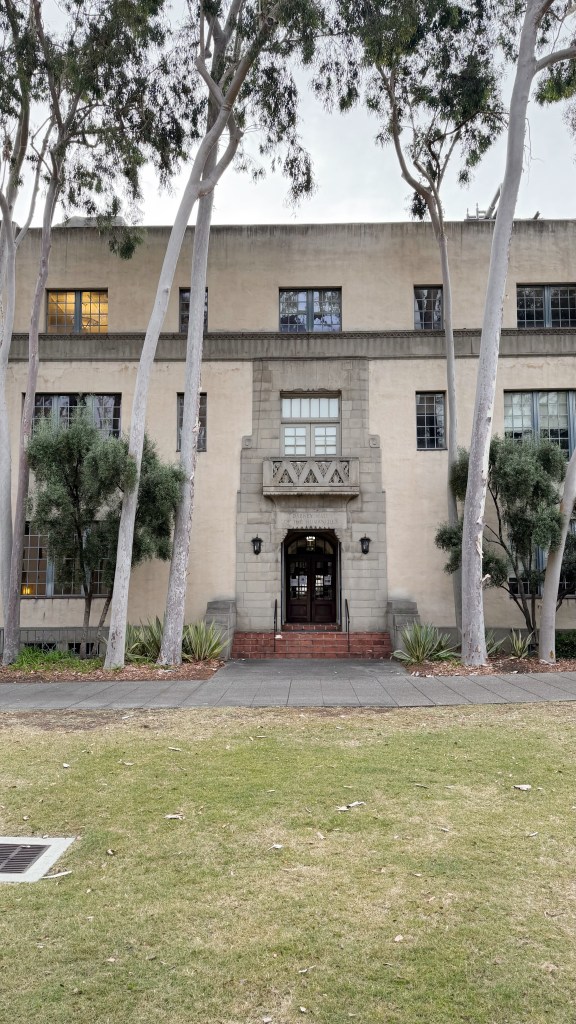
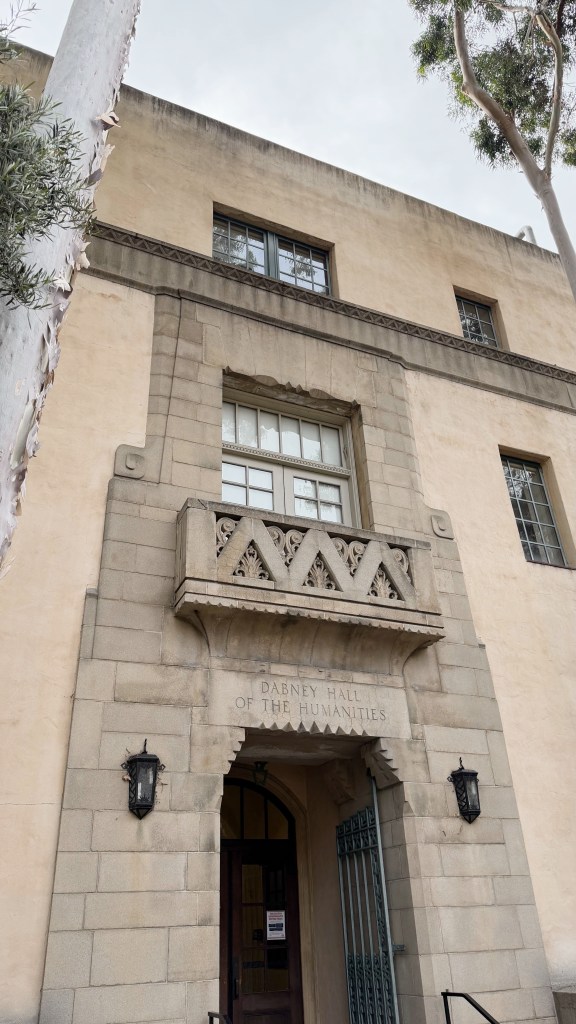
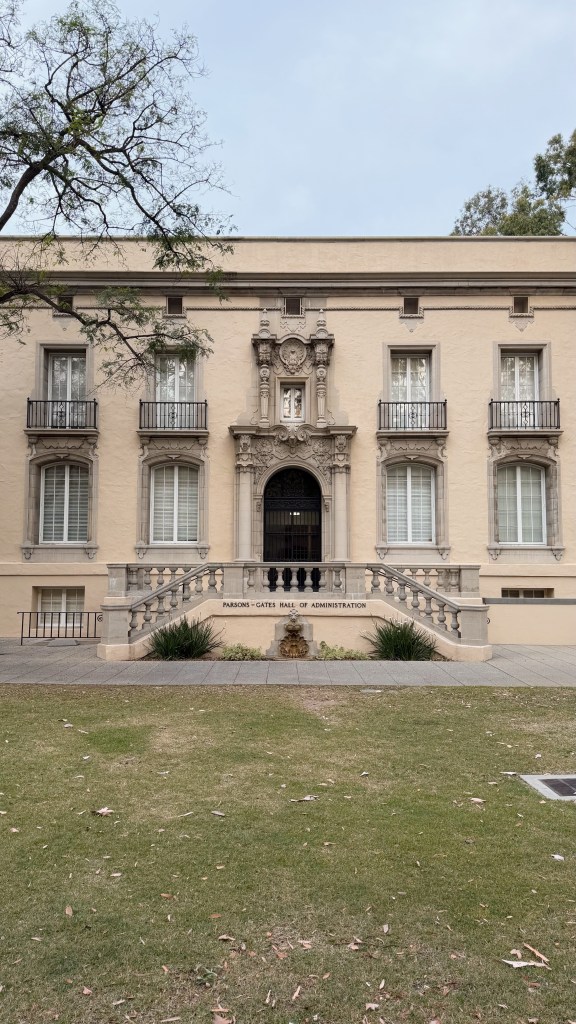
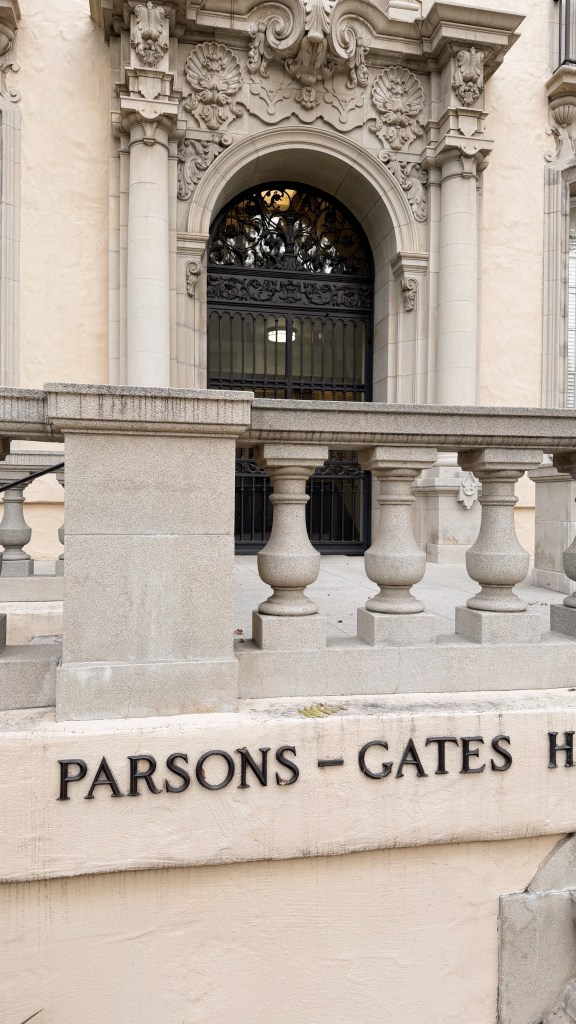
Continuing south I see a colonnade that is oriented east to west with two buildings connected at each end. Both buildings face each other. The grove of sycamore trees at the end of the Beckman Mall completes the square. Dabney Hall is the building on the eastern end and Parsons-Gates Hall is the building on the western end. Both are nice buildings and fit well into the overall campus design. Parsons has a more elaborate façade, but both buildings complement each other well. They seem to be a blend of a few styles. You can see elements of Spanish Colonial architecture in the textured walls of Dabney Hall. There is no ornament around the windows, a design feature that carries up to the roof and across the rest of the wall. As a result, the façade sort of blends together into one solid mass of wall. There is a parallel here with the wings at the Beckman Institute, but a key difference is the roof. At Beckman Institute there is a roof line that follows the architrave seen in the center section. The line is unbroken across the entire façade. Here there is no such line. The roof just ends at a natural point on Dabney Hall. This feature is seen in adobe architecture throughout the southwestern United States. The entrance to Dabney Hall shows elements of Gothic architecture. It looks like a side entrance at a Gothic cathedral. Above the door is a stone Juliet balcony with an elaborate design. Overall, the design is a nice mix of styles and details. This building was designed by Bertram Goodhue, the architect who designed the original campus master plan.
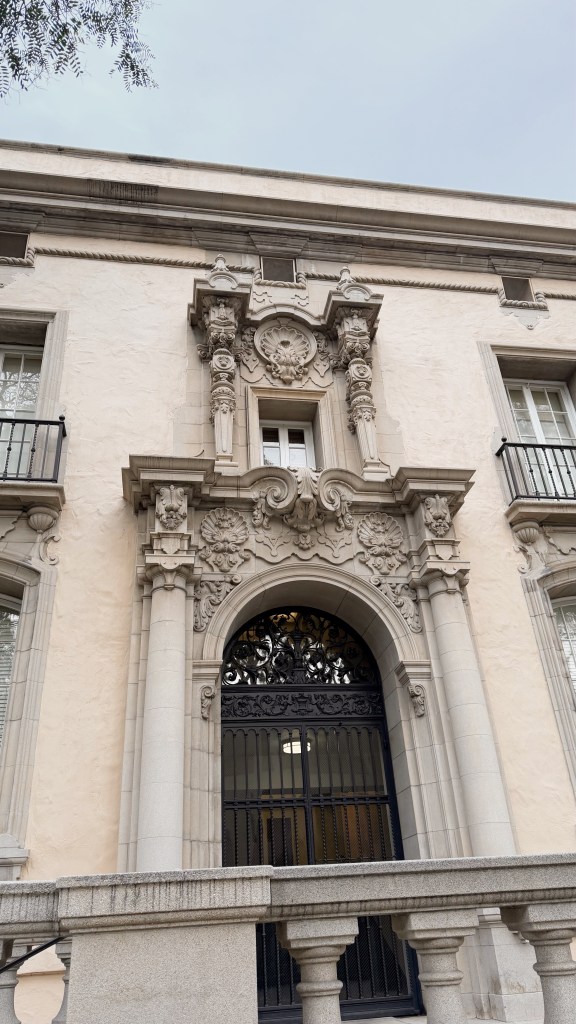
Parsons-Gates has the same textured finishing but there are elements of French Renaissance architecture that reminds me of a French chateau. This is seen in the ornate detailing around the windows and the elaborate stone staircase with stairs on both sides at the entrance. At the front of the staircase landing is a Gothic gargoyle built into the base that spouts water into a small stone basin. The façade features a symmetrical pattern of windows. The basement windows round out the tidy design. These buildings lack the monumentality and bravura of Beckman Institute, but they are beautiful designs. They remind me of some of the smaller Italian churches from the Renaissance. They are humble, compact, and unassuming at first glance, but they carry an element of quiet dignity and gracefulness that are earned with age. These are ideal attributes for a college building.
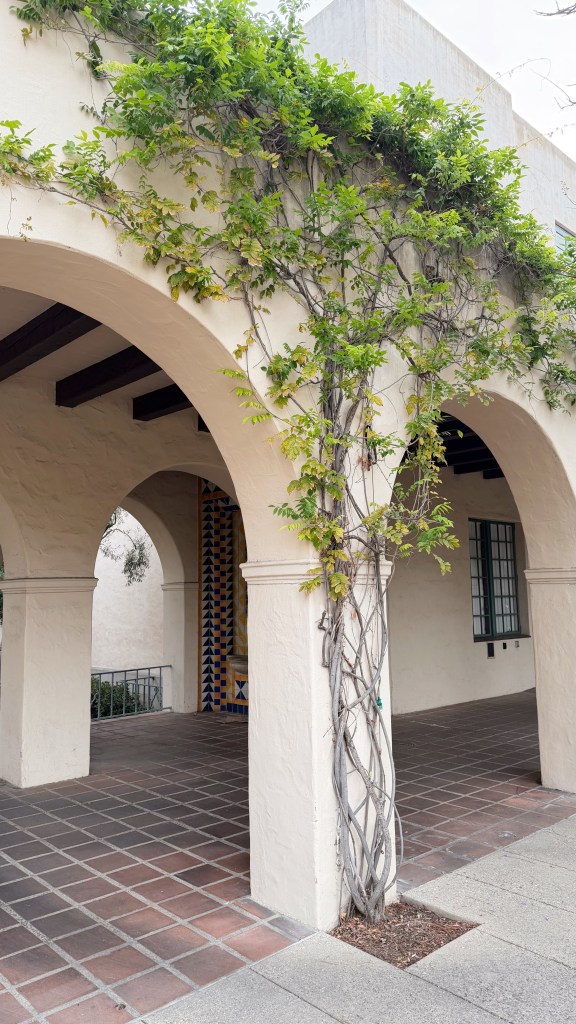
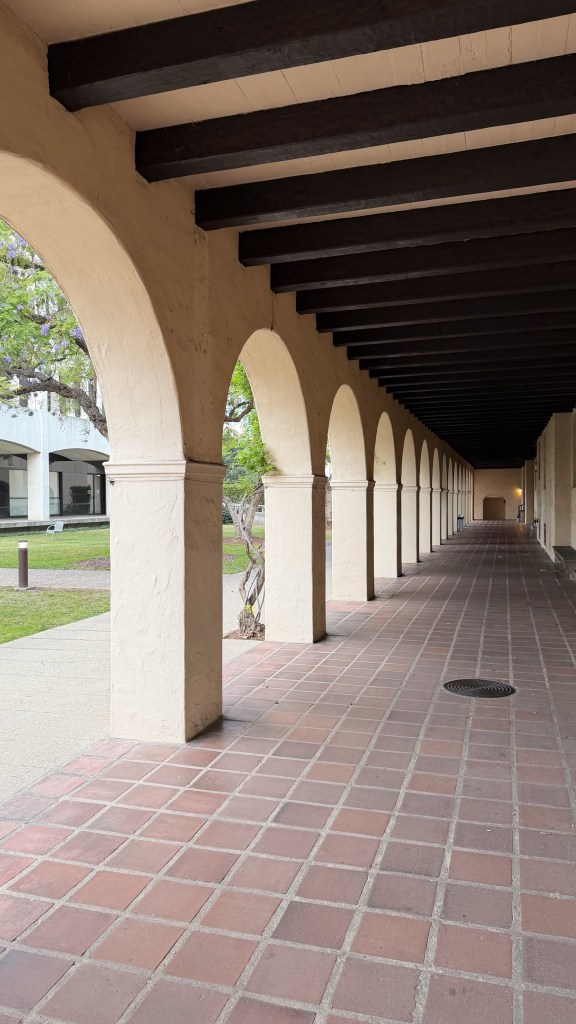
The colonnade that separates these two buildings leads to another quad. This colonnade features the same squat square columns we saw at the Beckman Institute. There is a simple rectangular band separating where the column meets the arch. The floor under the colonnade is square brick that is made to look like weathered Spanish tile. The walls are textured like Parsons and Dabney. The ceiling is lined with square exposed timber beams. The resulting effect is a Spanish Colonial inspired design. This was probably a deliberate choice by Bertram Goodhue since Spanish Colonial is a popular design style in Southern California.
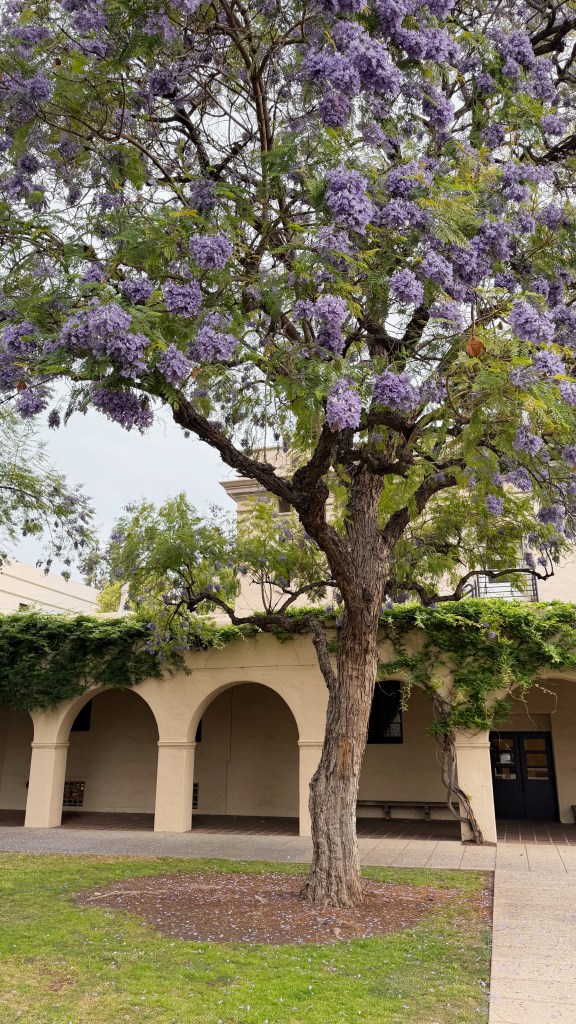
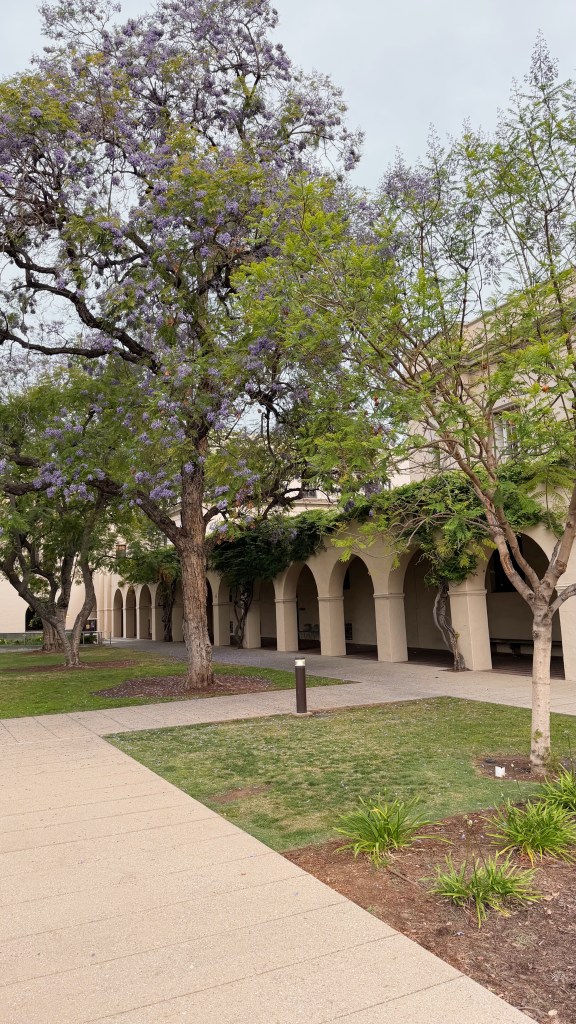
There are wisteria trees that line the arches like we saw at the Beckman Institute, but these colonnades stand alone with no second floor above them. The wisteria branches reach up to the roof where they then extend horizontally along the edge. There are square planter boxes and square lawns with concrete paths between them. There are blue jacaranda trees with purple flowers that provide a pop of color. The flowers look beautiful set against the sandy colonnade. The quiet dignity that I saw at Dabney and Parsons is seen here too. This is an area for private reflection and meditation. Walking through the colonnade is almost like walking through a barrier that cleanses your mind of stress and worry. I’ve written about this effect before at the Kimbell Art Museum. It is a subtle use of landscaping and architecture to bring about a specific desired effect. The feeling is palpable.
The overall design makes me think of a medieval cloister and garden. The purpose of a cloister is to create an enclosed barrier from the outside world. The quadrangle that is created is continuous on all sides. The difference here is that the quadrangle is only enclosed on two sides. The colonnades feel continuous because of their repetitiveness and overall length. The arches seem to continue forever into the distance. Sitting under one of the trees or taking a leisurely stroll under the arches keeps you grounded and present with your thoughts. The other two sides are open, which reminds you there is an outside world beyond these halls. You can stay here, and you can leave. And you are encouraged to leave. But not before you are ready. Use the safety of this environment to grow and develop. Let your thoughts wander. Be inspired. And when you are ready, go out and find your own place in the world.
Sitting under one of the trees, I am reminded that the first and most important relationship to architecture and the environment is the relation to ourselves.