
“As I am traveling alone this time, I have leisure to think over all I have seen and done during the past few months, and I do so with great pleasure.”
Johann Wolfgang von Goethe, Italian Journey
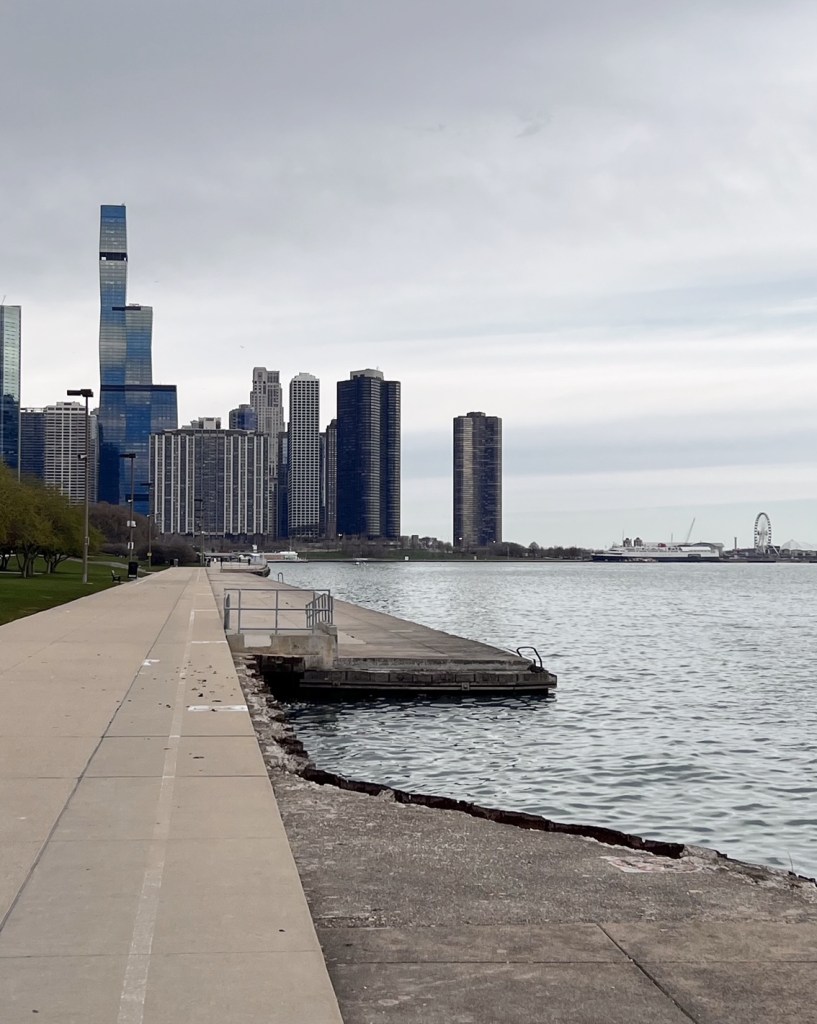
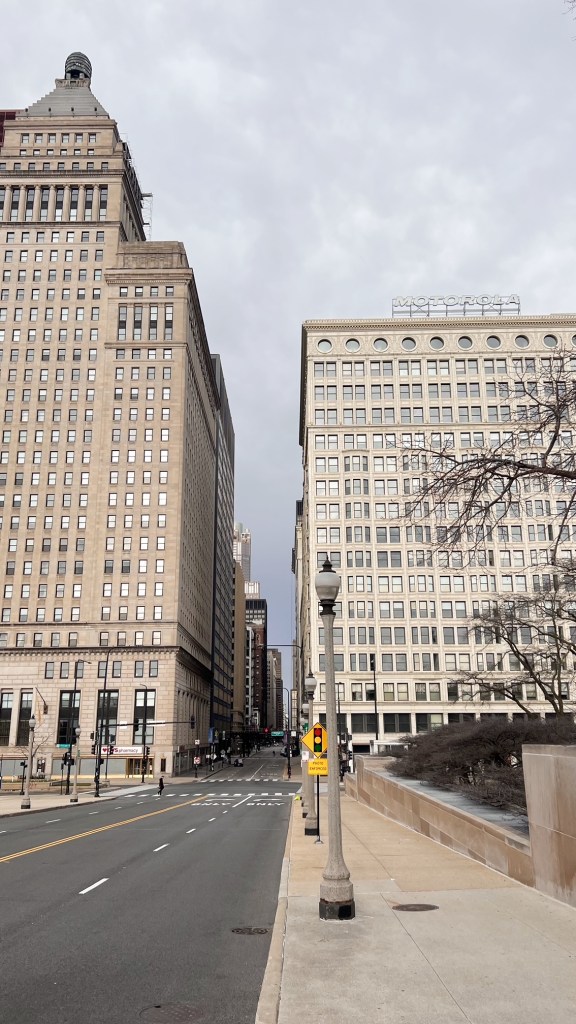
It was late Sunday afternoon and was standing near the lakefront looking back at the skyline at the north side of the Loop. It was pouring down rain and the tree I was standing under was providing marginal shelter at best. But I didn’t mind. Part of the fun of exploring is going out regardless of the weather. I was taking in the view and reflecting on the weekend I had.
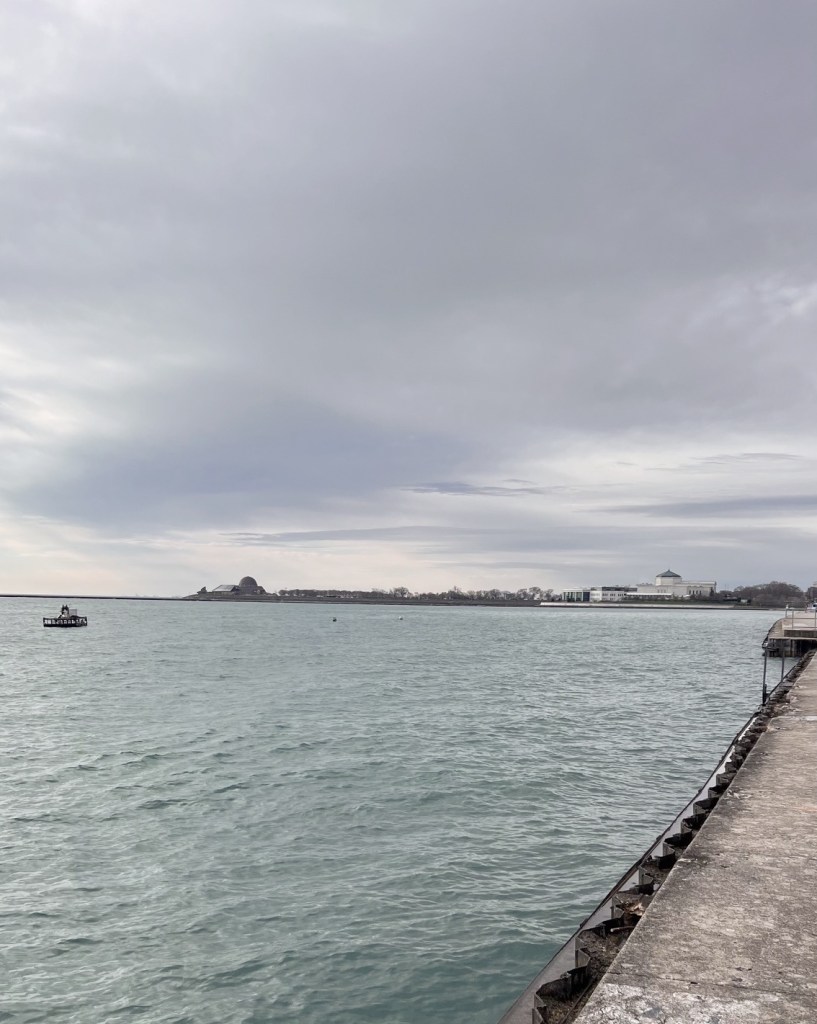
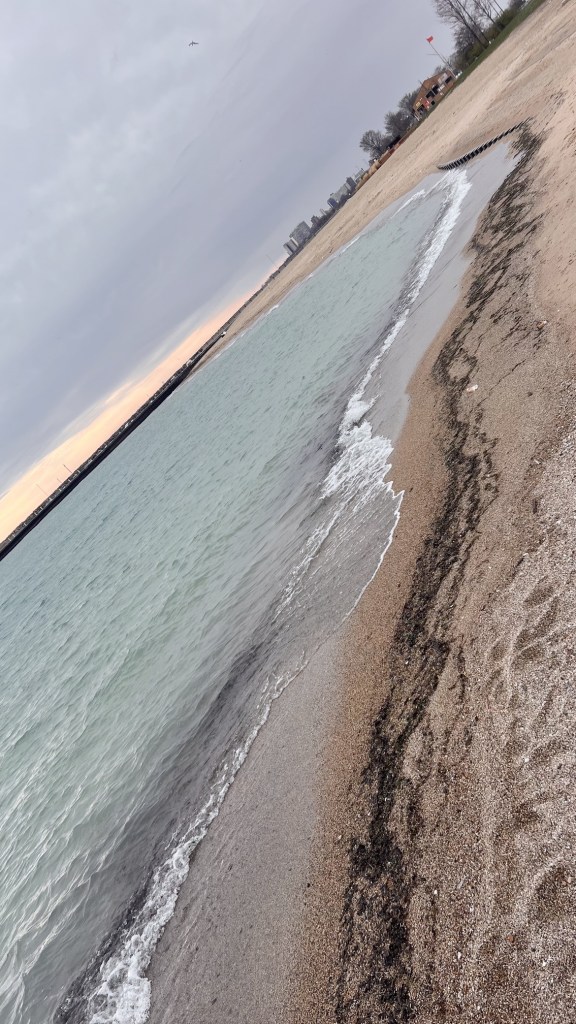
Sunday was my first full day in the city and was really going to be my only full day for exploring. I started early. I only had a loose plan that day: I wanted to explore Illinois Institute Technology, I wanted to walk along the lakefront, and I wanted to eat some dumplings. I made it to the waterfront right at sunrise and watched the sun struggle to break through the heavy clouds. It made for some beautiful scenery. The water was on my left as I walked south. There is something peaceful about walking along water on a chilly morning. There is a concrete seawall along the Lakefront Trail and the waves lapped against the wall violently and rhythmically. My destination was a sandy beach at 31st Street where I would then cut west over the freeway and walk to Illinois Institute of Technology. Along the way, I walked by the Chicago convention center, McCormick Place, a large steel and glass structure with a three-dimensional truss roof. The span of the roof is one of the longest ever constructed.
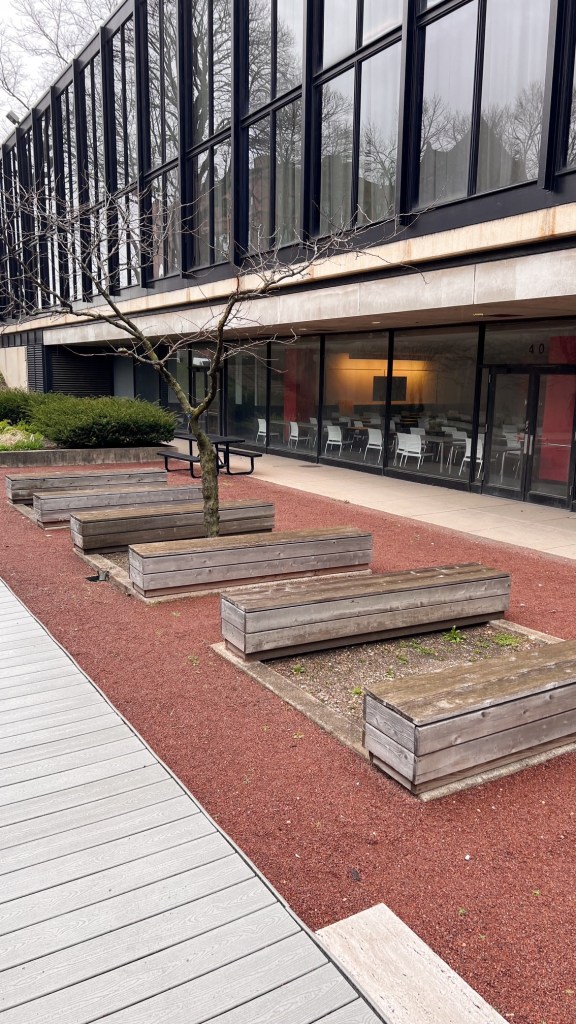
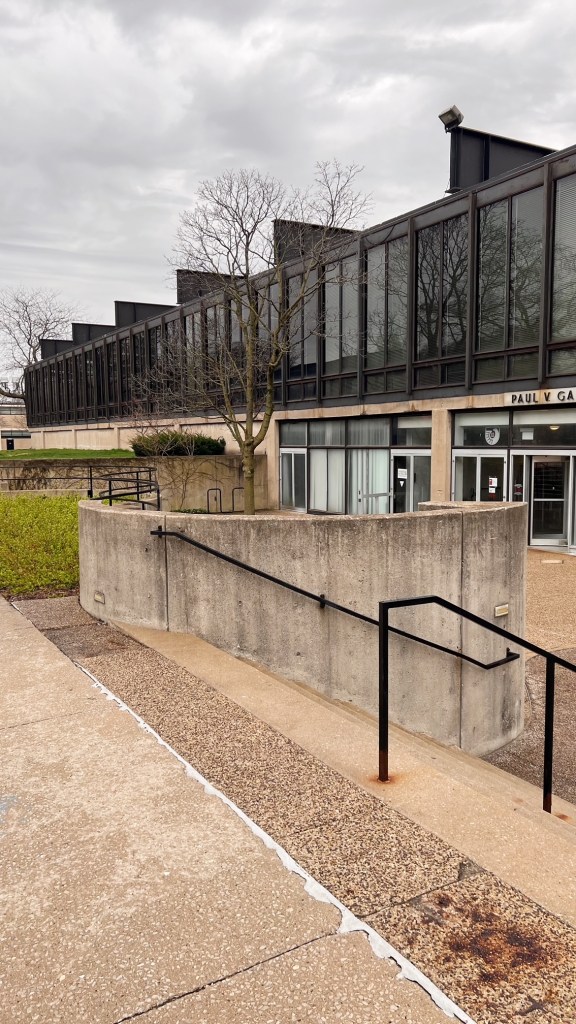
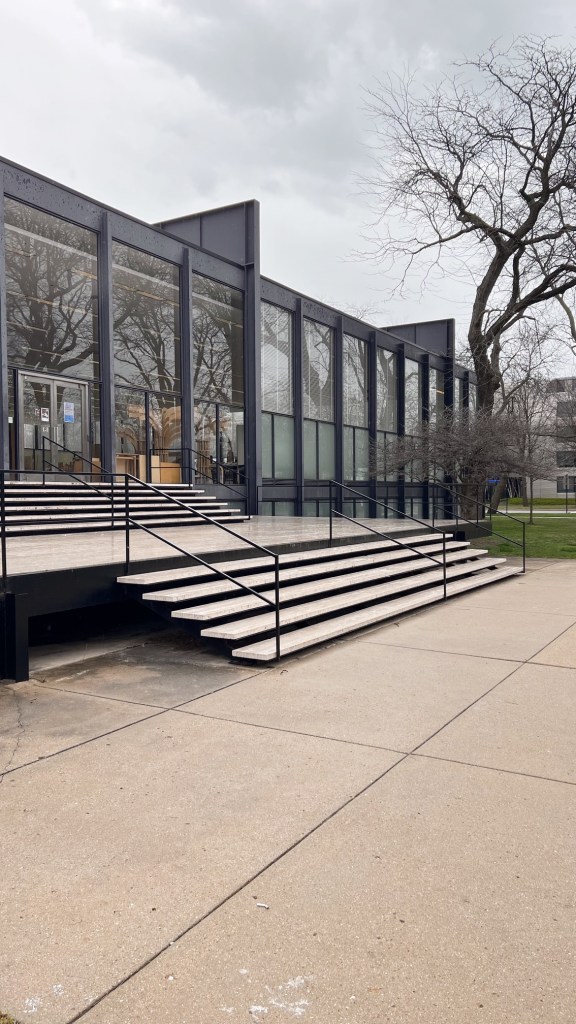
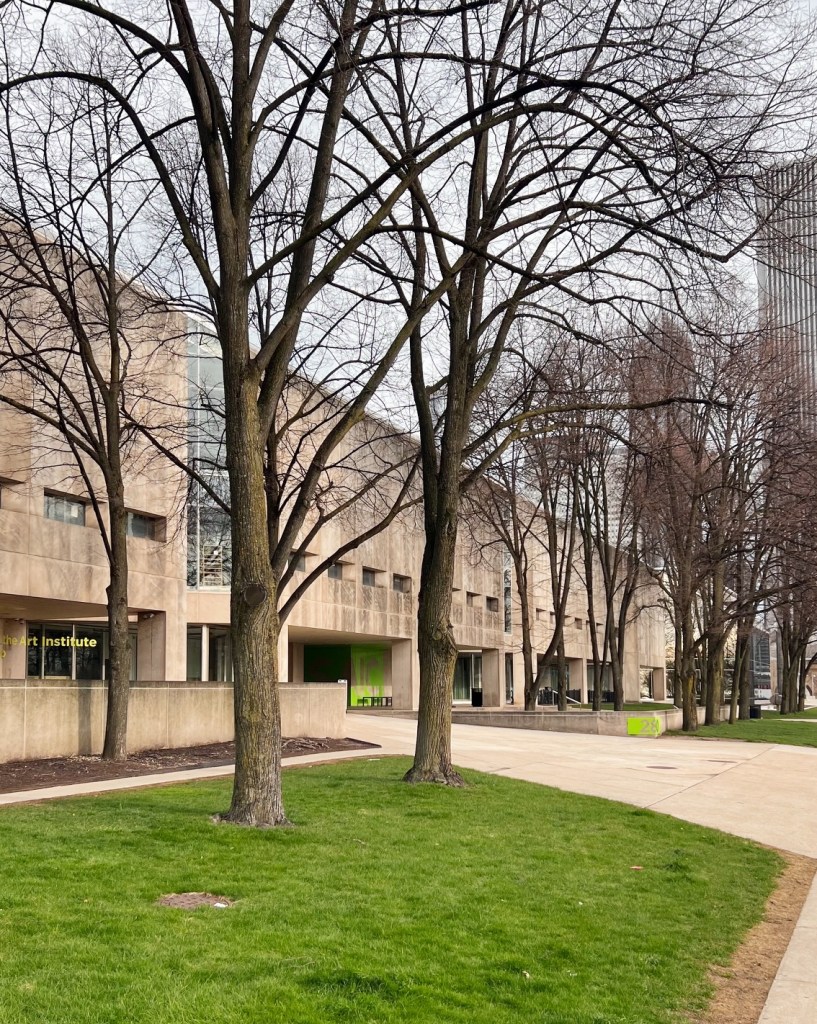
The sky had been threatening rain all day and it started when I arrived at Illinois Institute of Technology. Among many things, the university is famous because it is where Ludwig Mies van der Rohe worked when he moved to America. As a result, most of the buildings on campus incorporate elements of his design style (as does most of Chicago. The new McCormick Place was designed by Gene Summers of C.F. Murphy and Associates. At one time he had worked in Mies van der Rohe’s office.) The campus is beautiful. Since it was Sunday morning, it was quiet and empty. Perfect for a peaceful walk.
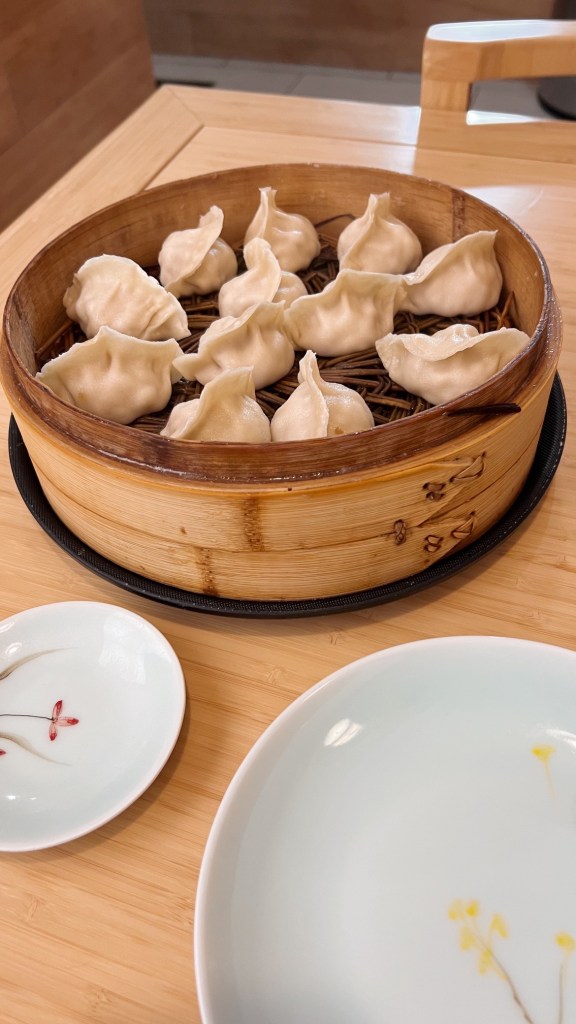
After walking around campus for a few hours, I decided to walk to the dumpling place in Chinatown. It is called Qing Xiang Yuan Dumplings. Now anyone who has visited or lived in America will have undoubtedly noticed that sometimes what you see on the map is not necessarily what you see in reality. According to the map, the dumpling place was a mile from campus and required walking in a relatively straight line down one road. The fact that this one-mile walk was going to take thirty minutes should have been dead giveaway that this wasn’t going to be an easy walk. But in the spirit of adventure, and the fact that these dumplings were going to be amazing (author’s note: they were), I decided to go for it. Ten minutes later I found myself walking on the sidewalk with the brick wall of a building on my left and traffic on my right coming towards me at forty miles per hour down the freeway exit road. On the other side of the exit road was a seven-lane freeway. Every twenty feet or so there was a light pole or road sign obstructing the sidewalk. This was also when the rain picked up. But like I said, adventure. It was worth the walk because the dumpling place was amazing. They had steamed, boiled, and pan fried with lots of different meats and vegetables. I ordered steamed Kurobuta pork and cabbage (黑豚猪肉白菜), fried chicken and coriander (鸡肉香菜), and a pot of Taiwan oolong tea (乌龙茶). I would recommend getting there early as they fill up fast for lunch and there are only a handful of tables available.

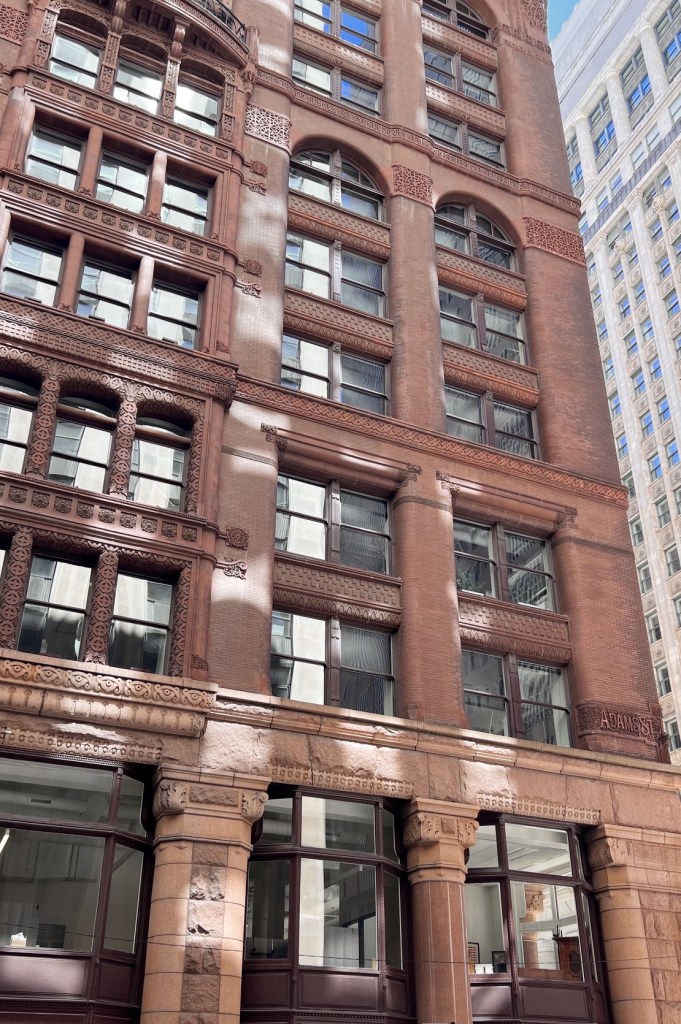
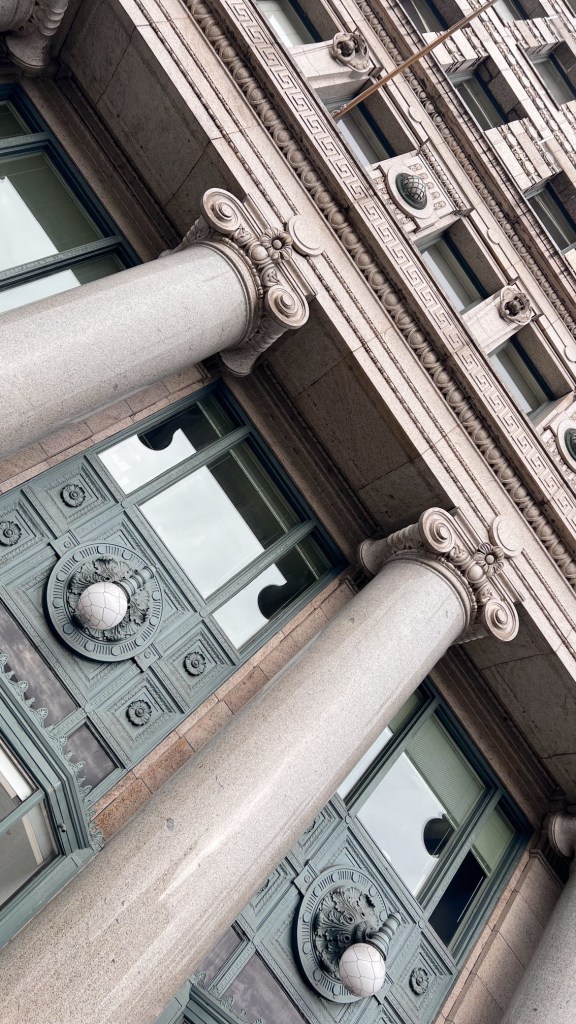
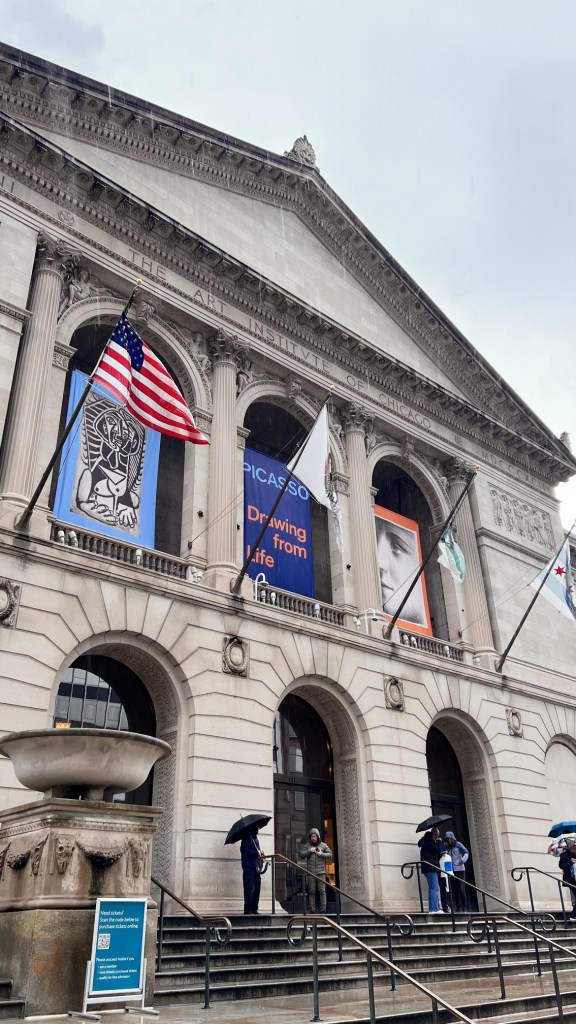
The rest of the afternoon was carved out for the Art Institute of Chicago. The museum features a large exhibit in a building designed by John Wellborn Root, one of the most prominent Chicago architects of the late 19th century. He is most known for his collaborations with Daniel Burnham. One of their monumental designs, the Rookery Building, still stands at the corner of West Adams and South LaSalle (see picture below). The museum was expanded in 2009 with a design by renowned international architect, Renzo Piano. Two of Piano’s museum designs are in my metropolitan area: the Nasher Sculpture Center in Dallas and the Piano Pavilion at the Kimbell Art Museum in Fort Worth. One thing I liked about the museum is they provided a brochure for the museum-goer who had a minimal amount of time to spare. They selected a few prominent pieces and provided a map for them to see these pieces in under an hour. In popular culture, the museum is famous for the scenes in Ferris Bueller’s Day Off by director John Hughes. The main characters wander around the exhibits and there is a prominent scene featuring the pointillism painting A Sunday on La Grande Jatte by Georges Seurat from 1884. Here is a selection of my favorite paintings in the museum:
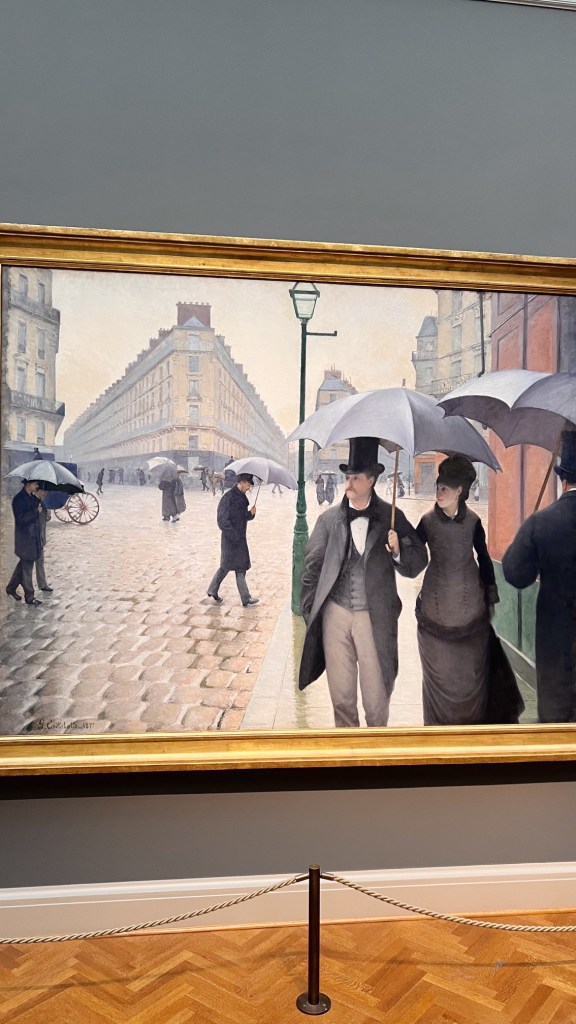
Paris Street; Rainy Day by Gustave Caillebotte (1877)
I first saw this painting at a Caillebotte exhibit at the Kimbell in Fort Worth. I am immediately struck by the distorted perspective of the scene. The two promenaders are grinning and looking at something to their right just out of scene. The cobblestones are detailed in the foreground and gradually start to blur together as they extend into the background. The square is flanked by many buildings but the most prominent is a triangular building built in the Haussmann style from his 19th century redesign of Paris. Its shape defines the square. The rainwater that is pooled on the sidewalk and the cobblestones is pleasant and calming. The painter is showing us how relaxed we should feel on a rainy day.
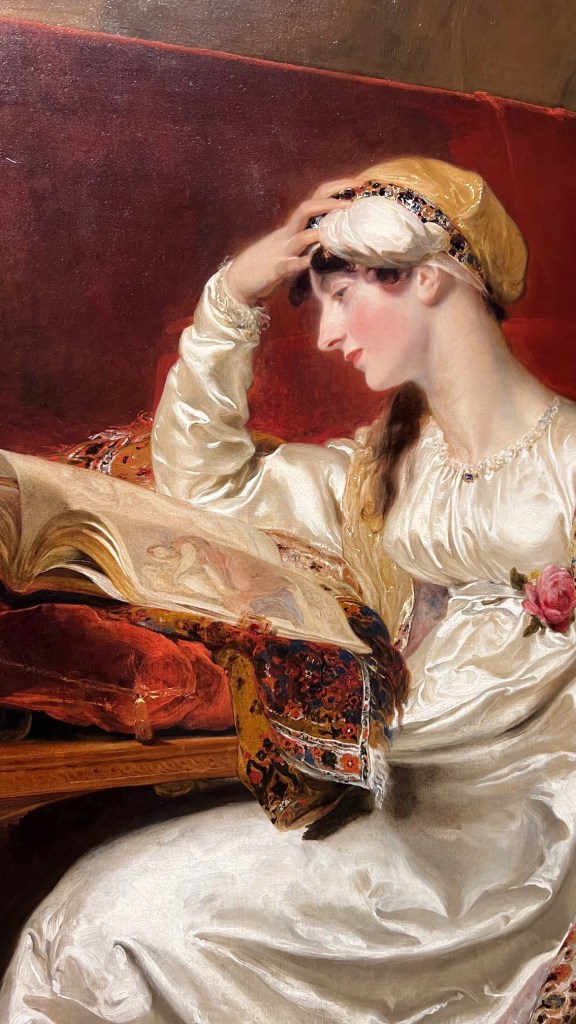
Isabella Wolff by Thomas Lawrence (1803-1815)
Famous for his portraits, this painting is prime example of his mastery. The subject is sitting and reading a book. We can see the texture and folds of her satin dress. The light in the room is delicately reflected in every fold. Her book is resting on a velvet pillow. Her dress is tied with a satin belt and she has also used it to tie a pink rose to her side. The delicateness of the rose adds to the overall mood of the painting. It is tender and sweet.
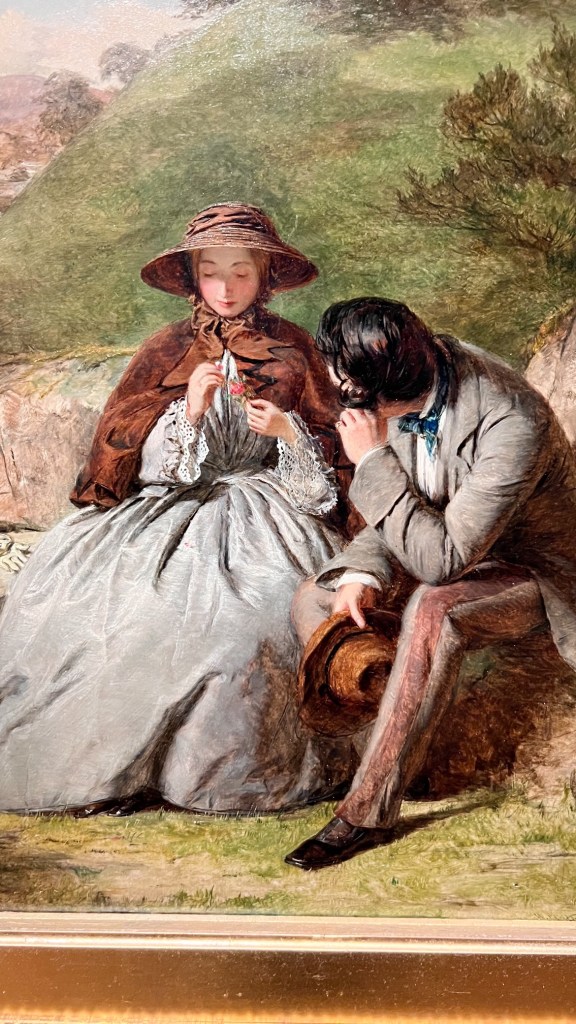
The Lovers by William Powelll Frith (1855)
Two lovers are sitting on a rock in the hill above their village. She is preoccupied with a flower petal from a small flower he must given her from the lapel of his jacket. He is turned away from the viewer and is showing her with his body language that she has his full attention. He is not even giving the viewer any of his attention. This must please her because she is blushing.
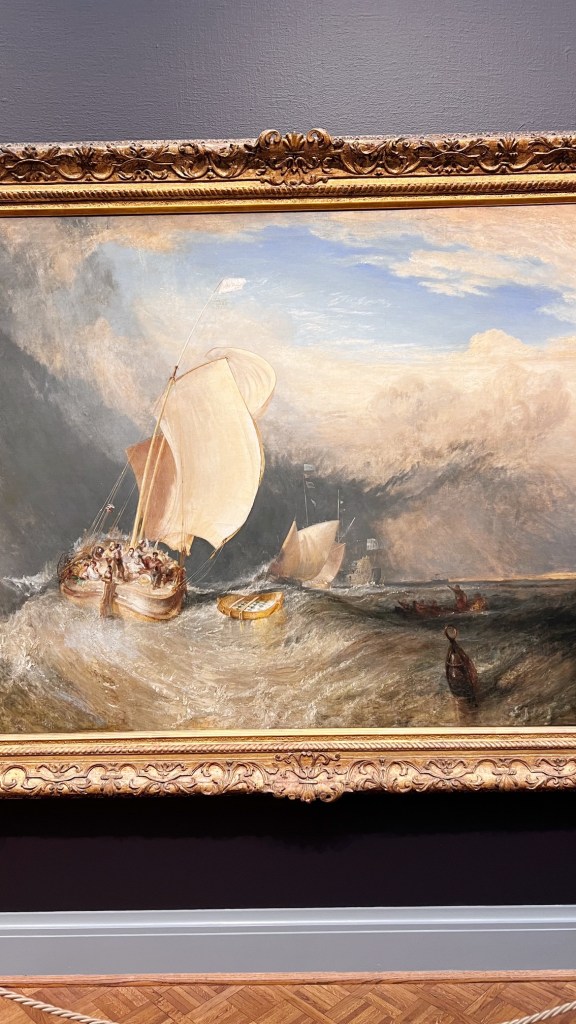
Fishing Boats with Hucksters Bargaining for Fish by J.M.W. Turner (1837-38)
This is a classic example of Turner’s style. A turbulent seascape with storm clouds and a raging ocean. The sail of the ship is positioned to embrace the gale. I love Turner’s attention to detail. The sea is a mix of colors and we can see the whitecaps. The clouds are threatening rain and we are witnessing the calm before the storm.
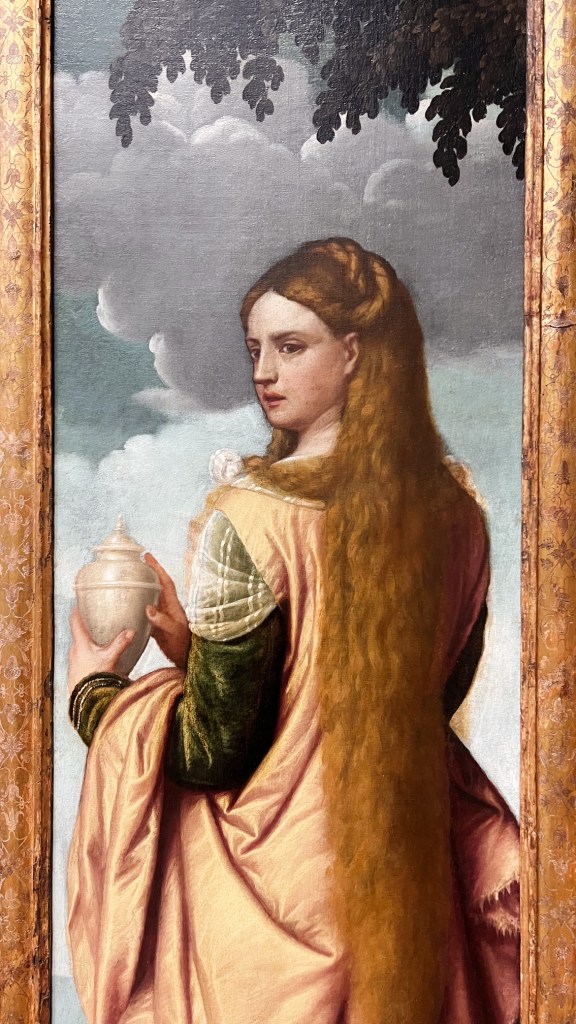
Mary Magdelene by Moretto da Brescia (1540/50)
An early Renaissance painting, the subject has her back to the viewer. In the background there are some storm clouds. Her head is turned to the viewer and she is giving them a serious look. There is so much emotion captured in her eyes and mouth. The storm clouds could be signaling the private battle she is having with her emotions. She is hiding them from the viewer by turning her back to the viewer. She gives us a peek into her battle when she looks back at us.
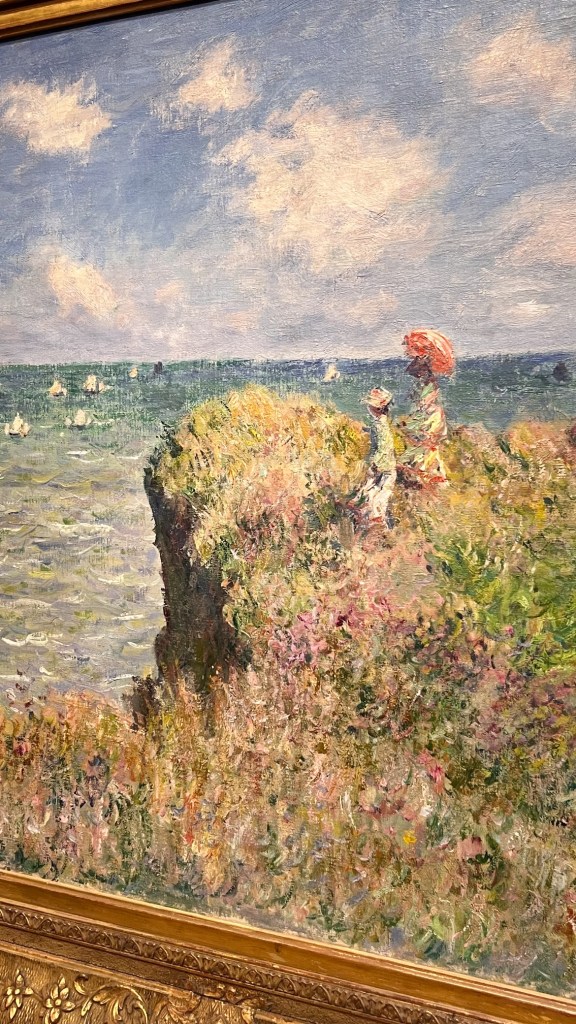
Cliff Walk at Pourville by Claude Monet (1882)
Monet’s seaside paintings always remind me of summer. This is one of my favorite paintings by him. The flowers on the hill, the boats on the water, the blue sky and summer clouds, and the windswept figures who are standing on the cliff and taking it all in. I can feel the warm wind from the sea on my face and can taste the saltwater in the air.
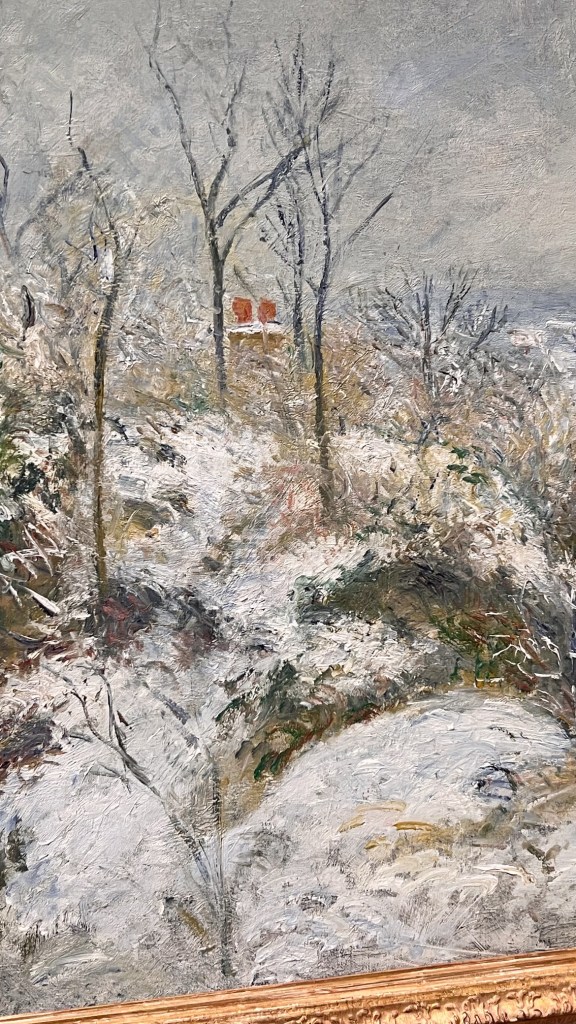
Rabbit Warren at Pontoise, Snow by Camille Pissarro (1879)
Pissarro is one of my favorite painters and his landscapes are simple and powerful. His brushstrokes are choppy and inviting. I like to view his paintings from a few meters away and then gradually make my way closer. The closer you get, the more the detail is revealed. What appears to be a simple scene is a combination of many different colors all working towards the common goal of simplicity. He perfectly captures what it means to walk through nature. When we first arrive, we take in the big picture and as we walk, we see all the details that make up the whole.
The rain started while I was at the museum. I walked out and went to the Starbucks across the street to think about my next move. I knew I wanted to get a deep-dish pizza from Giordano’s, but I wasn’t quite ready to call it a day. I was still wrapped up in the spirit of adventure. Walking through a museum always enhances that feeling. And I want that feeling to linger as long as possible. What better way to do that than by taking a walk? So, with that, I turned up the collar on my coat and walked through the rain to the lakefront.
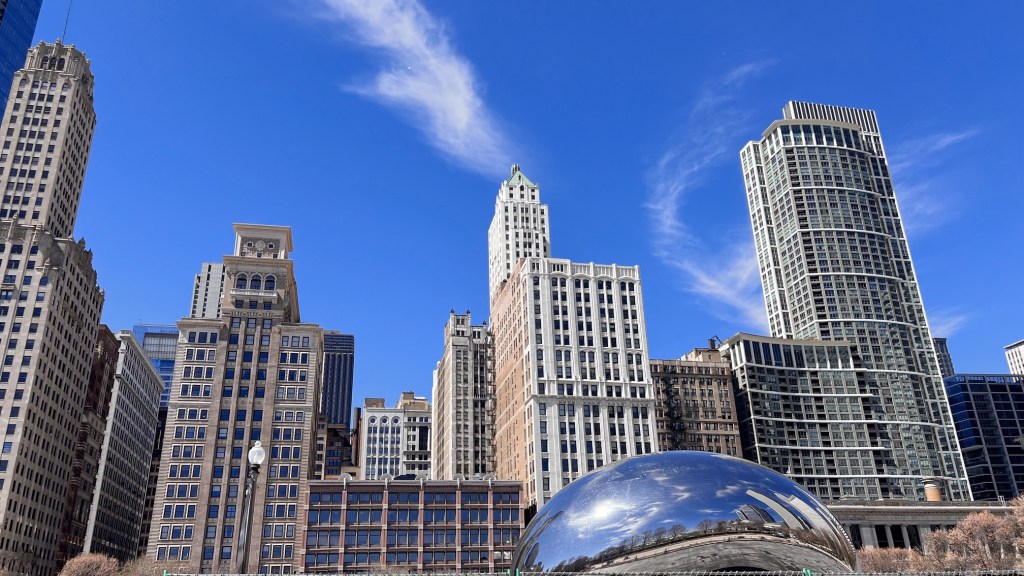


 A Walk Through The City
Looks like you had an awesome trip. Great shots and write-up. The food looks so good… did you like Giordano’s?
LikeLike
Thanks man! Yeah it was really fun! I liked Giordano’s. It was a lot of food but it was really delicious!
LikeLike
I love how you captured the tranquility of exploring a city alone, on a quiet day all to yourself (aside from the cars on the freeway on your way to the dumplings). I could hear the cars, the water lapping at the shore, the sound of your footsteps in the museum. Your attention and appreciation for details is admirable.
LikeLike
Thank you so much! I am happy you like it!
LikeLike