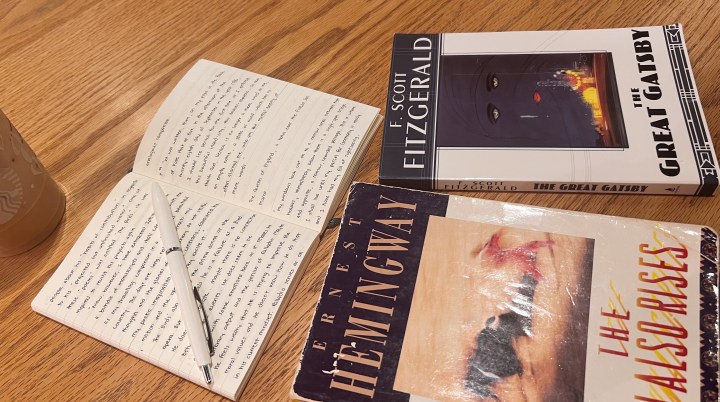
I recently finished The Great Gatsby and The Sun Also Rises, two iconic novels from two of the most famous writers in the American literary canon: F. Scott Fitzgerald and Ernest Hemingway. Despite some problematic language and outdated viewpoints indicative of their time, the stories hold up well. Both stories are set in the 1920s and feature characters and events that were similar to people and events in the authors’ own lives.
In both books, there is an underlying theme of restlessness that is shared between the characters. Hemingway touched on this early in The Sun Also Rises in the form of a conversation between Robert Cohn and Jake Barnes. Robert says:
“’Listen, Jake,’ he leaned forward on the bar. ‘Don’t you ever get the feeling that all your life is going by and you’re not taking advantage of it? Do you realize you’ve lived nearly half the time you have to live already?’”
Hemingway page 19
And then again on the same page they have the following exchange:
“’Listen, Robert, going to another country doesn’t make any difference. I’ve tried all that. You can’t get away from yourself by moving from one place to another. There’s nothing to that.’
‘But you’ve never been to South America.’
‘South America hell! If you went there the way you feel now it would be exactly the same. This is a good town. Why don’t you start living your life in Paris?’
‘I’m sick of Paris, and I’m sick of the Quarter.’”
Hemingway, page 19
Robert tries to cure his restlessness by leaving his long-suffering fiancée, Frances, and having an affair with Jake’s love interest, Lady Brett Ashley. Jake and Brett attempt to embark on a love affair of their own, but it is Brett who puts a stop to it. Book One ends with an air of uncertainty.
In The Great Gatsby, we are introduced to this feeling of restlessness when Nick Carraway visits his second cousin, Daisy Buchanan, and her husband, Tom, for dinner one Sunday. When he arrives, Daisy and her professional golfer friend, Jordan Baker, are sitting on the couch drinking. We get the sense that they are sleepily passing the time away. Daisy and Jordan capture the mood with the following exchange:
“’…I always watch for the longest day in the year and then miss it.’
‘We ought to plan something,’ yawned Miss Baker, sitting down at the table as if she were getting into bed.
‘All right,’ said Daisy. ‘What’ll we plan?’ She turned to me helplessly: ‘What do people plan?’”
Fitzgerald, page 11
It is from this scene that the story unfolds, and we start to learn more about the characters. Nick, after having graduated from Yale and serving in the first world war, moved to the East Coast to work as a bond salesman. The “good town”, in the words of Jake, that Nick chose was New York City. He rents a small house next to Gatsby’s mansion in the suburb of West Egg and begins building his life. Daisy lives with Tom and their daughter in nearby East Egg. Jordan makes appearances throughout the novel and begins a romance with Nick. Gatsby is introduced to the reader later in the story at one of his parties. In a parallel of Fitzgerald’s own life, we learn that Gatsby was left heartbroken as a young man and joined the first world war fully intending to die. Him and Nick served in the same division in the European Theater. Gatsby tells Nick:
“Then came the war, old sport. It was a great relief, and I tried very hard to die, but I seemed to bear an enchanted life.”
Fitzgerald, page 66
After the war, Gatsby also moved to the East Coast, where he lives next to Nick in West Egg in an extravagant mansion. We follow Nick into the world that Gatsby has created.
One thing the characters have in common is they are all from the Middle West and they all chose New York City as the place they wanted to stake their fortunes. Fitzgerald introduced the threat of failure by having the events of the novel take place near a literal ash heap, located near the watching “eyes” of Doctor T.J. Eckleburg. Fitzgerald describes the billboard as follows:
“But his eyes, dimmed a little by many paintless days under sun and rain, brood on over the solemn dumping ground.”
Fitzgerald, page 24
And he contrasts this with the new service stations along the same road:
“Already it was deep summer on roadhouse roofs and in front of wayside garages, where new red gas-pumps sat out in pools of light…”
Fitzgerald, page 20
The only characters who lived by the ash heap were George and Myrtle Wilson. George spent most of the novel in conflict with Myrtle. Myrtle Wilson was not happy in her marriage and was desperate to escape and live a different life. She carries on an affair with Tom throughout the novel. Her and Tom would spend time in New York City, where they kept a fashionable apartment and had a dog and entertained their neighbors. She spent most of the novel trying to rise out of the ash heap only to be tragically killed when she was struck by Gatsby’s car, driven by an emotional distraught Daisy. It is described in the book as an accident, but it’s possible Daisy subconsciously ran over Myrtle because she was stealing the life that Daisy should have had. And Tom, the person whose actions brought on this sequence of events, tells George that the car was owned by Gatsby. George, in his rage and his grief, goes out and kills Gatsby and then turns the gun on himself. Fitzgerald calls the reader back to the ashes right before Gatsby was killed. He writes:
“He must have looked up at an unfamiliar sky through frightening leaves and shivered as he found what a grotesque thing a rose is and how raw the sunlight was upon the scarcely created grass. A new world, material without being real, where poor ghosts, breathing dreams like air, drifted fortuitously about…like that ashen, fantastic figure gliding towards him through the amorphous trees.”
Fitzgerald, page 161
George, resigned to fate, never had the chance to leave the ash heap. He lives there, and he dies there. Myrtle, who briefly experienced a life outside of the ash heap, is returned to them in the most violent way. While Tom should have joined Myrtle and George in the ash heap, he cleverly trades the place reserved for him and gives it to an unknowing Gatsby. George, who Tom referred to as being “so dumb he doesn’t even know he’s alive” (Fitzgerald, page 26), is the instrument in his scheme. The remnants of his affair, and his wife’s affair, is buried in the ash heap, with all the other discarded and forgotten refuse.
Nick is subdued after Gatsby’s death, and he gives up the chance to start a relationship with Jordan. He lets her go, as if she was a leaf in his hand taken up by the wind. It could be that Nick saw Jordan as another link to the tragedy of his friend Gatsby, and he wanted a clean break to start new. Fitzgerald foreshadowed this before Myrtle’s death. All of this was happening on Nick’s birthday, and he reflects on this by saying:
“I was thirty. Before me stretched the portentous, menacing road of a new decade.”
Fitzgerald, page 135
The fragile veneer of Gatsby’s life continues to crumble into the ash heap. There is a funeral service for him, and only a few people attend. Notably, none of Gatsby’s party guests go to the funeral. In a metaphorical sense, the party is over and all that remains is that sobering liminal period of time felt right after the end of a party. That these events also take place at the end of summer just adds more to the feeling. Fitzgerald noted this in an earlier exchange between Daisy and Jordan:
“’What’ll we do with ourselves this afternoon?’ cried Daisy, ‘and the day after that, and the next thirty years?’
‘Don’t be morbid,’ Jordan said. ‘Life starts all over again when it gets crisp in the fall.’”
Fitzgerald, page 114
In the end, Nick determines that all of them—Tom, Daisy, Jordan, Gatsby, and Nick—are Midwesterners who aren’t suited for life on the East Coast. Nick closes his chapter in the East and goes back West and avoids succumbing to the ash heap. He describes his feelings of living in the East:
“Even when the East excited me most, even when I was most keenly aware of its superiority to the bored, sprawling, swollen towns beyond the Ohio, with their interminable inquisitions which spared only the children and the very old – even then it had always for me a quality of distortion.”
Fitzgerald, page 176
And he closes his return with the following:
“That’s my Middle West–not the wheat or the prairies or the lost Swede towns, but the thrilling returning trains of my youth, and the street lamps and sleigh bells in the frosty dark and the shadows of holly wreaths thrown by lighted windows on the snow.”
Fitzgerald, page 176
There is a similar liminal period experienced by the characters in The Sun Also Rises. Whereas in The Great Gatsby it was the metaphorical end of a party marked by Myrtle and Gatsby’s deaths at the end of summer, in The Sun Also Rises it is the literal end of a party, the end of the weeklong fiesta in Pamplona. During the fiesta, the characters spend their days getting very drunk and watching the bullfights. Jake, in a parallel with Hemingway, is passionate about the bullfights. When the fiesta closes, and the nicer café chairs were returned to their proper place at the outdoor tables, each character began to go their separate ways. The aftermath of the fiesta was noted by Hemingway when he wrote:
“The three of us sat at the table. It seemed as though about six people were missing.”
Hemingway, page 228
Brett leaves her fiancée, Mike Campbell, and goes off on another affair, this time with the youthful matador, Pedro Moreno. Robert, who is smitten with Brett after their affair, becomes possessive and tries to pursue something more serious with her. He spends his time at the fiesta being antagonized by Mike, Jake, and Jake’s friend from New York, Bill Gorton. He ends up being rejected by Brett and severs his relationship with the rest of the group by attacking Jake, Mike, and Moreno before leaving in disgrace. Bill returns to Paris. Mike goes to Bayonne, where he originally intended to meet Bill and Jake for a fishing trip before their collective trip to Pamplona. Jake decides to go to San Sebastian before he goes back to Paris. As the characters depart, the story stays with Jake, and we follow him on his trip to San Sebastian. Before the events in Pamplona, Jake and Bill went fishing in Bayonne. There they fished all day, drank heavily, and took leisurely naps under the trees. It’s almost like they went through a sort of meditative cleanse before the chaos that would come in Pamplona. After the events in Pamplona, Jake went through another meditative cleanse, this time by himself. He spent his time in San Sebastian swimming and recuperating. His trip is interrupted though by a telegram from Brett, who was in Madrid, now without Romero, and in need of his help. Jake comes to her rescue and learns she has left Romero and intends to go back and be with Mike. They have a moment together in a taxi where she tells him:
“’Oh, Jake,’ Brett said, ‘we could have had such a damned good time together.’”
Hemingway, page 251
The novel ends the same way that Book One ended, with Jake and Brett thinking about what could have been.
Another underlying theme in both novels was this pervasive sense of loneliness. Like all of us, the characters were looking for happiness, and they were forced to contend with their circumstances. And that’s what made the characters relatable. We have all had our struggles, and we could empathize with the struggles of the characters. Fitzgerald writes this passage early in Gatsby and it is emblematic of both novels:
“At the enchanted metropolitan twilight I felt a haunting loneliness sometimes, and felt it in others–poor young clerks who loitered in front of windows waiting until it was time for a solitary restaurant dinner–young clerks in the dusk, wasting the most poignant moments of night and life”
Fitzgerald, page 56
 A Walk Through The City
Excellent comparison essay! I like the quotes you included to demonstrate the similarly in themes. I felt that in both stories one of the bigger themes is the search for belonging, and how the friendships they build are circumstantial. Jake and Gatsby were both attached to romantic ideas of having a lifelong relationship. Both Daisy and Brett, however, represent the reversal of women’s roles at the time. The women want the financial stability of marriage, but to be free from commitment. These books must have been very scandalous at the time, and the men are actually portrayed as more conservative types looking to “settle down.” It is telling how much both Jake and Gatsby were willing to accept, and to secretly hope the girlfriend would either leave her husband (Daisy) to be with him or get tired of empty love affairs (Brett) and go live in the country with him. In both books, there is a profound loneliness because all the relationships (both platonic and romantic) are limited.
LikeLike
I really like your assessment, thank you for sharing! I agree, they all seemed to be looking for somewhere to belong and to call home. And the circumstantial nature of their friendships meant they were never going to find happiness without moving on. Their limited relationships meant that the more they gave emotionally, the less they received. I appreciate your insight!
LikeLike
Thank you for such an informative write up! I could really get a sense of your feel for the books, and it made it all the more enjoyable to know your thoughts on two literary icons.
LikeLike
Thank you very much! I am happy that you enjoyed it!
LikeLike
You mentioned that Fitzgerald had been in the war; Hemingway was too – and that that sense that each is trying to find connections could be a call-back to the relationships they formed in the wars. Wether they be romantic, or platonic, the relationships formed outside of the crucible are entirely different and therefore are experienced and felt at different levels. Their loneliness and lack of direction in regards to their relationships could be due to that, or at least, it is what I always think of when I read these two authors in particular.
LikeLike
That’s great insight! I agree, I think that was a huge driver of their behavior. I can see that in both authors’ book too.
LikeLike