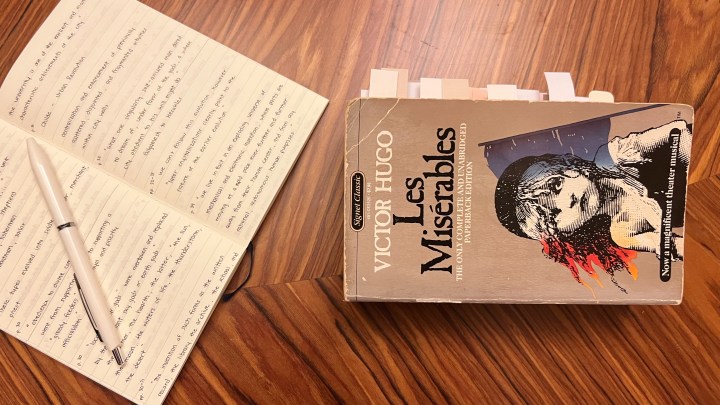
“…but they were students, and to say student is to say Parisian; to study in Paris is to be born in Paris”
Victor Hugo, Les Misérables, page 120
“He loafed. To err is human, to loaf is Parisian”
Victor Hugo, Les Misérables, page 654
“But Gavroche, who was of the wagtail species and slipped quickly from one action to another, had picked up a stone. He had noticed a street lamp.
‘Well, well,’ he said, ‘you still have your lamps here. That’s not proper form, my friends. It’s disorderly. Sorry, this will have to go!’
And he threw the stone into the lamp, whose glass fell with such a clatter that some bourgeois, hidden behind their curtains in the opposite house, cried out, ‘There’s ‘Ninety-three all over again!’”
Victor Hugo, Les Misérables, pages 1157-58
There is a passage in the introduction to Les Misérables where Lee Fahnestock writes:
“Reading Les Misérables today, nobody would deny that Victor Hugo’s prodigious flow of words occasionally produces moments of excess, when we might wish he had shown more restraint”
(Introduction xii)
I disagree. I am happy that Victor Hugo did not show any restraint in his novel. Les Misérables is unlike any book I have ever read, and I doubt I will ever read another book like it in the future. It is a sprawling epic in every sense of the word. Hugo’s text is rich in detail and description and serves as a love letter to his beloved Paris. We see Paris through his eyes, “the Paris of his youth, that Paris he devoutly treasures in memory…as though it still existed.” (Hugo 446). Paris, its history; Paris, its buildings and streets and monuments; and Paris, the stories of its citizens. Everywhere in the novel you can see Hugo’s love for Paris. He names the streets as we walk alongside his characters. He tells us where streets intersect. He describes the buildings, the doors, windows, alleyways, the houses, colors, shapes, noises. He tells us what is here now and what was there before. His knowledge is encyclopedic but at no time does it feel dull or repressive. On the contrary, these passages represent some of the best parts of the novel. Victor Hugo was at heart a poet and like his contemporaries Pushkin and Lermontov, his prose is infused with the same magic that makes his poetry so memorable. To read Les Misérables is to read an epic in prose from a master of verse.
Continue reading “To Love is to Act: Thoughts on Les Misérables”
 A Walk Through The City