“Unlike many architects, Wright loved designing houses. In his essay ‘The Natural House’ he wrote that a proper house should be one that is ‘integral to site; integral to environment; integral to the life of the inhabitants.’ Houses were places to be fitted to clients, like a tailor fits a suit. Their form should be so in tune with the setting as to appear that they were growing from their site, like a tree grows from the ground. He called the style ‘organic architecture.’”
Lynda S. Waggoner, Fallingwater: Frank Lloyd Wright’s Romance with Nature
It is time to continue our series on designing a house. In our last essay, we worked on the exterior design. We incorporated features from English, French, and Japanese garden design. In the essay before that we put together a preliminary layout of the house. In this essay we will focus on editing the design we put together in the previous three essays. We began by asking a few theoretical questions and we will end by answering some of those questions.
In our current design, our house is two stories with two bedrooms and two bathrooms on the second floor and the master bedroom and master bathroom on the ground floor. We specified that the garage would be located on the left side of the property. The goal of this essay is to review our design and make changes. Before we start though, it would be helpful to do two things. The first is to remind ourselves of our design goal. If you recall, we selected a passage from Koji Yagi’s book A Japanese Touch for Your Home:
“As a result, the Japanese house plan can be described as being composed of three parts: exterior, intermediate, and interior. The exterior is of course symbolized by the garden, and the interior is where the inhabitants spend most of their time. The intermediate area is an important buffer between these two and helps draw nature into the home while still providing protection and security.”
The goal is to create a space that is close to nature but isn’t completely exposed. Our space should also provide protection and security. One of my best friends recommended writing down your goal and keeping it on a sticky note while you work. I’ve written our goal on a sticky note that is attached to my laptop next to the touchpad. By keeping our goal close by, we can stay on track as we start going through our design and making changes. The second thing we want to do before we start is align our house along the cardinal directions so we can put a direction behind the descriptions. For this design, I am going to align the house along the intercardinal, or ordinal, directions (northeast, southeast, northwest, and southwest). The front of the house will face southeast and the back of the house will face northwest. Our house will be aligned 135° from cardinal north. I sketched this below:

There are a few reasons for this orientation. The main reason is I want to limit the amount of direct sunlight in the morning and in the evening. I plan on putting a lot of windows to maximize the amount of natural light and I don’t want one area to receive the full brunt of the sun. If you recall from the last essay, we will be building our house in a neighborhood with old growth trees in the front yard. This will help with diffusing the direct sunlight. Another reason is we are building a house that is a little off kilter, so it would make sense to orient it off kilter as well. Now that we’ve got a framework, let’s start digging into what we have and see if we want to make any changes.
A Design Change
The first major change to the design will be to move the master bedroom. And the reason is I just can’t visualize it in its current location. The reason why I wanted to put it on the opposite side of the kitchen in the first place was because I wanted a private courtyard attached to the master bedroom that was isolated from the rest of the backyard. I visualized the backyard as a combination of open spaces and private reflective spaces. But its current location creates some issues. The first issue is now the room will be subjected to the noise from the kitchen and the laundry room. I grouped these rooms together for a reason because they are work rooms. They are going to be noisy. One way I considered reducing the noise was to put a private hallway between the bedroom and the laundry room. This could potentially act as a buffer zone. But in trying to draw it, it just didn’t make sense. I couldn’t visualize it. The other issue the current location creates is the bedroom is blocking the view from the kitchen. I visualized the kitchen in the northern corner of the house with big windows. I also envisioned integrating the kitchen with the outdoor patio. Putting a bedroom on this side of the house would either limit the amount of light coming into the kitchen or would block the view outside the kitchen completely. I would also be isolating this room from the rest of the house, which isn’t something I want to do in this design. We should feel connected to our homes. There is something comforting about being in one room and hearing the muffled sounds of the television from the living room or from the chatter in the kitchen. It is like a night light and makes a house feel lived in.
Putting the bedroom on the opposite side of the house wouldn’t make sense either. I was considering putting the garage over here and creating a boundary for the backyard. I also want to preserve the intermediate zone we are creating between the backyard and the house.
It appears the only logical solution is to move the master bedroom upstairs to the east corner of the house. Since we are aligning this house southeast to northwest, we will get indirect sun in the morning if we put the windows on the southeast and northeast sides. We will put the walk-in closet and master bathroom on the northern corner of the house. We can maximize the space since the master bedroom will span the entire width of the house. And by putting the master bathroom above the kitchen, we can run plumbing piping up from the kitchen. I will still create some verandas and patios on the ground floor. As Koji Yagi said, “Closeness to nature is the ultimate goal of Japanese architecture” and for this design, that is the goal as well. One patio will be located off the kitchen and the other will be incorporated into the living room. For the ground floor patios, I am envisioning a unique design, one that borrows heavily from some elements of traditional Japanese architecture. But we will pick that up later on in the essay.
By moving the master bedroom upstairs, we will have to adjust the locations of the two other bedrooms. For this, we can make a simple change and utilize a common bedroom/bathroom/closet arrangement. One bedroom will be located on the western corner of the house and the other bedroom will be located on the southern corner of the house. Each bedroom will have its own closet located in the space between the rooms and each bedroom will have its own bathroom. The second-floor hallway will now extend to the front of the house and wrap around the void created by the stairwell. There will be single-access points to both bathrooms and both bedrooms on the SW side and two access points to the master bedroom: one at the head of the stairs and the other at the front of the house. One added benefit of the upstairs hallway is now we have a dedicated place for putting up pictures. A home without pictures is just a house.
I still like the idea of each bedroom having its own balcony but now I want to make one large balcony that wraps around the southwest, northwest, and northeast sides of the house. I am imagining a design that borrows from multiple sources, including Frank Lloyd Wright, Japanese architecture, and the American Craftsman style. The only potential issue with going down this route is the roof design. I will be committed to a more customized roof structure as opposed to a more traditional gabled roof with peaks and valleys.
The Roof
The goal of a roof is to protect the house from the elements, like rain and snow, and to deflect the wind. The “pitch” of the roof is the steepness of the angle that is formed by its rise over run. The lower the pitch, the flatter the roof is, and the more susceptible the roof is to water dispersal issues. Flat roofs are notorious for having water leakage issues and it was a major reason for the failure of a lot of the houses designed by the International Style architects in the 1920s. Most houses have a traditional pitch, which is between 4:12 and 9:12, that is, the roof “rises” (vertical) 4 inches for every 12 inches of “run” (horizontal). In my opinion, roofs with gentler pitches tend to look more like storage units and roofs with steep pitches look like the building is wearing a dunce cap. The difficult part about designing a roof is accounting for all the different lengths and angles of the exterior walls and making sure that it also adequately disperses water. There is also the aesthetic component as well that can’t be discounted. A roof is a statement piece. It is one of the first things you notice walking up to your house. You want it to both stand out and be functional. And it is perfectly fine to design a customized roof because we are designing a customized house. Witold Rybczynski talks about the cost of roofs in one of his books and how the cost usually represents a large percentage of the overall cost to build the house. He mentions it because a lot of the roof is wasted space. We spend a considerable amount of money and resources heating and cooling a portion of the house that isn’t even used. Not to mention the construction materials themselves. If we are going to spend the money, we may as well make a unique design. In order to reduce the amount of wasted space, we will keep the roof pitch low. The goal with this is to emphasize the horizontality of the house. If the roof is too steep, it will make the house look too vertical and imposing. We want our house to be inviting.

Some Design Inspiration
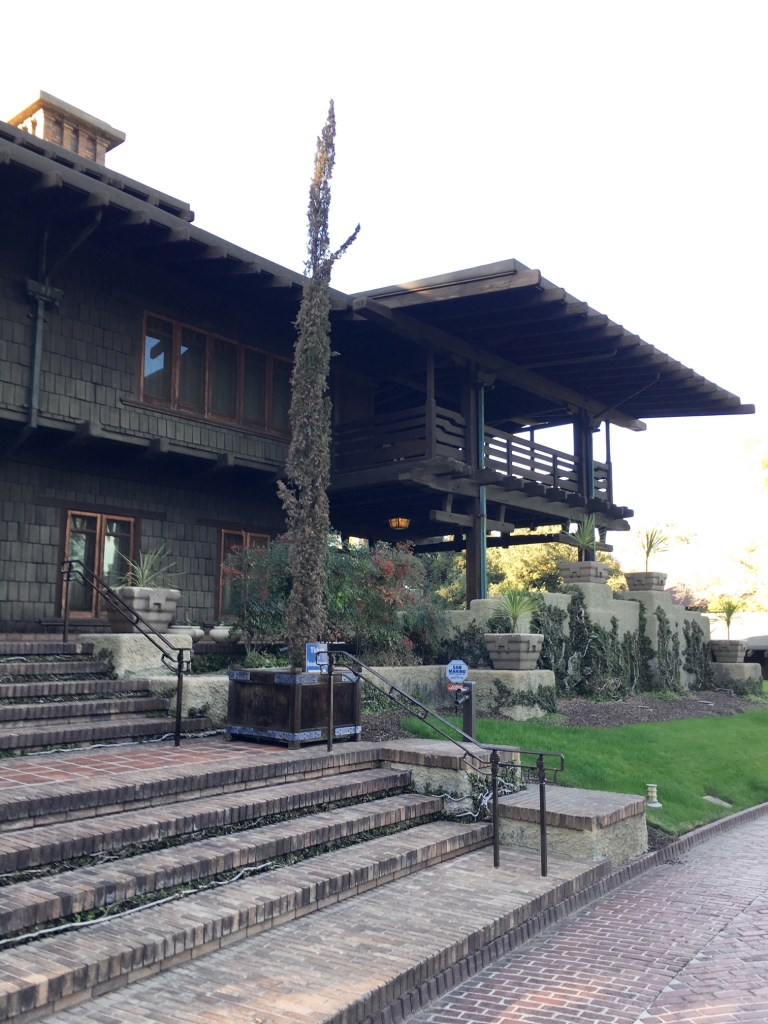
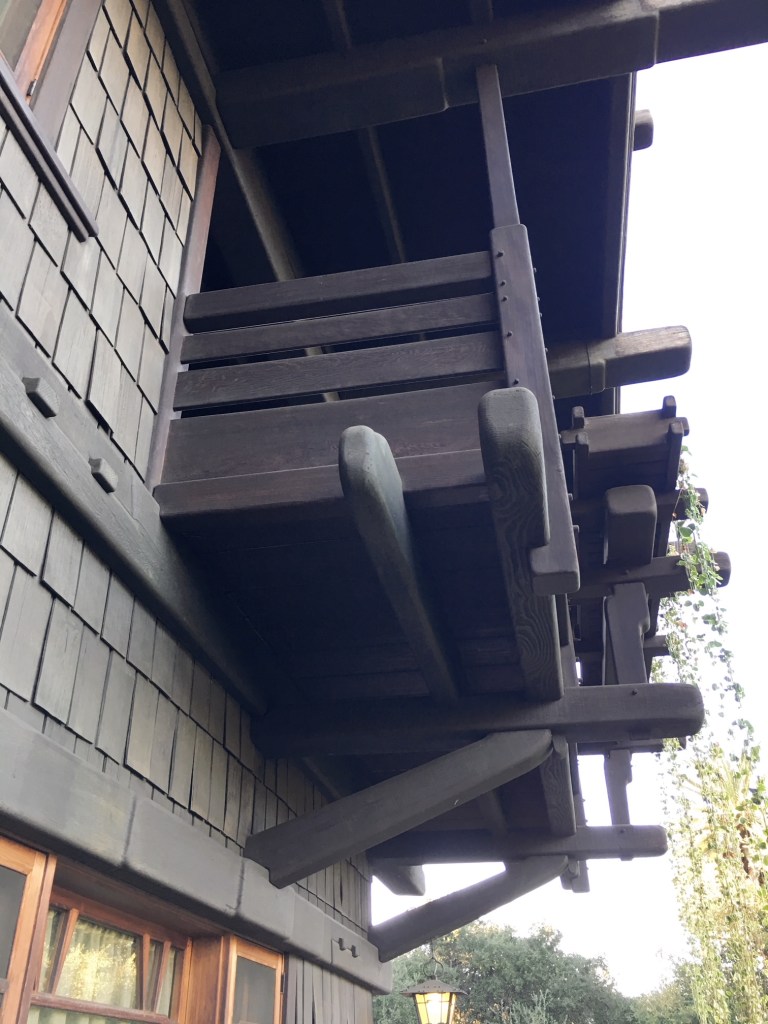
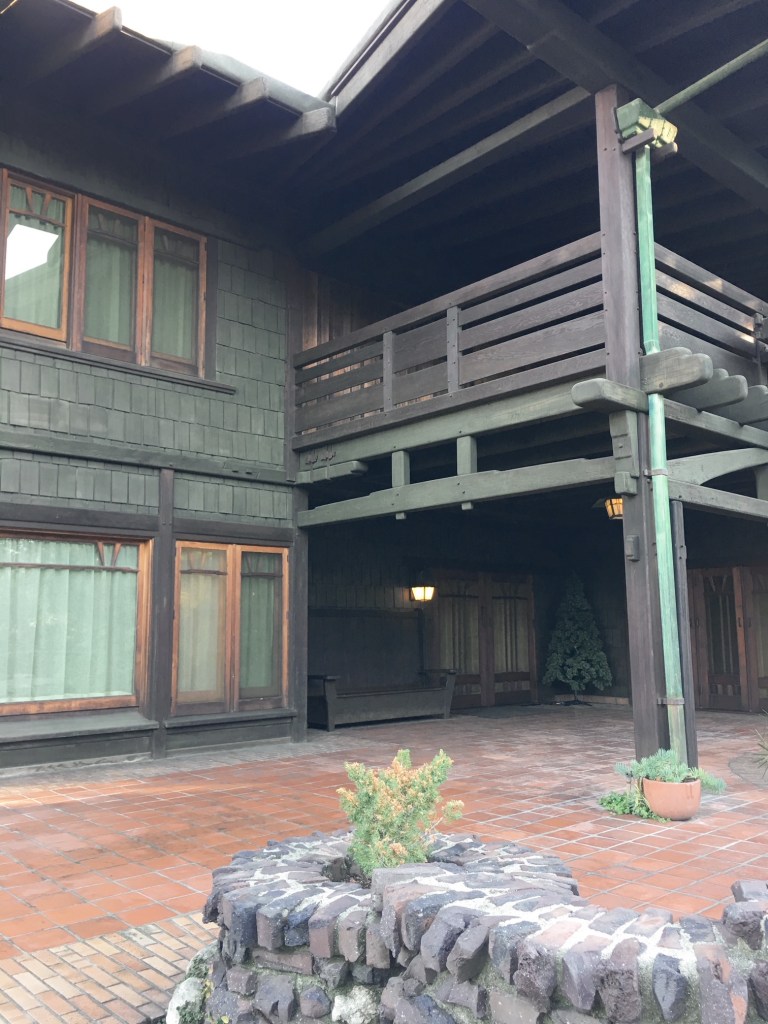
For this design we can look to a few examples for inspiration. The Gamble House in Pasadena, California is an example of the Arts and Crafts style of architecture and was designed by the architect brothers Charles and Henry Greene in 1908. Readers might recognize the house from the movie Back to the Future. It served as the exterior model for Doc Brown’s house. On one side of the house, there is a ground floor veranda and a second-story balcony. The roof is gabled and the eve extends out over the whole area. These exterior spaces achieve the “closeness to nature” goal and will be great sources of inspiration for our design.
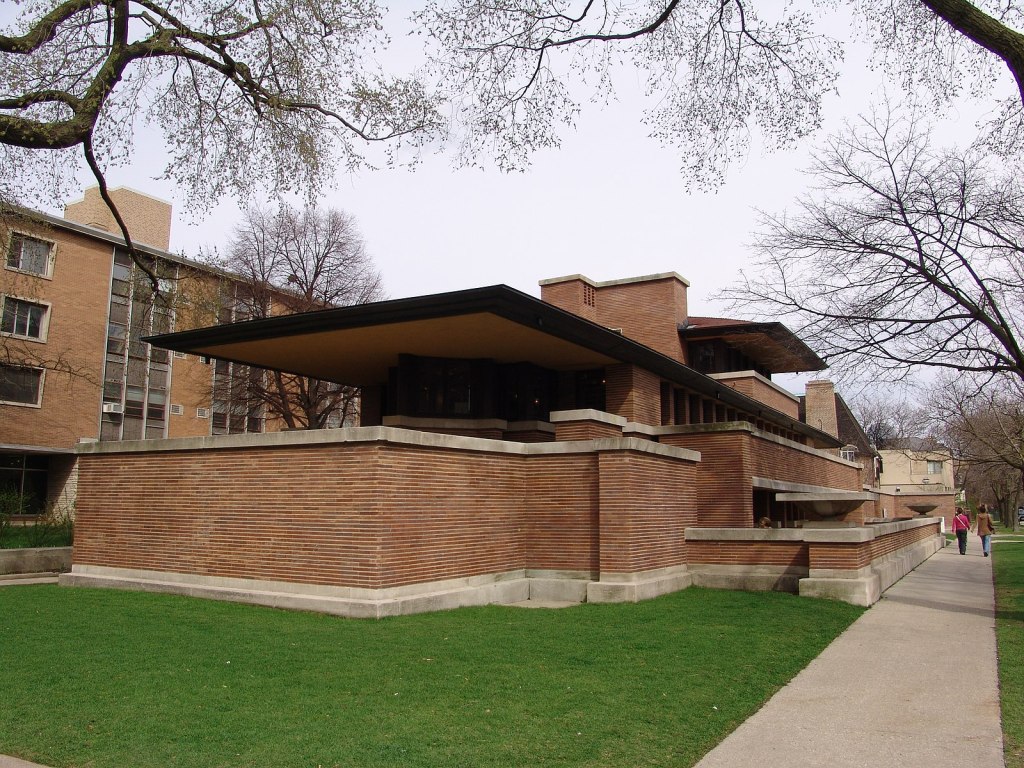
In addition to the Gamble House, we can look for inspiration in Frank Lloyd Wright’s Frederick C. Robie House in Chicago, Illinois and in his masterpiece, Fallingwater, in Stewart Township, Pennsylvania. In both designs, there is an emphasis on horizontality. At the Robie House, the ceilings and floors were constructed of large steel beams that carried the weight of the house to support piers at both ends of the house. Since the exterior walls weren’t needed to carry the structural weight of the building, Wright was able to play with their design. He filled them with windows and decorative art. The combination of these windows and the lack of interior partitions results in an airy and open space inside.
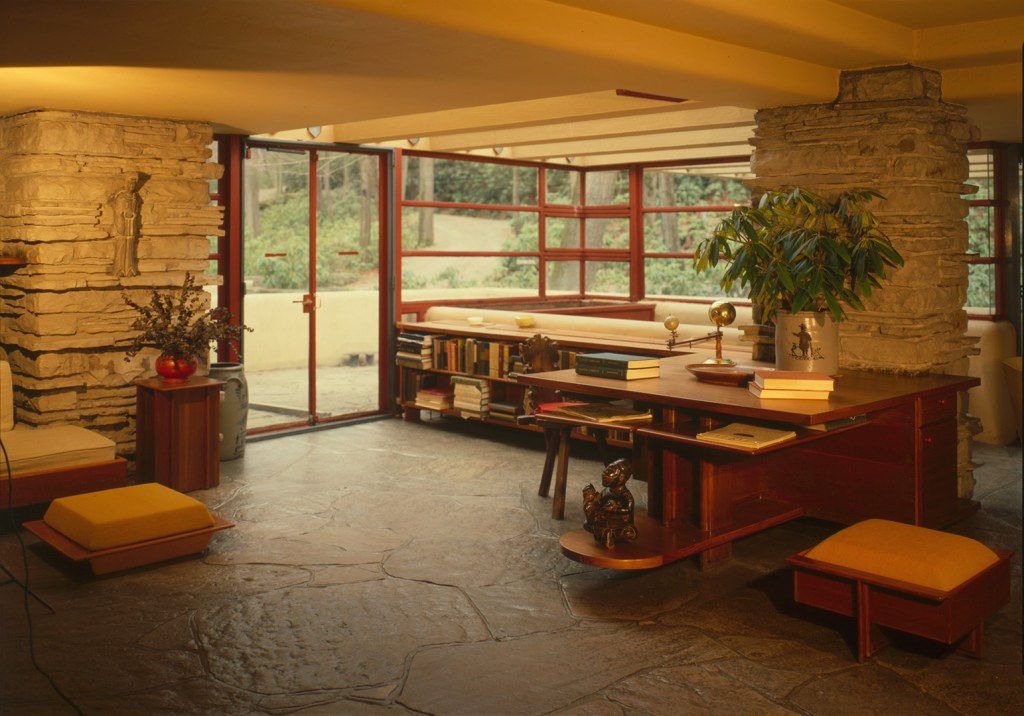
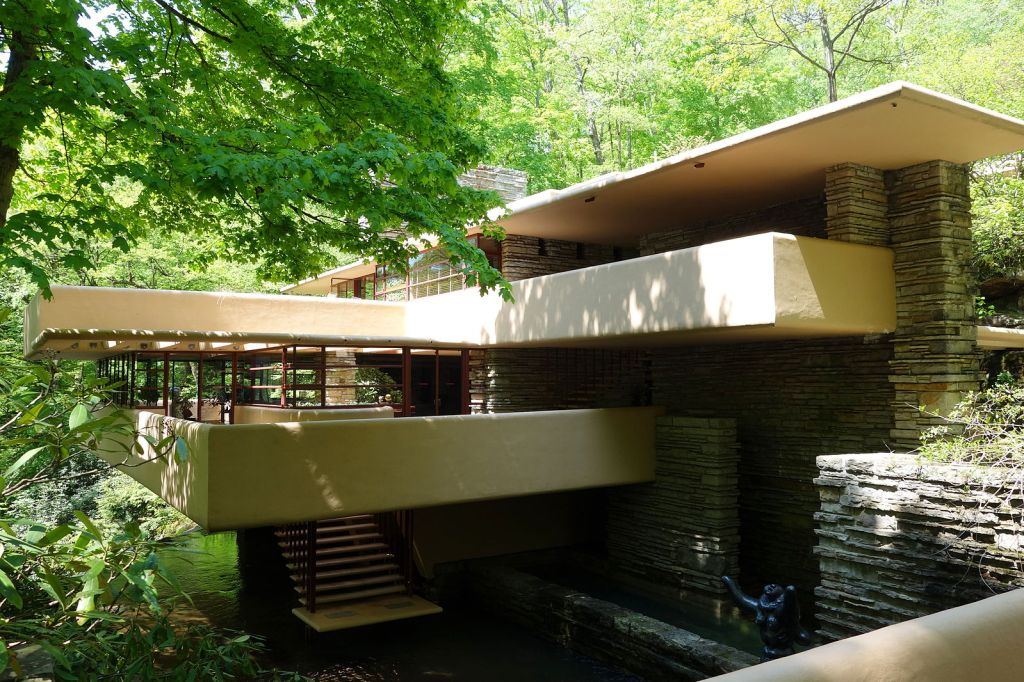
Fallingwater was incorporated into a mountainside and waterfall. The waterfall runs underneath the house. The house looks like it is protruding from the rock face and it fits perfectly with its natural surroundings. There is a vertical core and horizontal floors jutting out in different directions over different levels. The vertical core is faced with rough stone that protrudes from the wall. It makes the vertical core look like a jagged rockface on the side of a mountain. The horizontal floors all have the same overall design and color. They are horizontal viewing platforms nestled into the side of a mountain. The line between exterior and interior is blurred. The effect is of a series of open spaces that are natural extensions of the landscape.
The Gamble House and the Robie House both have traditional gabled roof designs. They both look massive, but they aren’t overwhelming. Instead, their long spans are pleasing to the eye and the houses look comforting and inviting. In the Robie House, these feelings are reinforced by the airy interior spaces. At the Gamble House these feelings are reinforced by the large patio and balcony areas that are set back deep under the protection of the roof eve. We are outside but we feel like we are inside. At Fallingwater we feel invited in the same way we feel invited to a park. The open horizontal platforms have simple flat roof eves that protect us like a tree canopy would. We can hear the gentle flow of the creek everywhere on the property. The natural building materials provide us with an extra connection to the area. The vertical core acts like a hearth. If the weather turns, we can retreat into the safety and security of the core. There is a perfect harmony with nature.
For our design, we can confidently play with space and masses because we have so many unique sources of inspiration.
Here are some pictures I took of the Gamble House in Pasadena. Note the massive wooden roof and balconies:


Here is a picture of the Frederick C. Robie House in Chicago. Note the long horizontal roof structure. Picture source is credited below:
Here is a picture of the interior of Fallingwater. Picture source is credited below:
And here is an exterior photo of Fallingwater. Note the long horizontal spans over different levels of the house. Picture source is credited below:
The Patios
Now that we’ve discussed the roof and reviewed some design inspirations, let’s revisit the patio we will be incorporating into the living room area. If you recall, we are adding this patio because we moved the master bedroom upstairs. Now that we have a second-floor balcony, we will want to be creative with this design and try and incorporate the patio below into the balcony above. We will also be putting a similar patio on the kitchen side as well. The first thing to consider are the exterior walls at these locations. On the living room side, I am envisioning this patio with three sides that is within the overall exterior wall. Like a little pocket in the living room. This will give this space a feeling of a quiet retreat. I think of the Kimbell Art Museum in Fort Worth. In the center of the gallery, there is a small open-air patio with a fountain and some planter beds. The walls and planters are faced with the same travertine marble as the rest of the museum. The space feels like a peaceful and tranquil sanctuary. We will aim for the same feeling of tranquility here. Each wall will be filled with windows in a grid pattern. Here we can borrow from the shoji pattern that is seen in the interiors of Japanese homes. The shoji pattern is a wood lattice pattern. Instead of translucent sheets that are typically seen in shoji, we will add windows. The wall will be broken up into two halves: a stationary wall and a sliding door. In the center of the patio, we will put a rectangular recessed rock garden with a small fountain in the center. The fountain will bubble water up over the rocks and drain into the same basin. We will make this fountain recirculating. We will also put Japanese elm trees in each corner that will climb up the wall. This patio will also be open to the elements like the one in the Kimbell. We will use the upstairs balcony to partially shade this patio but leave it open for rain to fall into. Since we want this to feel like a private sanctuary, we will restrict access so that it can only be entered through the living room doors. A person sitting on the upstairs balcony can look down into the patio as well.
We will make the patio on the kitchen side larger but retain the same overall design as the living room patio. The difference is we will tie this one into the backyard. We will enlarge the rock garden and put more Japanese elm and maple trees. Since this patio will also connect to the front yard, we can put an orchard and some shrubs. We want this part of the yard to look like a forest thicket. This will give us some privacy from the front yard and provide a natural barrier as opposed to a hard barrier like a fence. We will tie this patio into the Japanese garden in the northern corner of the property that we established in our landscape essay and we will tie it into the veranda on the rear of the house.
The Kitchen
Now that we have the patio, let’s talk about the exterior walls in this part of the house. We will utilize the same shoji pattern we used for the doors on the living room patio. The difference here is we want this space to be more open. This is where the kitchen is located and we want an area in front of that where can put an informal dining room table. We can achieve this by turning our walls into foldable patio doors. The northeast wall extending from the kitchen to the northern corner of the house will be broken into thirds: the first third will be at the northern corner and will be a stationary wall of windows. The other two thirds will be a foldable patio door. The doors will slide down towards the kitchen into a receiver that will be incorporated into the exterior wall. The northwest wall will be broken into fourths: two quarters will be connected and will fold into a receiver in the northern corner and the other two quarters will be connected and will fold into a receiver on the exterior wall where the kitchen and living room meet. With these three foldable doors we can open our kitchen area to the backyard. To further achieve an airy effect in the kitchen, we will make an atrium and extend the exterior walls up past the foldable doors and fill them with windows. This will affect the second story bedrooms but we can easily navigate this additional height by putting in an additional staircase leading up to the master bedroom.
For the kitchen layout itself, we will utilize a kitchen island setup. The kitchen cabinetry will be on three sides. The “working triangle” of a kitchen is the triangle that is formed by the distance between the range/oven, sink, and refrigerator. A good working triangle has a total perimeter of approximately 27 feet. I like having a window over the sink so we will put the cabinets for the sink against the exterior wall and add in a window. Our window will look out onto the patio. From here we should have a great view of the backyard. We will put the cabinets for the refrigerator on the adjacent wall to the sink wall. The range/oven will be opposite the sink and will be set into a kitchen island. To round off the kitchen, we will put another set of cabinets on the other side of the kitchen island. These will be against a half wall topped with a countertop. We will put bar stools under this counter. We will also put bar stools on the kitchen island.
The Living Room
I am visualizing the living room being sunk down three steps from the kitchen. The steps will be floating like the entrance stairs on Mies van der Rohe’s S.R. Crown Hall on the Illinois Institute of Technology. The interior wall that separates the living room from the downstairs hallway and staircase will have built in bookcases. These will be a series of simple shelves mounted directly into the wall. It is here we will borrow some elements from the interiors of homes designed by Frank Lloyd Wright. The steps leading down to the living room will not extend the full length of the threshold. Instead, we will build a wood bench on either side of the stairs that spans part of the threshold from the stairs to the interior partition and on the other side from the stairs to the exterior wall. We will also build two open bookcases that are mounted above the bench. The bookshelves can be viewed from both the kitchen side and the living room side. The bookshelf will provide some soft barriers between rooms and provide some additional seating. In the corner space between the living room patio and the exterior wall leading to the backyard we will build a desk. We will add exterior windows that extend from the top of the desk up to the ceiling. In the corner we will build a shelving unit that extends up the wall. In this corner we can borrow heavily from Frank Lloyd Wright’s Fallingwater. In the exterior wall we can add French doors that are full glass. These doors will lead into the backyard These doors will pair nicely with our windows above the desk. These windows will have a wood lattice pattern like the shoji doors on the patios but they won’t have verticals. There will be horizontals in a thirds pattern.
For the desks and bookcases we are designing, we will utilize a combination of natural wood and modern finishes like lacquered wood, plastic, and glass. I like these combinations, and they are perfect for open airy spaces. We will also add a lot of indoor plants. With these designs, our kitchen and our living room will be places we want to spend a lot of time. And in these spaces I am surrounded by things that are important to me: natural light, big windows, plants, books, and a sense of peace and tranquility.
In Summary
I’ve thoroughly enjoyed working through these essays. I hope the reader has enjoyed them as well. There were two main inspirations for these essays. The first was from Witold Rybczynski. He stated in one of his books that he asks his architecture students to walk him through their designs. And throughout all his books he takes the reader on a tour through history and a tour around town looking at architecture. He is an excellent tour guide. The second was from Vincent Scully. In his book, Architecture: The Natural and The Manmade, he puts himself into his narrative by accompanying Louis XIV on a tour of Versailles. Louis XIV wrote a short treatise that outlined the specific route he wanted visitors to take when they toured his property. He wanted to be their tour guide. Professor Scully even playfully left Louis “standing on the Parterre du Midi with his guidebook” (Scully 237) and took his reader onto a different subject. I thank the reader for allowing me to be a guide for them through this design.
The reader is encouraged to explore the books below for more insight and commentary into our relationship with our built environment:
- House by Tracy Kidder
- Crabgrass Frontier by Kenneth T. Jackson
- The Geography to Nowhere by James Howard Kunstler
- Home: A Short History of an Idea by Witold Rybczynski
- The Most Beautiful House in the World by Witold Rybczynski
 A Walk Through The City

