
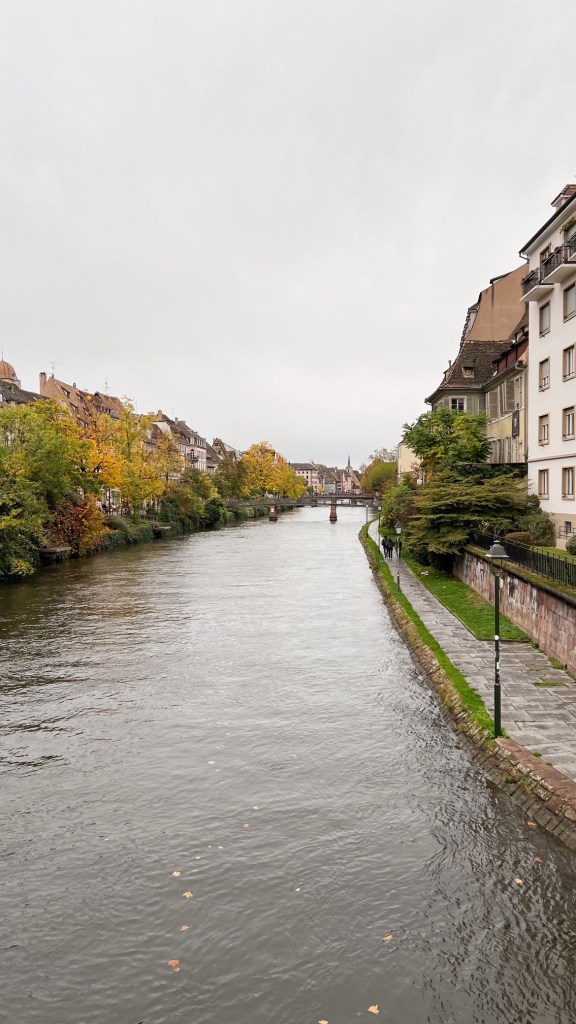
The next city on my itinerary was Strasbourg, a major city in France in the Alsace region. It is located on the river Rhine, which serves as the border between France and Germany. The historic core of Strasbourg is called the Grande Île (German: Große Insel; English: Large Island) and its border is formed by the river Ill and a canal that was constructed off the Ill called the Canal du Faux-Rempart (English: Canal of the Fake Rampart). The city is home to the European Parliament, a university, a medieval church, and some beautiful parks. The Grande Île was designated a World Heritage Site by UNESCO in 1988.
The Hotel
My hotel in Strasbourg was very different from the previous two hotels I stayed at. It was located near the Place Kléber (German: Kleberplatz), which is the largest square in Strasbourg and home to the Christmas market. They were setting up the Christmas tree when I was there, and I wasn’t in town long enough to see it formally unveiled. I did, however, buy an ornament and a snow globe from one of the Christmas stores around the square. My hotel room was on the top floor and from my window I could see the spire of the cathedral over the row of shops across the way. The room had a small writing desk inside by the window with a red mat and a cool telephone. I set my snow globe on top of the desk and would look at it at the end of the night when I was reviewing photos from the day and writing in my travel journal. The room was quiet with occasional interruptions by the rumble of the streetcar on the street below.

The City
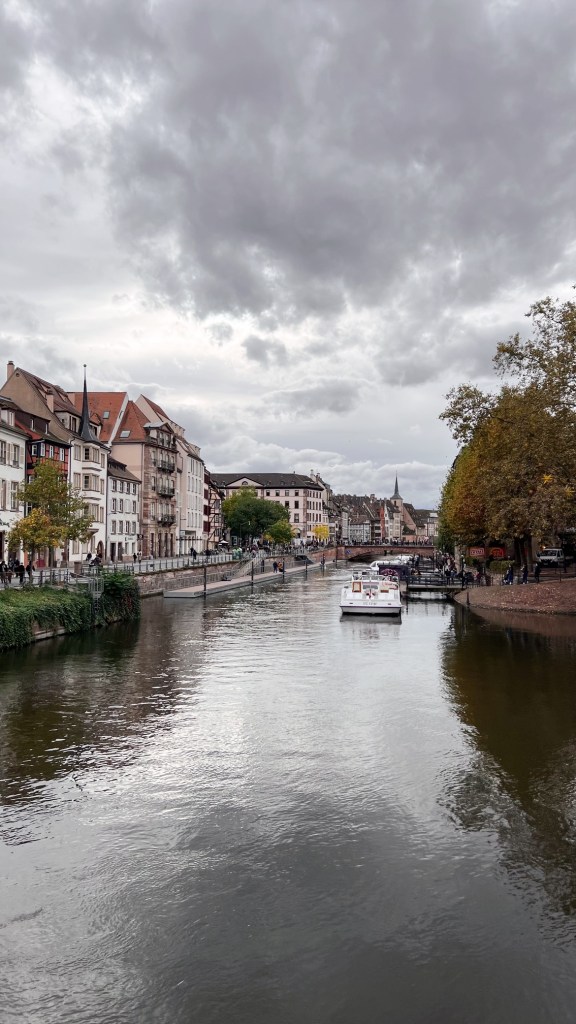
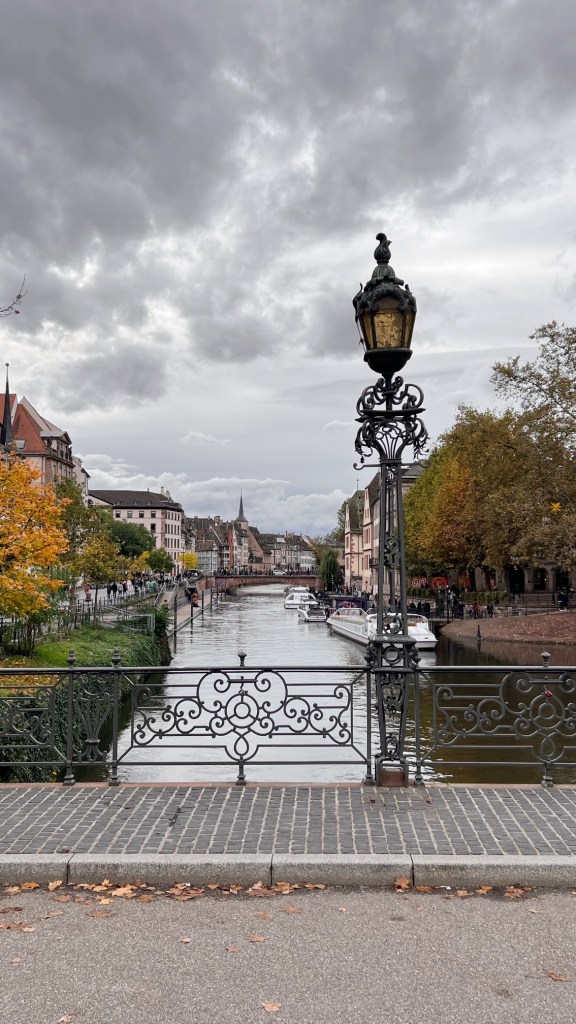
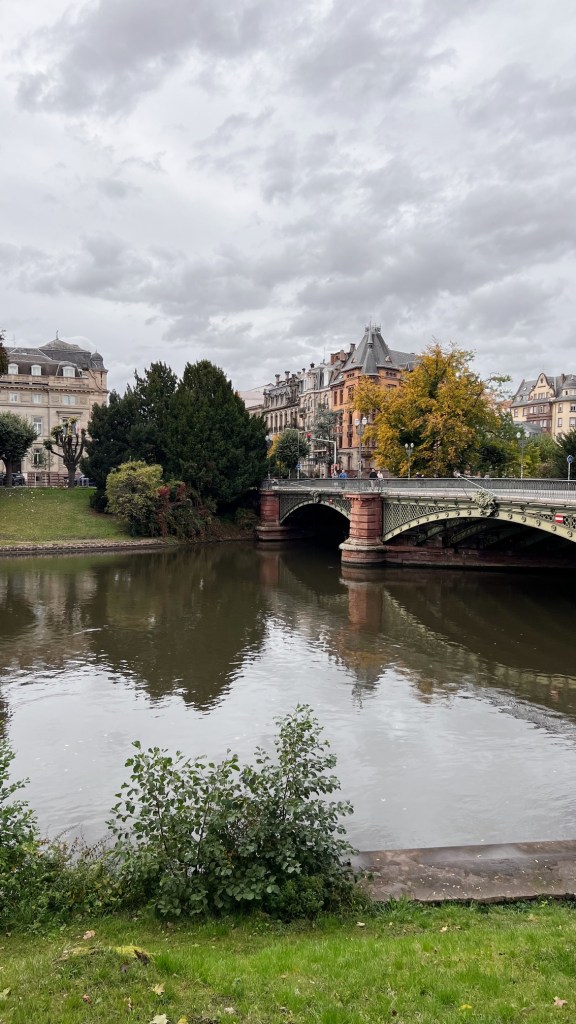
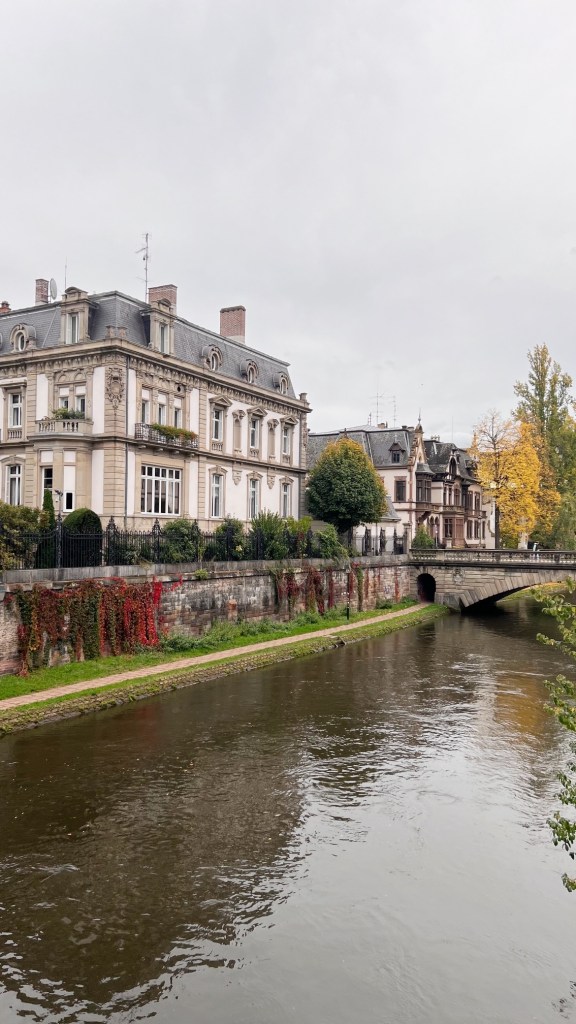
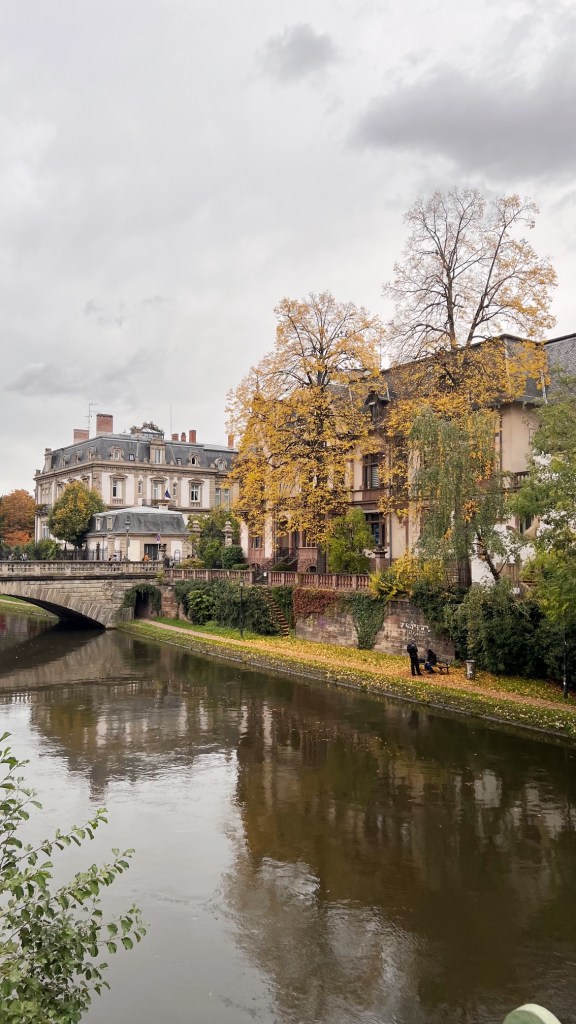
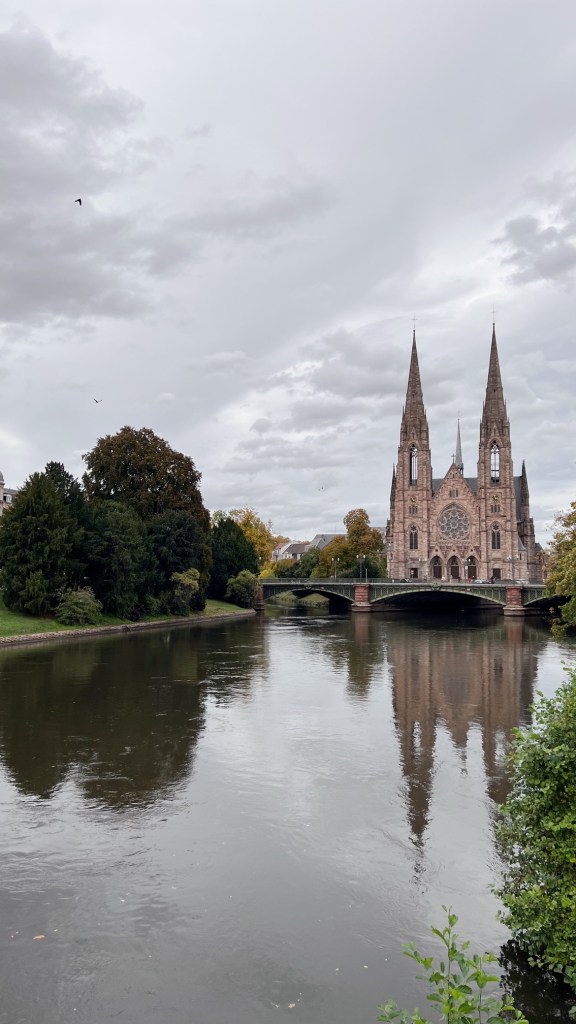
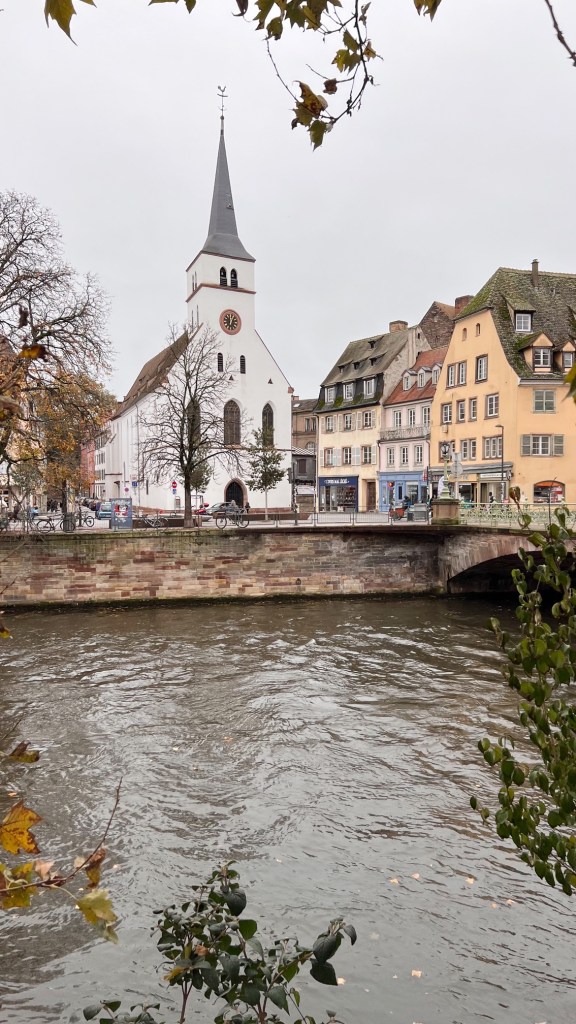
Strasbourg is a beautiful city and was the most touristy of the cities I had visited so far. My favorite part of walking around the city was seeing the different bridges that connected the Grand Île to the rest of the city. The most scenic bridges were in the Quartier Allemand (English: German Quarter). Overall, the experience of walking through the city was like walking through a maze. Streets were curved and there were lots of squares and aesthetically pleasing houses. I also loved the trees near the river and how their leaves blended perfectly with the surrounding buildings. My favorite café was Le Café Potager, a corner place with delicious carrot cake. There were big tables with lots of seats and everyone was sharing. I felt like I was plugged into an energy source. There were people having conversations, people reading, people working on schoolwork, and people who were just there to enjoy the moment. Almost everyone was eating carrot cake, which was refreshing for me because carrot cake is one of my favorites. It was the perfect way to spend a few hours on a rainy late afternoon.

The Church
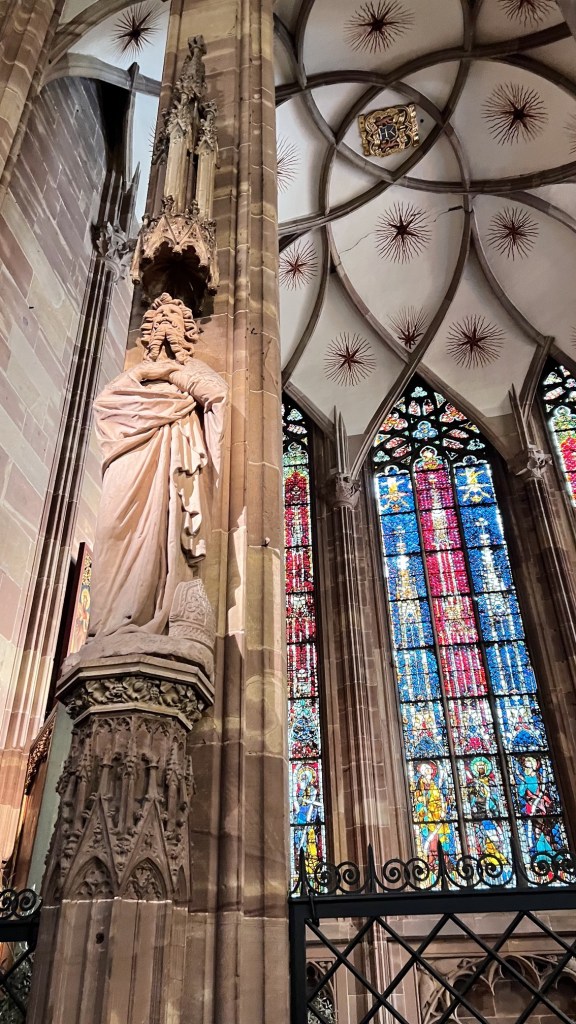
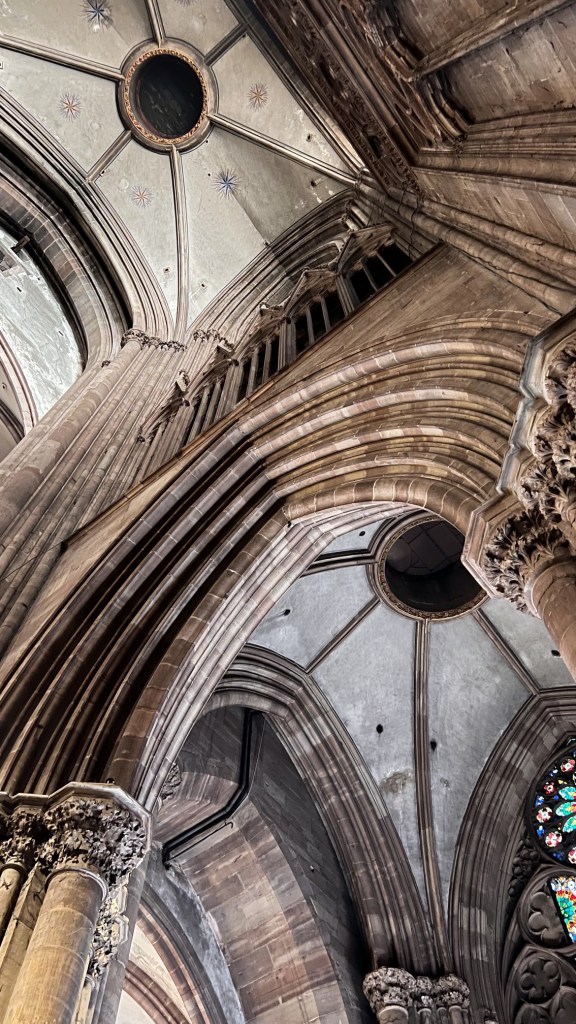
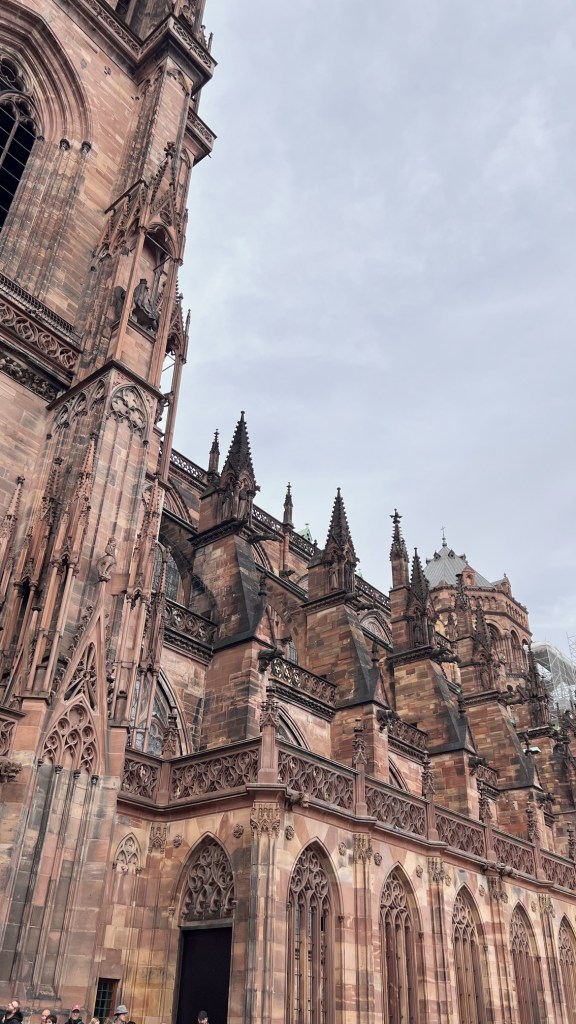
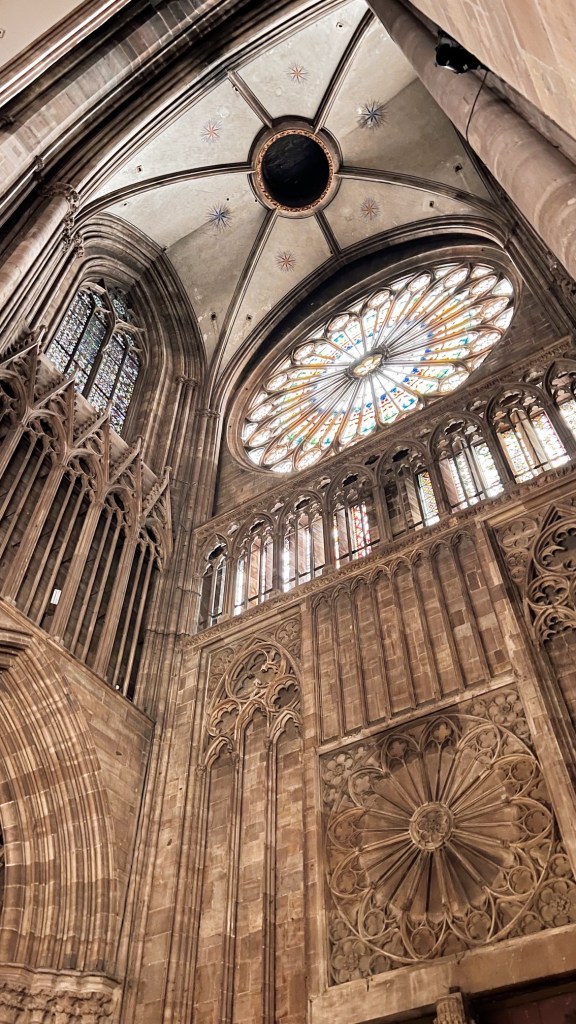
Cathédral Notre-Dame de Strasbourg (German: Liebfrauenmünster zu Strasbourg) is situated behind a row of shops and the Palais Rohan on the Place de la Cathedrale (German: Müensterplatz). It is an example of the Rayonnant form of French Gothic architecture. Some defining features of this style is the rose window and more windows in the clerestory, which is the uppermost level of the three levels that make up the walls in the interior nave. The Cologne Cathedral in Cologne is another example of this style. One of the most noticeable features of the Strasbourg cathedral is the seemingly “missing” second spire on the western end. The one spire that is in place soars to the heavens. The level of detail on the façade and the sheer size of the cathedral is almost too much for the eye to take in all at once. That was most likely the desired effect. And with all the external stimuli we are confronted with in our current environment, the fact that this thousand-year-old building can still humble its visitors is a testament to the awesome powers imbued in its design. It is no wonder that Victor Hugo described the cathedral a “gigantic and delicate marvel”.
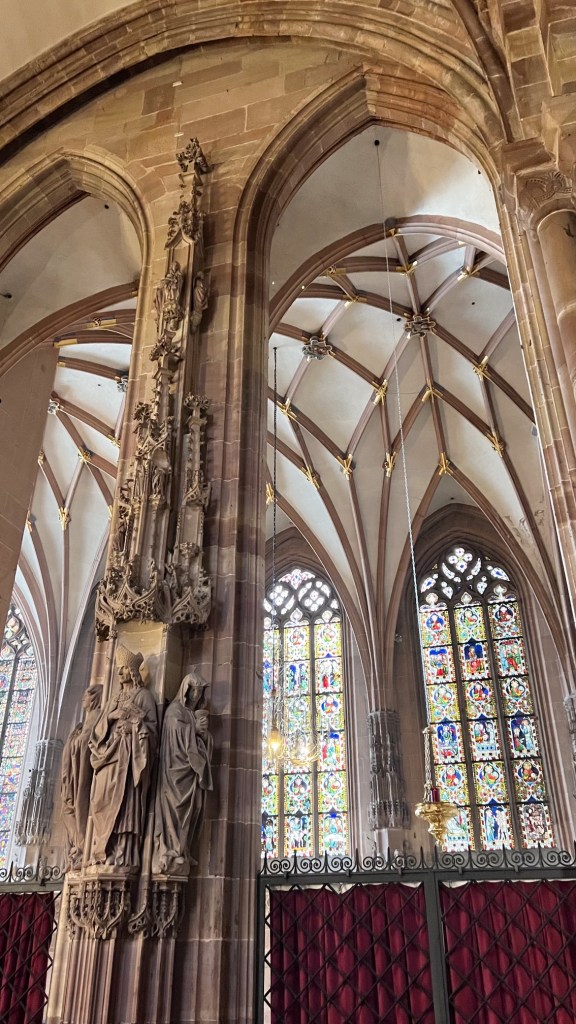
Stepping inside the cathedral I saw the typical features of Gothic architecture. The fun part about visiting different Gothic cathedrals is that you can see the differences in the designs. Gothic churches varied by country and, since they were under construction over hundreds of years, they often feature elements of other styles, such as Romanesque. Gothic itself evolved over the years and has been classified into different periods. The Rayonnant period is part of the High Gothic period. The “missing” spire on the western face was part of the design at one point, but it was removed by another architect who took over. I actually like the design without the second spire. It gives the cathedral a unique flair. My favorite parts of the interior were the stained-glass windows and the rose window on the western face. The choir was closed off to the public, which was unfortunate because I wanted to see the dome. The dome was massive and was adorned with large murals. Whereas Freiburger Münster had a few steps that led up to the choir, Strasbourg had an entire flight. I felt this complete disconnect standing at the base of the stairs. In a dome, the eyes don’t have a natural end line to focus on. It is like looking into the sky. In this metaphor, the murals would represent clouds. They gave a little perspective to the viewer, but not much. As a result, the choir seemed to be floating away right in front of my eyes. To reach out to try and touch it would be futile, like trying to touch the clouds in the sky. I personally liked the choir design of Freiburger Münster better. The difference between the two is the lack of windows. The choir in Strasbourg was dimly lit and looked medieval. And with the large staircase, it wasn’t inviting. In fact, most of the interior was cordoned off with barriers and so access was limited. But the views inside were spectacular. The windows in the clerestory were also filled with stained glass and the light pouring in the interior illuminated the nave in an entirely different way than Freiburger Münster.

The Garden
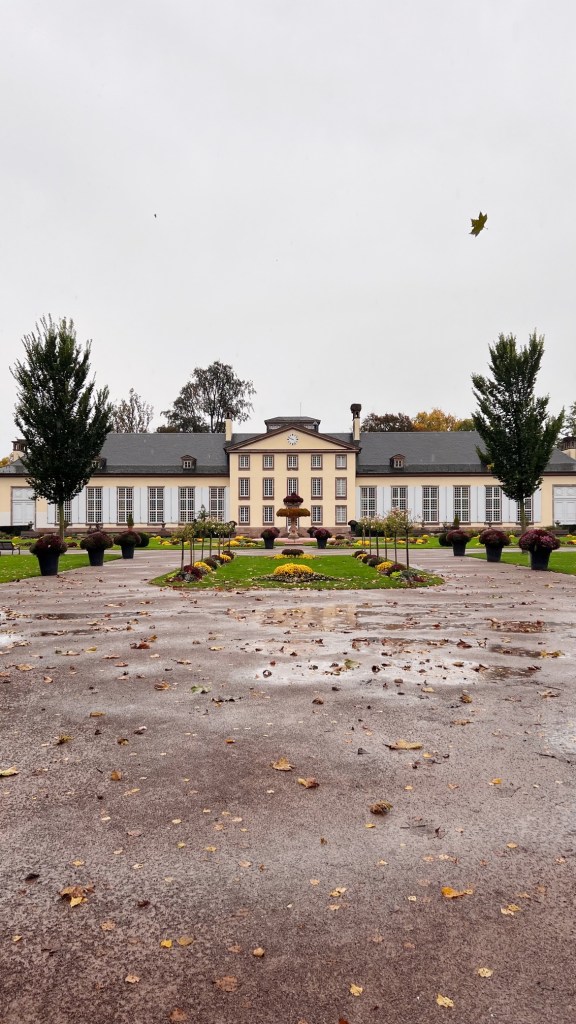
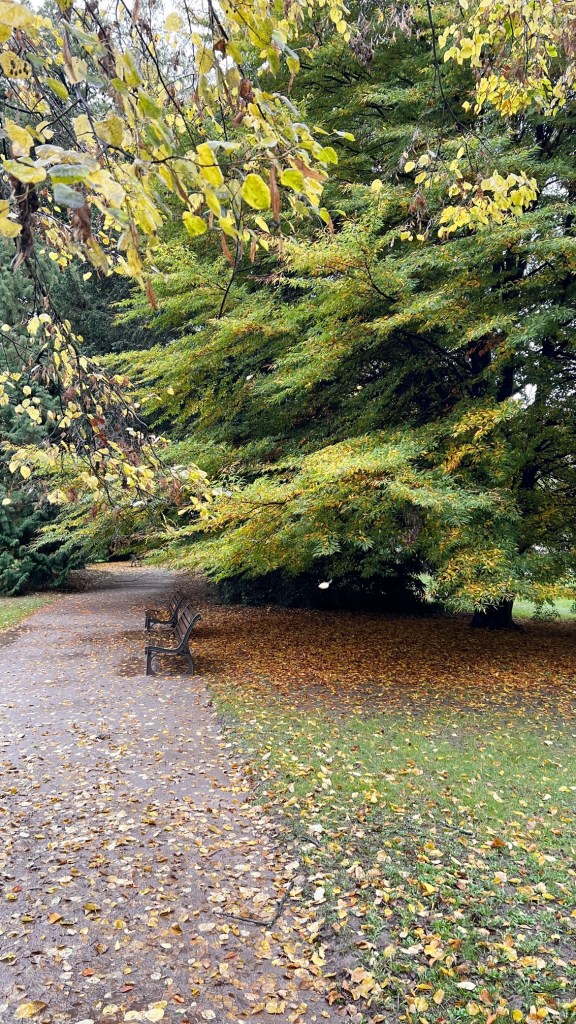
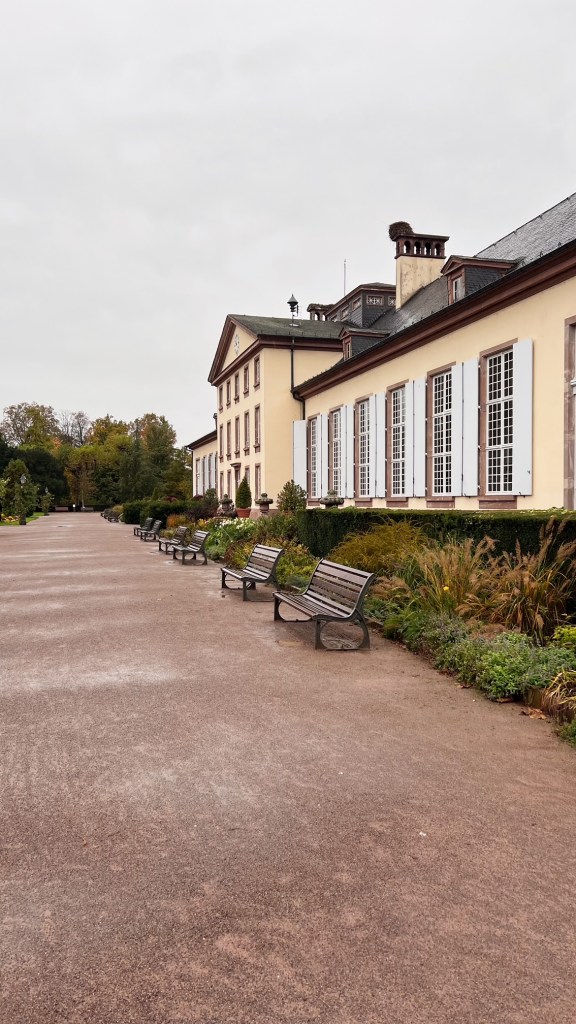
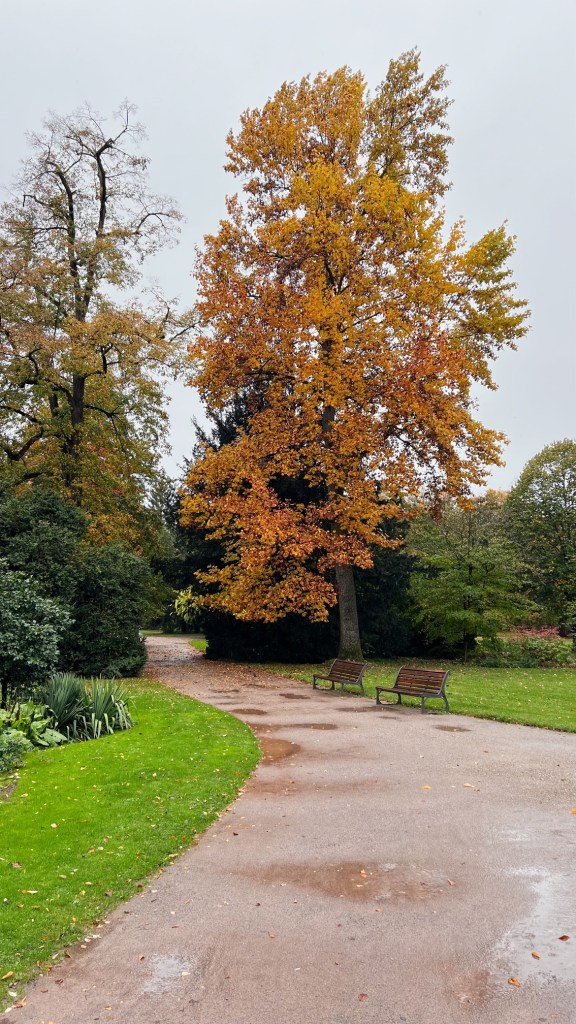
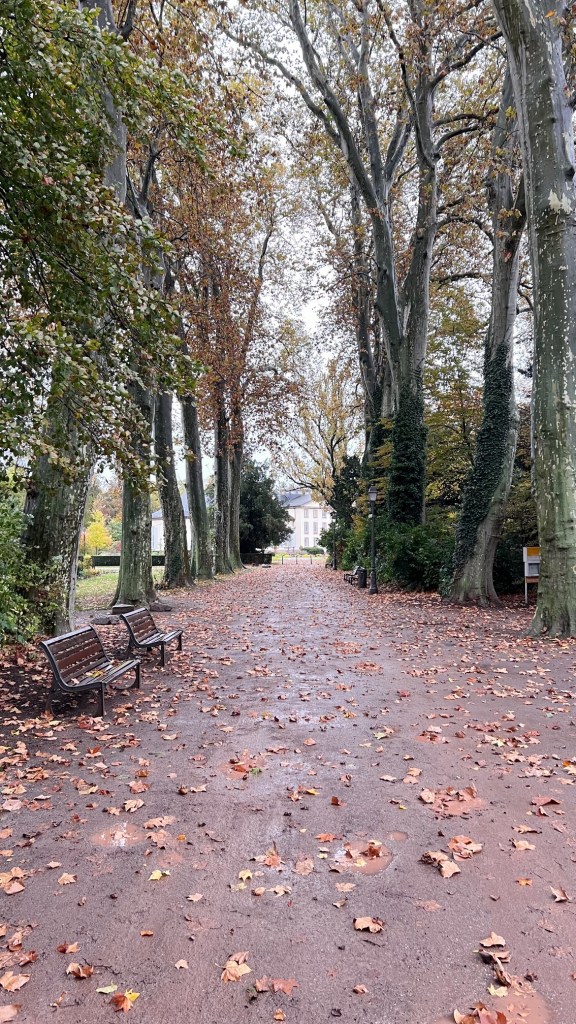
The Parc de l’Orangerie is located at the northwest end of the Grand Île. The park dates to the seventeenth century and was originally laid out in the French garden style by André le Nôtre. At the entrance to the park there was a white gazebo sitting at the end of a small peninsula. Two swans were in the pond. One was swimming and enjoying the rain. The other was asleep and floating quietly next to the bank. The color of the gazebo contrasted sharply with the autumn leaves. The leaves were falling gently from the trees and looked like orange and yellow rain. Across the pond from the gazebo was a stone observation platform with a stone balustrade and bench. Le Notre employed similar stonework in his projects at Vaux-le-Vicomte and Versailles. The stones were covered in moss and in a thicket of trees, which made me feel like I stepped into a grotto. It was positively Romantic. I wouldn’t have been surprised to see Lord Byron sitting on the bench and scribbling in a notebook. I left the swans and went down the esplanade that led to the Pavillon Joséphine, which is the main house in the park. The trees separating the lanes of the esplanade had already begun to lose their leaves. There were benches and ornate streetlights every few meters. The house itself was ringed by circular walking paths that were broken up with flower beds, lawns, trees, and shrubbery. One feature of French garden design is symmetry, which I could observe from every spot I was standing. The center of the house is on the same axis as the esplanade and everything unfolds from that center. In one flowerbed there was a statue of a maiden dressed in a simple frock with a basket of flowers and a duck at her feet. It is as if to say that even though the house is beautiful and set in an elaborate garden, the owner is, at the heart of it, a simple farmer. It was heavily raining the morning that I went. I think the park was designed for a rainy day. Luckily for me the rain also meant that I was alone most of the morning. In the back of the house there were large trees in sprawling green lawns. Here I could see the influence of English garden design, which features a lot of natural and wild landscaping. On the southwest side of the esplanade was a pond filled with ducks. The pond was in the bassin style, which can be seen in the Tuileries Garden in Paris and at Versailles outside Paris. The bassin is a notable feature of French garden design. As I stood by the edge of the pond looking at the ducks, I saw the two swans swimming over from where the gazebo was. All were disappointed I didn’t have any food for them, but they seemed to be enjoying the rain the same as me. I sat and watched them swim around for a while before I left. I took the exit that led to a quiet residential street. I walked through piles of leaves and puddles and looked at the balconies that were filled with plants. It reminded me of Heidelberg and Karlstraße in Freiburg. It also made me think that wherever I am in the world, I will always enjoy a quiet walk on a rainy morning.

 A Walk Through The City