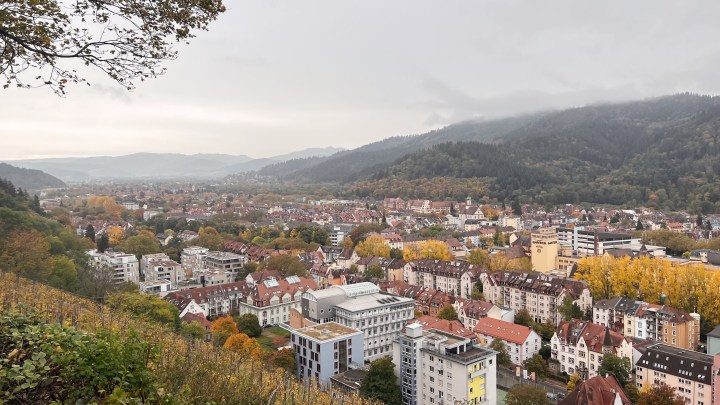
Next stop on my trip was Freiburg im Breisgau, the fourth-largest city in Baden-Württemberg. Freiburg is located on the Dreisam River, a tributary of the Rhine, and sits on the western edge of the Schwarzwald (Black Forest). Looming over the town is a large hill called the Schlossberg. It is home to a university, a medieval church, and a lot of interesting features for a wandering tourist.
The Hotel
This time my hotel was more modern. The lobby was long, linear, and lined with the perfect blend of wood and metal. The staircase was the floating design. In the reception and restaurant area, there were interesting dividers made from horizontal wood slats that were dotted with sculptures and books about architecture and design. There was an unbroken wall of ceiling to floor windows. I felt like it was built just for me. My room looked out over the rear courtyard which was filled with large black metal planters. The hotel also shared its building with an office, which I also saw from my room. The design was an open square with the hotel facing one side and the office facing the other three sides. The office was built in a Mies-van-der-Rohe-inspired style with long vertical panes of glass with mullions made from black I-beams. There were roofs that were lined with grass instead of a rubber membrane. The whole effect was of a modern, clean, and classic design that felt like walking through a forest. Perhaps the architects took some inspiration from the nearby Black Forest and incorporated that into an iconic design.
One of the wonderful parts about traveling is experiencing the different hotel designs. In Heidelberg, my hotel was quaint, which was how I experienced the city. The hotel accentuated my visit and made it even more special. Freiburg as I experienced it was the perfect blend of modern and classic. The hotel was an extension of that, and made my visit special as well.


The City
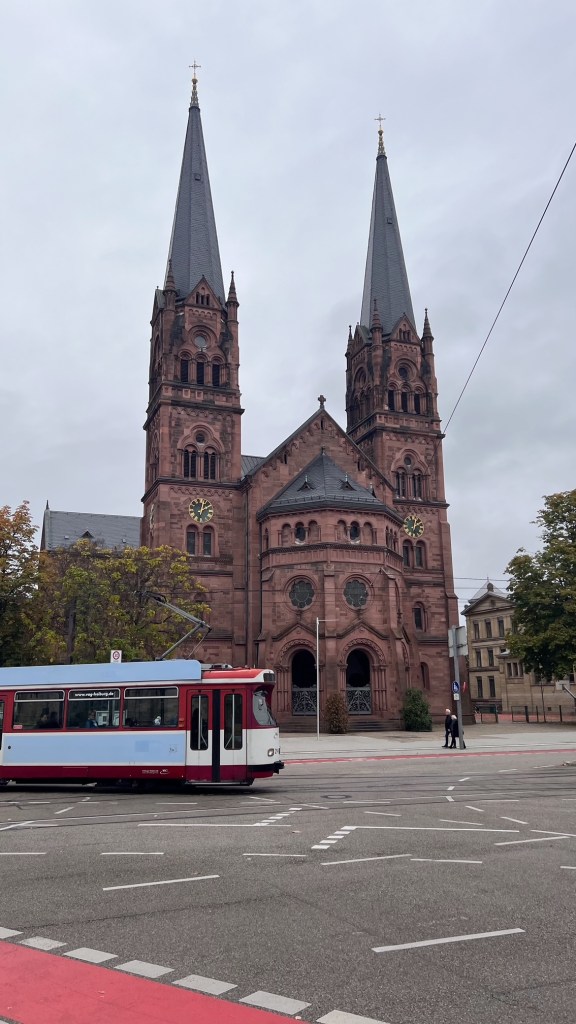
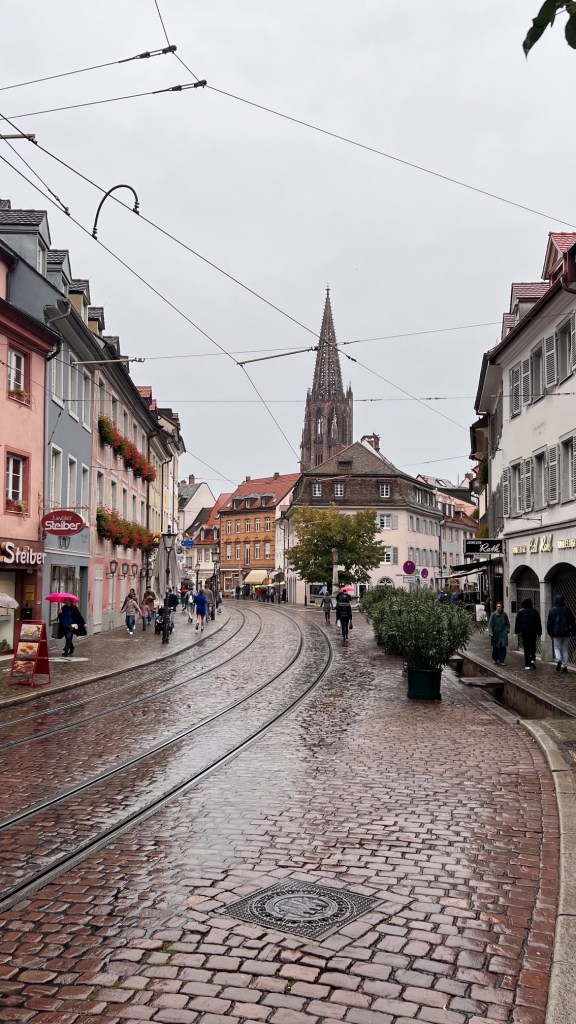
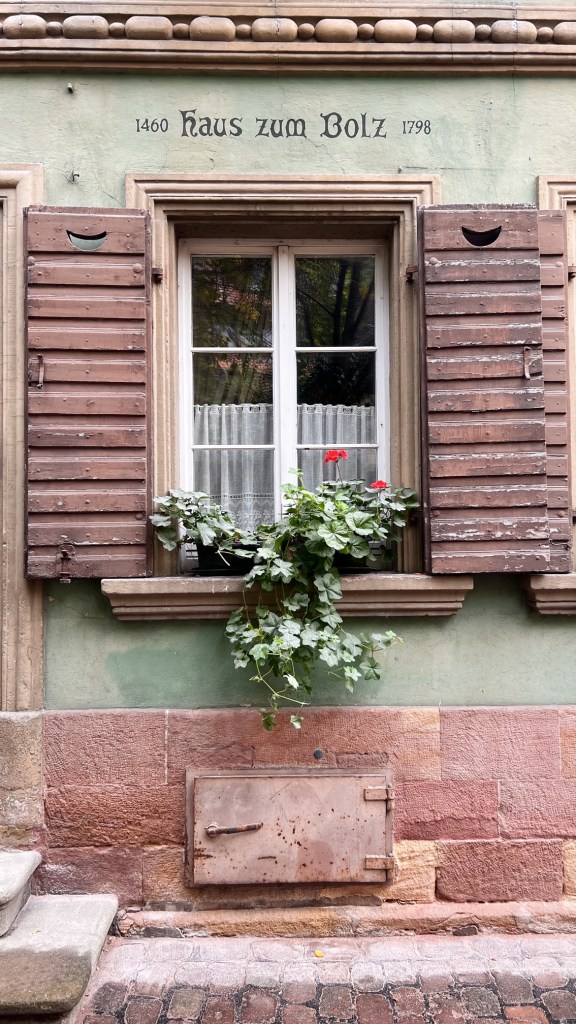
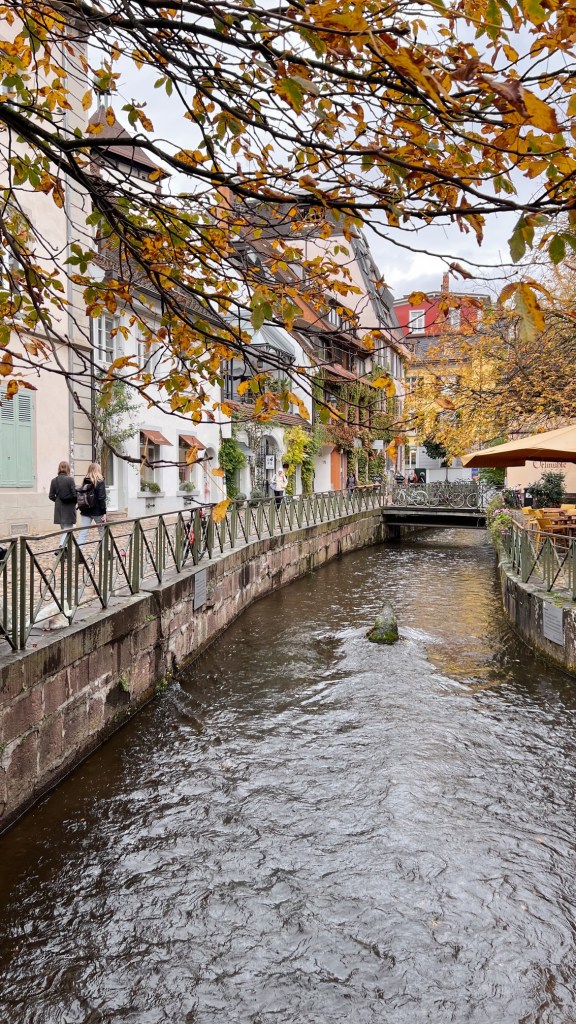
My hotel was located near the train station on the edge of the Altstadt. In the Altstadt, I was walking through narrow, curved streets. I kept thinking of Eliel Saarinen’s advice: “there must always be an end in view, and the end must not be final.” Just keep walking and you will find something interesting. Along these curved streets were cafes, restaurants, and shops. Eventually these streets would open up into larger streets with streetcars and large squares. One of the most open and notable squares was across from the university library. I mentioned the blend of modern and classic in my hotel. The university library was built in a modern style and was surrounded by the classic buildings of the university. I like the design itself, but I don’t think it fits in with the architectural fabric of the surrounding area. But like I.M. Pei’s glass Louvre Pyramid in the Louvre complex in Paris, perhaps it will eventually grow into its place. I went inside and the upper floors seemed to be floating with their cantilevered design. Each upper floor was filled with chairs and tables and private cubicles that gave the students multiple options for how they wanted to study. All the seating was facing the all-glass façade. I thought the design was conducive to learning and socializing, which is exactly the function of a library. Going back to the streets in the Altstadt. Most of them were lined with a system of gutters that were directing water all around the city. They are called the Freiburg Bächle. In some areas they were narrow and shallow and the water was flowing gently through them. Near the university and botanical garden, they were much larger and deeper and held more water. My favorite section was behind Freiburger Münster. There was a small, elevated planter box made from old stones that was across the way from a church courtyard. The bächle was at the base of the wall. The street was also made from old stones that had been smoothed over from centuries of use.
One of the main attractions in Freiburg is the Schlossberg. The kind employee at the hotel specifically pointed it out in the map he gave me. After walking around the church and the city, I reached the base of the hill. After my climb up to Heidelberg Castle, I felt ready for anything. Luckily for this climb there is a staircase that leads up to the first main plateau, which is paved in asphalt. The path zigzags a few times all the way up to the top. There is a combination of gravel and asphalt paving. This climb turned out to be just as difficult as the climb to Heidelberg Castle. When I finally did reach the top and regained my breath, I sat on the observation platform and looked out onto Freiburg. The city was just like Heidelberg with its brown roofs and church spires piercing through the low skyline. The trees were out in their yellow and brown and orange jackets. I walked along the route through the trees and came to a small restaurant with patio seating. It was at this point it started raining. I sat under a tree on a picnic table and ate currywurst with French fries and looked down the hill to the city below. The tree I sat under was just leafy enough to prevent most of the rain from reaching me. After I finished eating, I kept making my way down the hill, all the while stopping at each observation level to take photos.

The Church
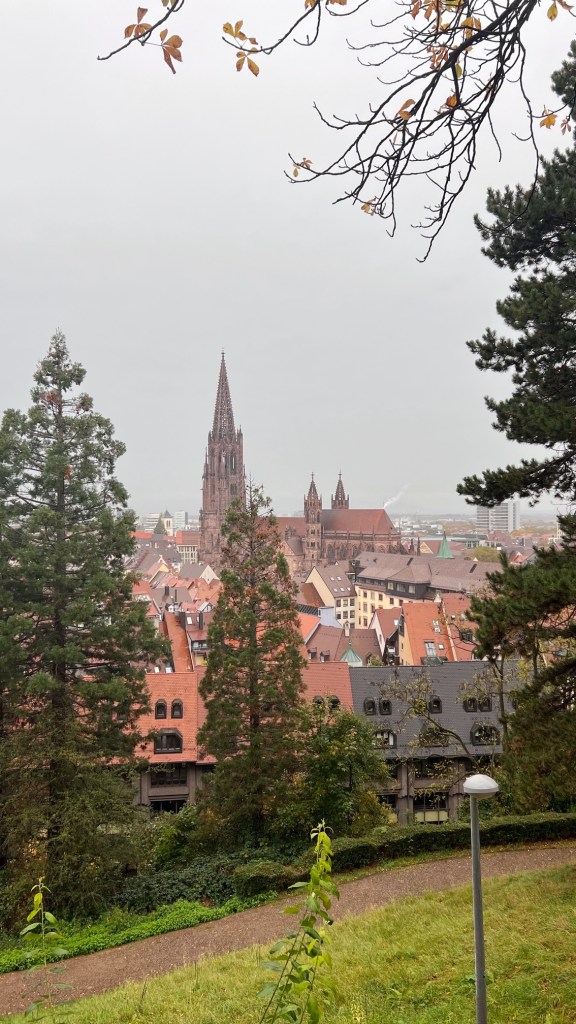
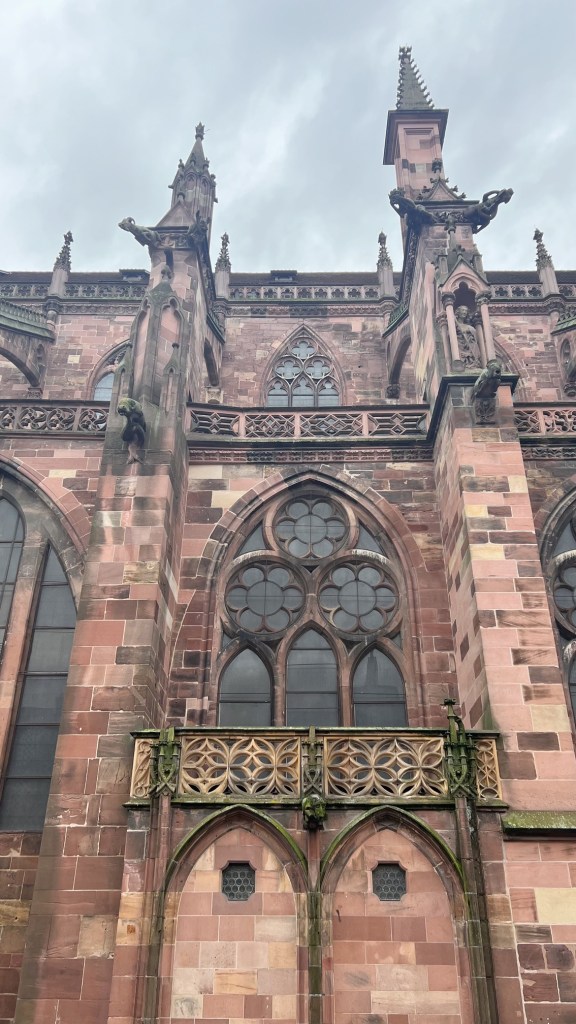
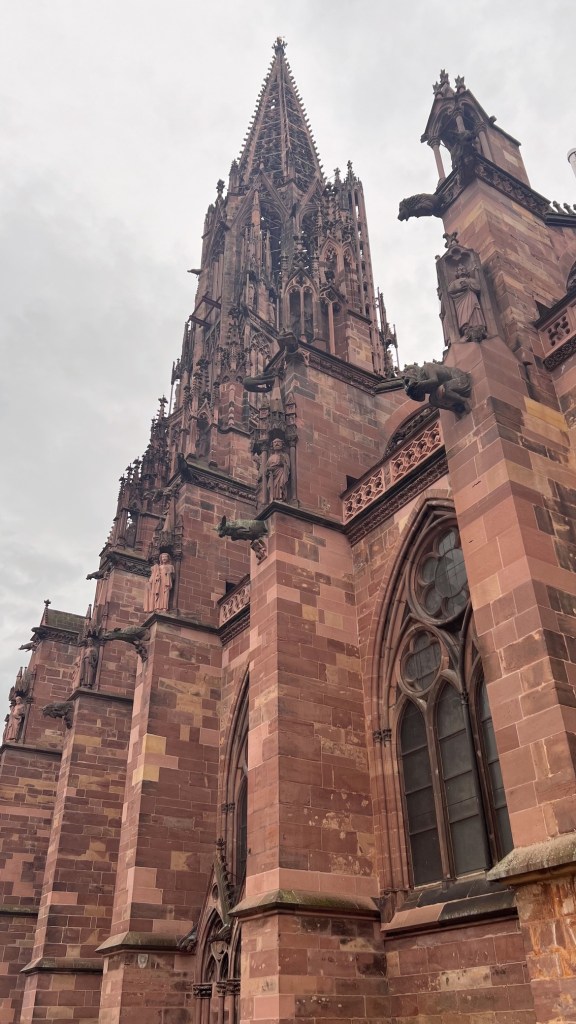
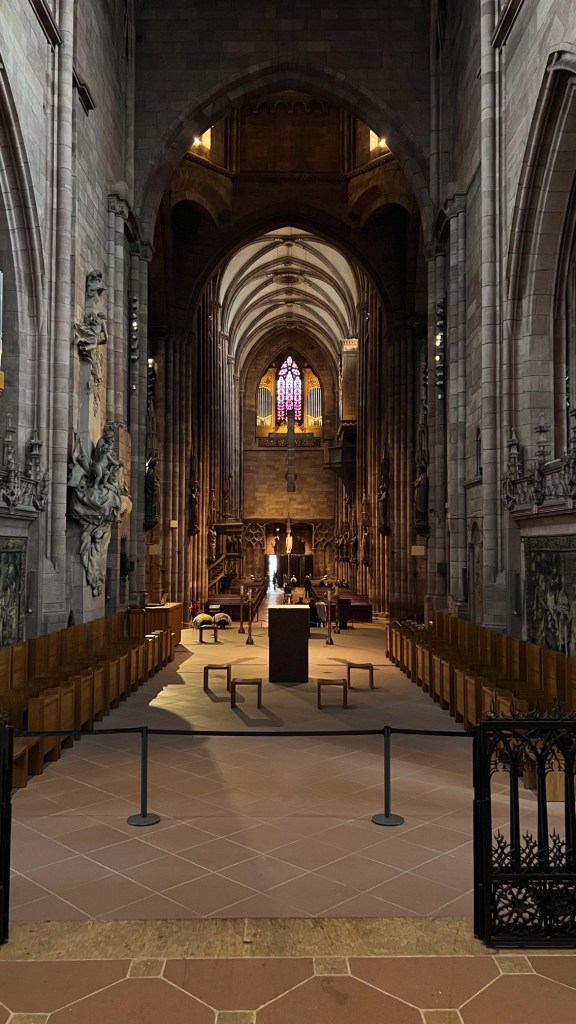
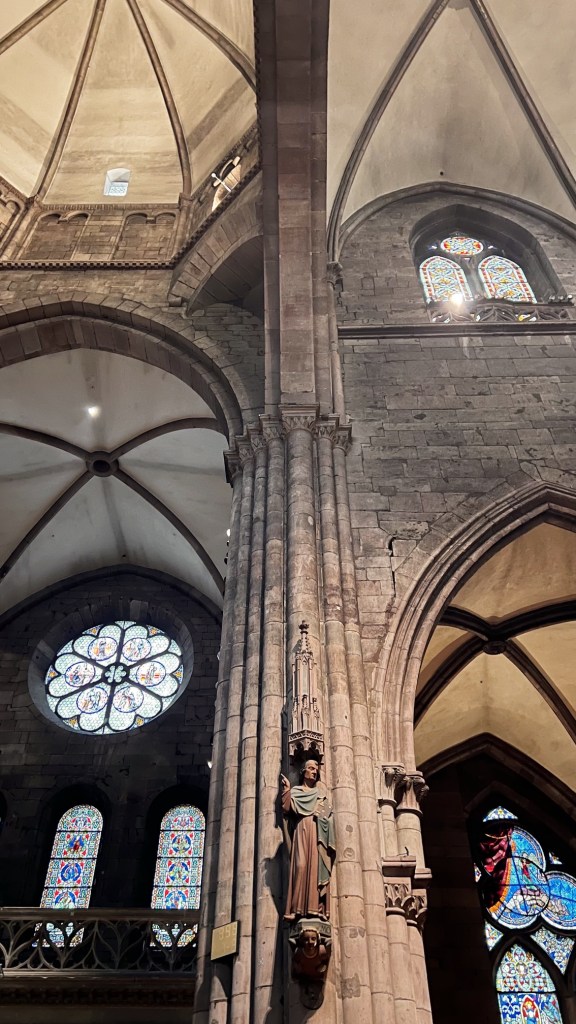
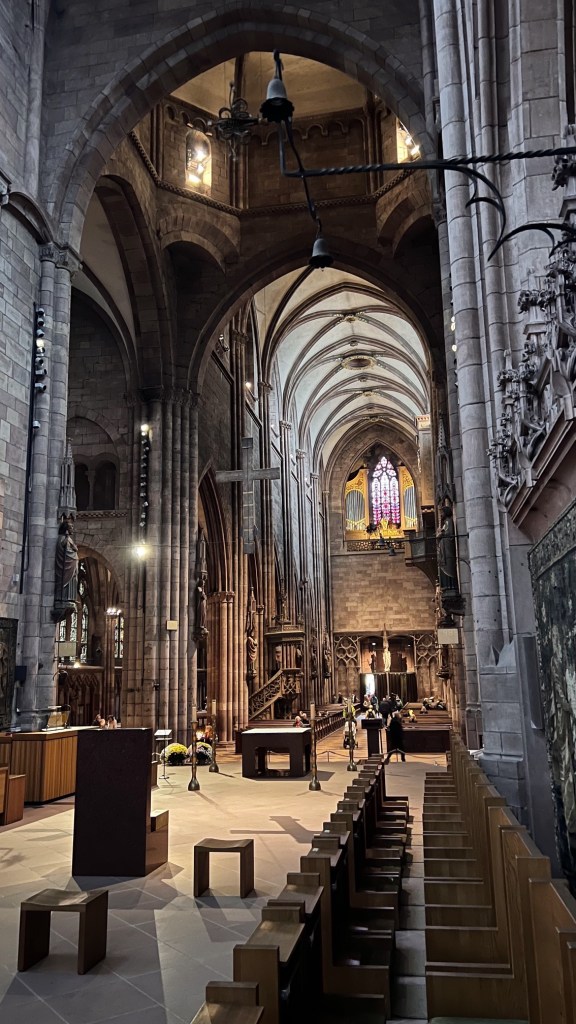
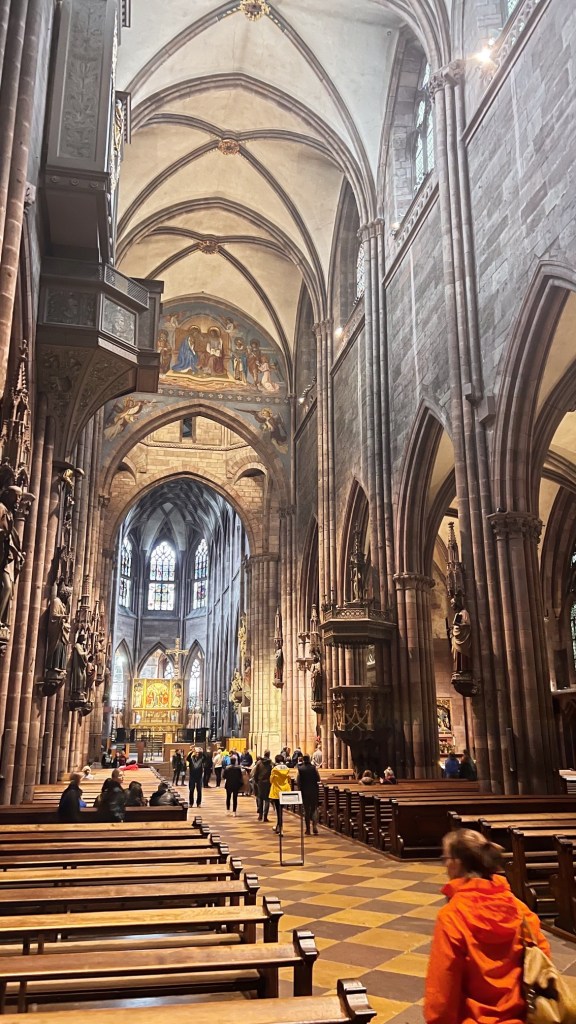
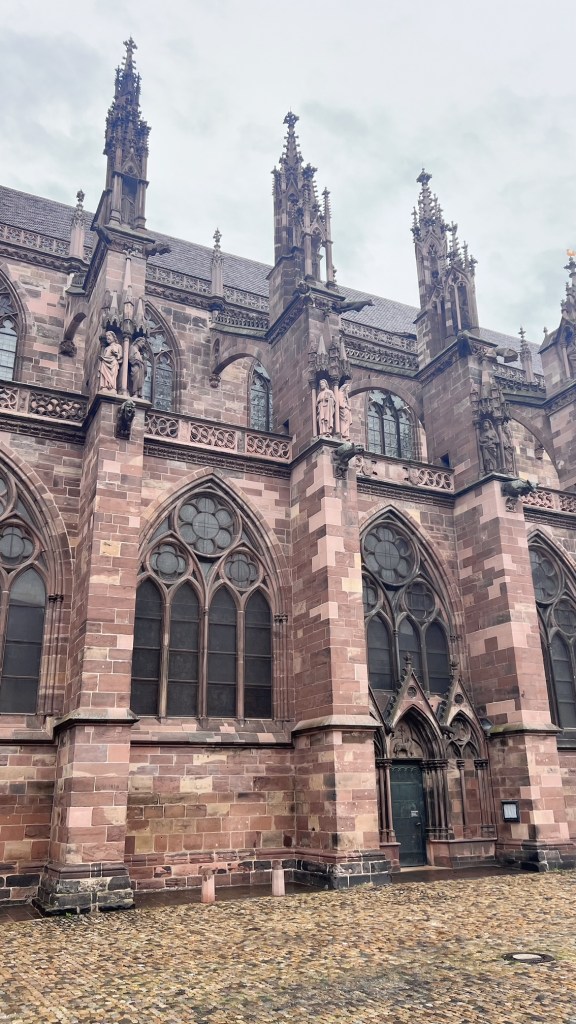
Freiburger Münster is a medieval church that was built over the course of hundreds of years in a combination of the Gothic and Romanesque style. Its defining feature is a towering single spire in the front. Along both sides are long aisles. The exterior walls of the aisle are connected to the vault by flying buttresses. The walls are made from stone and are varying shades of earthen red. My favorite part of the design were the gargoyles that jutted out from the exterior wall. Their mouths were open and had pipes inside. The rainwater would drain from their mouths like waterspouts. I also loved the details of the exterior façade. There were trefoil and quatrefoil windows and statues and beautiful arches. Inside was even more magnificent. I paid two euros to walk around the choir, which is the front of the church. The path around the choir is called the ambulatory and there are small chapels on the other side of the ambulatory called radiating chapels. The chapels were filled with artwork and triptychs and ornate furniture. The walls were filled beautiful stained-glass windows. The nave is the center area of the church. There are three levels of walls that line the nave. The lower level is the arcade, the middle level is the gallery, and the top level is the clerestory. The effect is of extreme verticality as the eye makes its way up the walls and into the vault. Throughout the walls and vault were bundles of stone colonnettes that seem to carry the wall into the vault. It is these that the eyes follow. They are purely decorative and serve no structural purpose. They are a visual effect, and the effect is achieved magnificently. I visited the church twice and each time I stood there for long periods of time and just looked at the structure.
The Gardens
The botanical gardens are associated with the University of Freiburg and are located at the north end of Karlstraße where it terminates at Hauptstraße. The grounds are fittingly adjacent to the biology building. The morning I walked up there was cloudy and chilly. On the way I stopped at a small café on Karlstraße and had a cappuccino. I liked this café because on the outside windowsill there were three padded cushions for people to lean against while they drank coffee. A lot of the shops I came across had these cushions. It is an easy way to make outdoor seating. Continuing down the road, Karlstrase turned into a residential neighborhood. There were a lot of unique houses. I loved that people decorated their windowsills. I saw unique objects like lamps and marble busts and almost all of them had plants and flowers. Within the neighborhood there was an old cemetery called Alter Friedhof with graves dating back as far as the mid-eighteenth century. The marble on the graves had developed a beautiful patina in their old age and some of them were overrun with vines and moss. The trees were gnarled and old. The atmosphere was perfect for quiet reflection and the only sound was of the wind rustling the leaves in the trees. In a word, it was perfect.
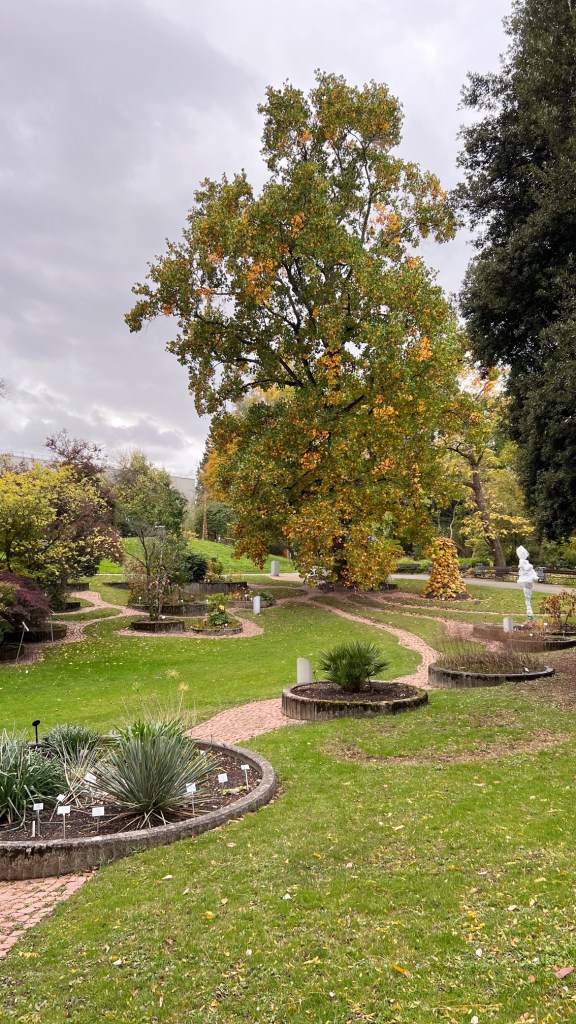
I entered the botanical gardens through the university entrance. The walking path led me around a grassy area with some very large trees, the biggest of which was a magnolia tree. I sat on a bench near the tree and worked on my travel journal for about an hour. I felt the same atmosphere that I felt in the cemetery. On the far side of the grassy area there were some elevated pools with water lilies and fish. Beyond that were some more trees. There was a house that shared a fence with the garden. They had some windows upstairs that looked out onto all the trees. It looked like a cottage in the woods. I wasn’t the only one enjoying the garden that morning. Someone sat on a shaded bench and read her book. Two friends were walking around the water lilies and taking photos. A mother and her young son were out for a morning walk in his stroller. He kept trying to grab the leaves from some of the low-lying trees. As I sat on the bench, I was reminded of this passage from Goethe’s Italian Journey:
“I have spent the day well just looking and looking. It is the same in art as in life. The deeper one penetrates, the broader grows the view.”
 A Walk Through The City