Here is a photo series from Bonn, Germany. Bonn is a beautiful city nestled to the west of the Rhine River. I stayed for a few days in 2019 when I was traveling through Germany. I remember the parks and walking along the river. Here are three photos that resonated with me.
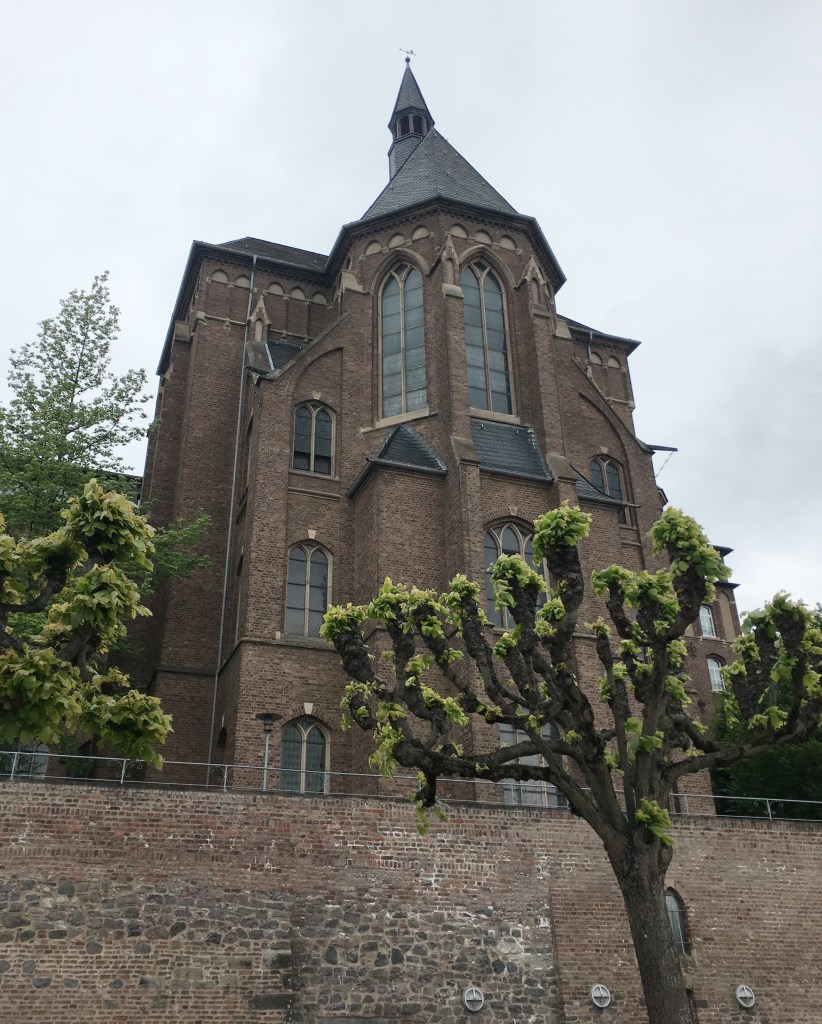
This is an interesting building. The longer you stare, the more detail you see. The prominent feature here is the apse with the conical roof. In church architecture, the apse is the semi-circular termination of the main building located at the east end. I took the picture standing to the left of center, so we are looking at the details from that angle. We can see two of the three sides that make up the semi-circle. Each side has a full-length window with an arch at the top. Arches feature prominently in the façade. A pilaster was added at the corner intersection of each wall in the apse. The pilasters help give the wall depth and they help guide the eye to the other architectural elements. Below the windows in the apse are three roofs that separate the top part of the wall from the bottom part of the wall. The pilasters that extend out on the left and right sides of the apse form the supporting wall. There are three windows on each side of the supporting wall: three on the east-facing side and three on the south-facing side. The designer used recesses in the façade to give the upper two windows more depth. The entire façade looks very three-dimensional, which is very difficult to do on a relatively flat surface, like a wall. This is a brilliant design. The top of the supporting wall looks like a flying buttress, but that is merely an illusion due to the recesses in the brick above the top window. Our eyes naturally follow the “flying buttress” down through the rest of the wall where it terminates at the concrete sill band that separates the lower third of the supporting wall from the upper two-thirds. The south-facing side of the supporting wall connects back to the main building. There are no windows on the east-facing side of the main building, but the concrete sill band is still there, and it helps preserve the two-thirds/one-third pattern that is seen in the supporting wall. And if you look closely at the top of the spire, you can see a weathervane.

Like Seminarkapelle, the more you look at this building, the more details you see. There are three parts to this building in this picture. In the lower left, there is a semi-transept in the form of a semi-circle. To the right of that, there is the nave, which is the higher part of the building, and the aisle, which is the lower part of the building. And in the back left, there is a spire. Each of these elements serves a distinct purpose in church architecture design, so it would make sense each would have their own visual style. Each style fits perfectly into the overall design because they all are using a variation of the circle and the arch in their respective designs. Let’s start with the semi-transept. The wall is broken up into thirds. There are a lot of different size arches in the upper two-thirds of the wall creating a visually pleasing pattern. There are arches in the lower third, but instead of arched windows we see a circular window with a six-leaf foil set inside it. It looks like a flower or a honeycomb. Moving onto the aisle, we see the multi-leaf foil pattern used again, only on a larger scale. Instead of a circle, the design is a semi-circle and features a seven-leaf foil. This design looks like a flower or the setting sun. Breaking up the wall sections between foil designs are pilasters that are connected to the nave by a flying buttress. If we follow the flying buttress up to the nave, we can see an exterior wall made up of five arches supported by columns. The arches have different lengths of brick that repeat in a pattern: ¾ full, ¼ full, none, ¼ full, and ¾ full. Above the arches and below the roofline is a band of bricks with small stone corbels. This section is my favorite part of the design. And finally, moving up to the spire, we can see it is broken up into sections of wall with different designs. The middle section has a series of arched windows with three columns supporting two smaller arches. The top section has a series of larger arched windows with four columns supporting three smaller arches. The roof of the spire is one continuous piece, which contrasts beautifully with the façade that is broken up into different bands. It makes the spire look taller and more visually pleasing. It features prominently in the design, but it doesn’t dominate the design. If anything it gives extra weight to the supporting building. And sitting atop the spire roof is another weathervane. I also like the little dormer windows in the nave and semi-transept roofs. It is a beautiful design and the weathered stone gives it a lot of character.
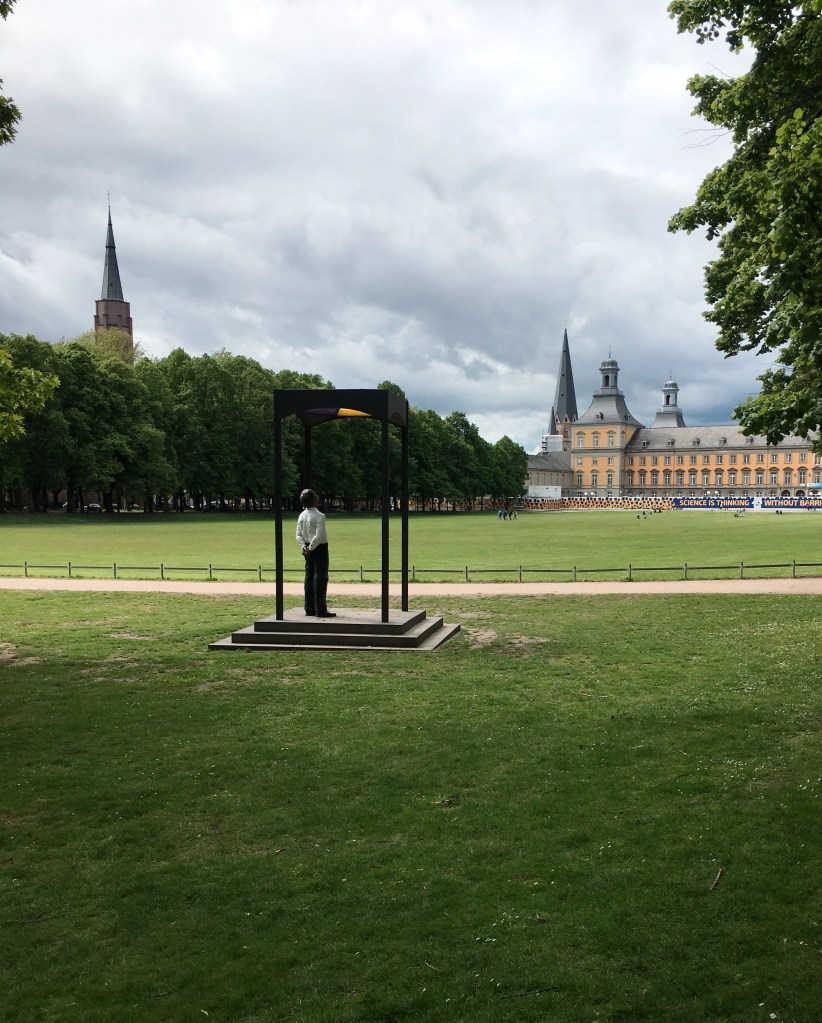
Here is the source of inspiration for this photo series. I was in the Hofgarten, which is located behind the university. I had just walked through the Akademisches Kunstmuseum, which was really interesting because it was filled with statues and historic objects. I usually go sit somewhere quiet after I visit a museum to reflect on what I saw. As I was walking to the benches I came across this art piece. I love that regardless of what direction you approach this statue from, you know exactly what he is doing. This is what I would point to if someone asked me what the definition of “curiosity” was. In the background to the right, you can see the university and the spire from Bonn Minster. The park is beautiful, and it is lined with trees on two sides. In the grass I saw students playing frisbee and laying down on blankets and studying and taking naps. It was nice knowing that university life in Germany didn’t seem to be much different from university life here in America. The statue in the art piece served as a good reminder that wherever we go in life, we can always find something interesting to see. All we have to do is remember to look up from time to time.
 A Walk Through The City