“And then, dreaming, the clouds methought would open and show riches, ready to drop upon me, that when I waked, I cried to dream again.”
William Shakespeare, The Tempest. Act III. Scene II.
I read two books recently that both mentioned The Architect’s Dream, Thomas Cole’s 1840 painting. The first book, The Secret Lives of Buildings by Edward Hollis, is about the history of famous buildings around the world and how their meaning and usefulness has changed to meet the demands that were required of them at the time. The second book, A History of Architecture by Spiro Kostof, is a general history of architecture. Both authors had similar observations in their introductions. The underlying theme of Edward Hollis’ book is that buildings must adapt, and they must change for them to stay relevant. And on page three, Professor Kostof wrote:
“that is how architecture is meant to be known. As the musical theater of human activity, its truth is in its use.”
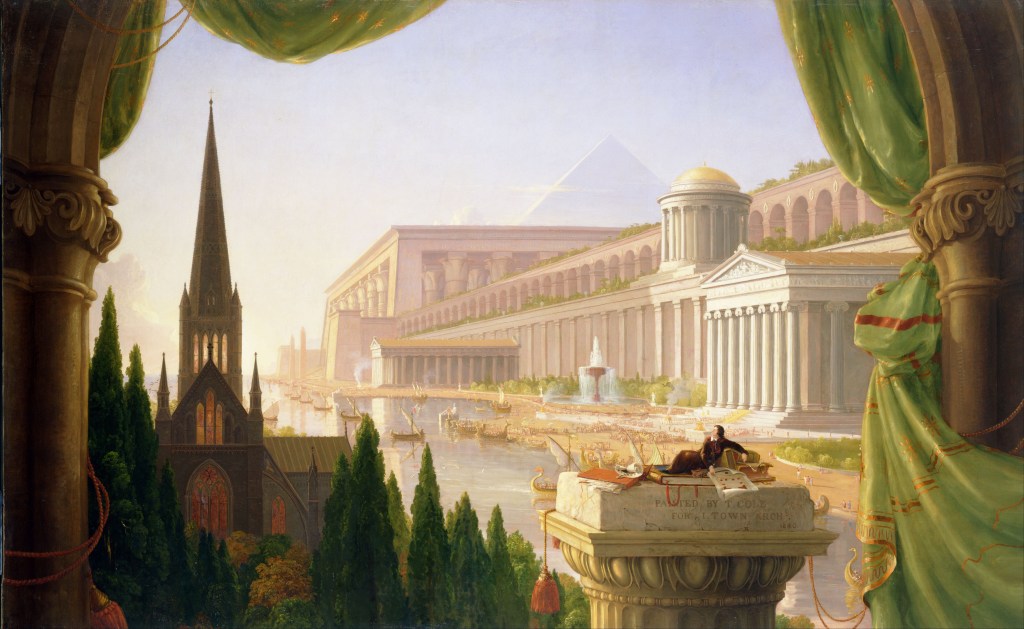
I thought it would be a fun exercise to describe what I saw in the painting. With the exception of the Gothic church, the original use of these buildings has long since been abandoned. The Egyptian, Greek and Roman buildings are preserved now as ruins of a bygone era or preserved as museums that celebrate the glory of a bygone era. I wonder how many buildings we will preserve from the last five hundred years and whether they will be immortalized in a painting. One can only dream.
Viewing the painting as a whole, the first thing I notice is the yellow glow. It seems to wash over the background while the foreground is more in focus and in color. The painting displays the architecture through history, with the earliest architecture in the background and the newest in the foreground. Perhaps the yellow glow was the artist highlighting the significance of the early architecture in the overall history of architecture. It has receded under the spotlight, taking its place in a museum of history, while the “newer” architecture is still working on its legacy.
Starting from the back, you can see the shadow of one of the great pyramids. It isn’t in focus, perhaps because it is very old compared to the rest of the architecture. The “newest” pyramid at the complex at Giza dates from c. 2510 BC and the Parthenon was completed in 438 BC. Even at the beginning of the construction of the Parthenon the pyramids were a memory of a distant past. The pyramid towers over the rest of the structures in the painting. In front of the pyramid is a great temple with a grand staircase that leads to the shores of the sea. On either side of the staircase is an obelisk and a massive wall that encloses the two sides. Lining the shore in front of the staircase appears to be miniature sphinxes. As you move to the foreground, you can see the start of Greek antiquity. The seashore makes a sharp right angle and at the base of that angle is a reclining figure carved into a slab of marble. She is looking out onto the sea.
On the right side of the massive wall is the Parthenon with its Doric capitals. There is smoke from a fire burning in front, perhaps it is to symbolize a religious procession. The shoreline makes an arch starting at the reclining figure statue and ending on the other side where there is another reclining figure statue. To the right of the Parthenon is a garden with some marble statues. And to the right of the garden is a small pool that has a large fountain in the center. Adjacent to that is the start of another large temple. There are massive columns with Ionic capitals. There is a large concrete courtyard in front of the temple where two gold statues sit atop marble blocks. There is a small, wide staircase separating the temple from the courtyard. There also appears to be a ceremony happening at this temple. Behind the Parthenon and the Roman temple is a large wall with columns and enclosed walls. At the top of this wall sits a golden-domed rotunda. Also sitting on top of the wall behind the rotunda appears to be one of the Roman aqueduct systems.
In the front left of the picture, there are some trees and there are spires from a Gothic cathedral. A few of the trees have brown leaves, perhaps indicating that autumn is most likely on its way. And perched right in front of all of this is a column topped with a flat concrete platform. The platform is lined with egg and dart molding. Sitting on top of the platform is a reclining figure, the architect, and he has his head back and eyes closed but he doesn’t appear to be sleeping. He appears to be fully awake, like he is taking in the scene all at once. His expression is dreamlike. He wears loose robes with a red stole, a collared shirt and tie, and he has longish brown wavy hair. He sits on some large books and holds a floor plan in one hand. At his feet is a binder full of loose blueprints. He is laying in the same reclining position as the two goddesses that line the cove. He also sits on a slab of weathered and cracked marble. Us, the viewer, are watching the scene from a window where there are two columns with Corinthian capitals and an arch protruding from the top of the capitals.
There is a magnificent green tapestry that has been loosely furled back and tied with braided cord. Dangling from the platform where the architect is perched is a braided cord with a red tassel. The tapestry that is tied back appears to be deliberately tied so that the viewer can see everything in the scene, and this is dictated by the view of the sitter. We are looking at a slight angle. We see the important parts of the Roman temple and the aqueduct and the rotunda. From the top of the window, we can see the full pyramid and the spires of the Gothic cathedral. In the space between the window and the main spire of the Gothic cathedral, there appears to be a mass of clouds hanging on the ocean. The spire is blocking the sun which appears to be rising. It bathes the background in golden light and illuminates the stained-glass windows in the Gothic spire. There also appears to be some scattered clouds between the pyramid and the larger temple that are receding into the distance. The small puff at the top of the temple makes it look like they are a great distance away. A small line of clouds appears to cut into the side of the pyramid. Maybe this was done to show that the pyramids were supposed to transcend the physical earth and the last barrier to overcome are the clouds.
The painting was commissioned by Ithiel Town, who was a prominent architect and civil engineer in the early nineteenth century. According to the Wikipedia article on the painting, he did not accept the painting after it was finished because it was “exclusively architectural.” I wonder what he was envisioning when he commissioned the painting. The painting is on display at the Toledo Museum of Art in Ohio.
 A Walk Through The City
