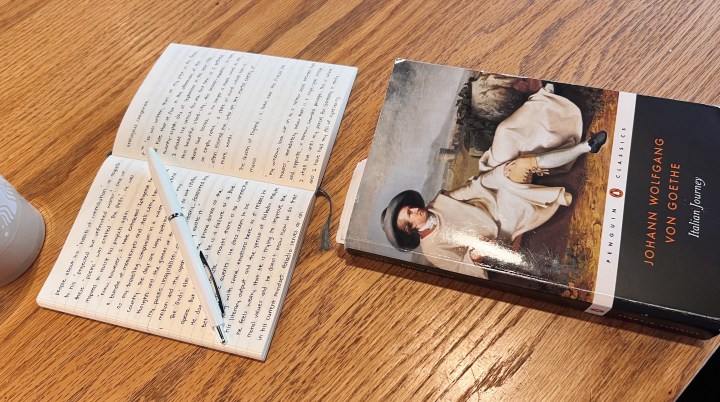
I finished reading Italian Journey and I am still finding inspiration from it. Below are some observations.
1.
One thing that all cultures share is their ability to tell stories. We tell stories when we are with our friends. We talk about things we see in our daily lives. We talk about the food we ate at a new restaurant. We talk about the places we’ve traveled to and the experiences we have had. We talk about the person we aspire to be.
2.
Everyone has an idea of their perfect self. We find the idealized version of ourselves in specific locations. A beach, perhaps, or in a certain city or even within the worlds of our favorite books. We attach the essence of these idealized versions of ourselves to these special places. We leave a piece of ourselves there. When we revisit these memories days, weeks or even years after, it is these pieces we pick up. And for a moment, those pieces bring us home. There is no set definition as to what home is. It is abstract. It is a state of mind. As Witold Rybczynski puts it, you can walk out of the house, but you always returned home.
3.
We want to experience a new restaurant to expand our horizons. We read books to relate to the world around us. We want to visit a new country to challenge ourselves in a place where we don’t speak the language. Maybe we travel there because we do speak the local language. Maybe we just wanted to escape. Whatever our reasons may be, we experience these things because we want to. Something about that place makes us happy. By chasing these things that make us happy, we are trying to make ourselves better. Life is a constantly giving us opportunities to improve ourselves.
4.
There is a scene on May 1 where Goethe watches Kniep put together a “quick sketch of an interesting distant view”, but it was really terrible, and he added in a few touches that weren’t in the original sketch to turn it into a “delightful little picture”. He wonders how many other paintings contain such “half-truths”.
I like this observation by him. He wrote this book thirty years after he returned home. This must have been a little nod to his audience. That what we are reading was not the quick sketch but in fact the delightful little picture complete with the additional details.
5.
There is a line on page 491 where he states:
“During all those years, in fact, I was tormented by an unsatisfied longing for the unknown, which I never succeeded in suppressing, though I often tried. So, when I had to leave Rome, I suffered greatly at parting with all these possessions, which I had so longed for and at last acquired.”
Imagine spending part of your life thinking a piece of you was missing. Goethe found his missing piece. He used his diary and correspondence to memorialize his missing piece into a book that still inspires people three hundred and fifty years later. W.H. Auden summarized the book in the Epigraph:
“Some journeys – Goethe’s was one – really are quests. Italian Journey is not only a description of places, persons and things, but also a psychological document of first importance.”
I found so many relatable things in this book. Goethe described everything in such vivid detail sometimes it was difficult to tell whether he was writing this book in the present day. I think that is part of its legacy. A lot has changed in the world since this was written. But the feelings he described feel applicable to today. Reading this makes me want to complete a quest of my own. And, if I am lucky, inspire someone else the same way Goethe inspired me.
 A Walk Through The City
Goethe’s Italian Journey is truly timeless. Thank you for inspiring me to read it! I picked it up in my library last summer and still remember the heaviness of that book (it was a large hard cover edition from the 1960s with beautiful illustrations that went along with the context). I will always remember turning those giant glossy pages in the summer light while eating pieces of cooking chocolates from a tiny bowl. Goethe had a profound curiosity and appreciation for all the details of life, and an ability to be amazed and see beauty in almost everything and everyone around him.
So many of the passages resonated with me too, but especially in Part III on his second visit to Rome where he described having found himself through his journeys. “[…] it is only during the last year, when I have had to depend solely on myself and at the same time be in daily contact with complete strangers, that I have really come to know my own.”
This makes me think of a passage in Running in Place by Nicholas Delbanco, where he describes the landscapes in a commune in southeastern France and how they reminded him of places he is familiar with back home in the US. He writes, “This insistent habit of comparison, the wanderer’s coordinates: formulations that bespeak familiarity, so that we feel at home.”
Traveling expands our point of reference, and Goethe is an excellent example.
LikeLike
Thank you for your words. I agree, he is very timeless. I am almost jealous of how easily he observes and appreciates the details around him. I like that quote by Nicholas Delbanco too. What an amazing feeling to go somewhere and have it feel like home.
LikeLike